Riding the Polybahn: Zurich's one-minute funicular
I lived three tram stops from Central for two years before I actually rode the Polybahn. I’d walked past the little glass-roofed station at the bottom of Zähringerstrasse dozens of times, watched the red carriage glide up the hillside, and never once thought it was for me. It looked like something for students in a hurry, not for someone with nowhere in particular to be. That was a mistake, and a fairly small one to fix.
What the Polybahn actually is
The Polybahn is a funicular, not a cable car, though almost everyone in Zurich calls it a cable car anyway. It connects Central, at the bottom of the old town by the Limmat, to the Polyterrasse, a plaza in front of the main building of ETH Zurich (the Swiss Federal Institute of Technology), about 41 metres higher up. The track is 176 metres long. Two carriages run on the same rails, one going up as the other comes down, balanced by a cable and winch system that has barely changed since it opened in 1889.
It was built for students and staff getting up to the university and the neighbouring University of Zurich, and that is still its main job. Ride it at 8:50am on a weekday and you’ll be shoulder to shoulder with people carrying laptops and lecture notes, not cameras. Ride it at 11am on a Tuesday, like I did the day I finally tried it, and you might have half a carriage to yourself.
The ride itself
It takes about a minute, sometimes less. You barely have time to feel the incline before the doors open again at the top. There’s no commentary, no view through tinted glass, nothing designed for tourists at all — which is exactly why it’s worth doing once. It’s a piece of everyday Zurich infrastructure that happens to be 137 years old and still runs every few minutes from early morning until close to midnight.
The fare surprises people. The Polybahn isn’t part of the ZVV network, so a Zürich Card or a standard ZVV ticket doesn’t cover it. It’s run by a private foundation, and you pay at a coin-operated turnstile — around CHF 1.20 last time I checked, cash only, no cards, no app. Keep a couple of coins in your pocket if you want to ride it rather than take the stairs. The stairs, for what it’s worth, are steep enough that most people who’ve tried both once take the funicular the second time.
What you actually see from the top
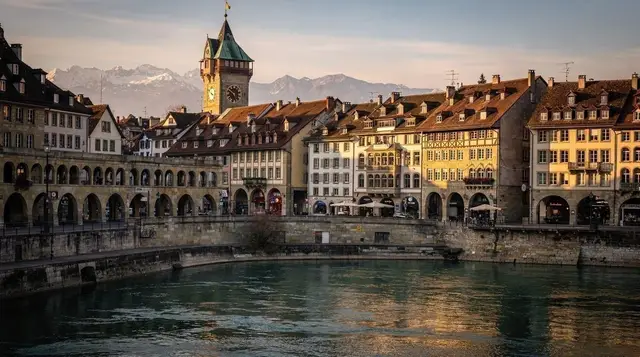
This is the part that made me annoyed at myself for waiting two years. The Polyterrasse is a wide open plaza right in front of ETH’s main building, and it looks straight back down over the old town roofs to the Limmat, with Lake Zurich opening up beyond it. On a clear day you can pick out the twin towers of the Grossmünster and, further off, a line of Alpine peaks on the horizon. It costs nothing to stand there. There’s no ticket booth, no barrier, no crowd management — just a terrace, a few benches, and students eating lunch out of Tupperware.
It’s not the highest viewpoint in the city — the Uetliberg does that job properly, and I’d send anyone who wants a full panorama up there instead — but the Polyterrasse has something the Uetliberg doesn’t: you’re still in the middle of the city. You can see the trams below, hear the bells from the old town churches, and be back down at Central in the time it takes to check your phone.
I go up now every few weeks, usually with a coffee, usually for no better reason than that it’s free, quiet, and takes ten minutes round trip including the walk from the tram stop.
If views are what you collect, the Polyterrasse belongs on a longer list. Our guide to Zurich’s viewpoints puts it next to the higher and more famous options, and the Uetliberg guide covers the full panorama if you want to compare. It also earns its place among the free things to do in Zurich, which is a handy list when the budget is tight. For a sense of what a wider day costs, see Zurich on a budget.
Getting there and combining it with a walk
Central is a major tram and bus hub, so getting to the bottom station is easy from almost anywhere in the city. From the top, the Polyterrasse connects directly into the streets around the university district, and it’s a short, mostly flat walk from there into the old town proper if you’d rather come back down on foot than pay for a second ride. I usually do the funicular up and the stairs down — steep, but it’s over in a few minutes and you get a slightly different angle on the rooftops on the way.
If you’re building a longer morning out of it, this sits naturally alongside an old town walking route, since the bottom station is only a few minutes from Niederdorf and the Grossmünster. Some guided walking tours in Zurich include the Polybahn ride as one stop among several rather than the whole point of the outing, which is roughly the right amount of attention to give it.
a guided walk through the old town that takes in the Polybahn ride as one of several stops covers this well if you’d rather have someone point out what you’re looking at from the terrace. For a shorter version aimed at people with less time, there’s also a five-hour city walking tour that includes the Polybahn crossing. If you’d rather just get a good photo of the lake and old town from a cable-car angle without joining a group, a photo walk that includes the cable car and the panoramic lake view is built for exactly that. And if funiculars and hills aren’t really your thing, a local-guided bike tour around the city covers a lot more ground in the same couple of hours, flat sections included.
None of these are necessary. The Polybahn on its own, with a pocket of coins, is a fine way to spend fifteen minutes in Zurich.
Fitting the Polybahn into a longer stay
The funicular works best as a small stop inside a bigger plan rather than a destination. If you have a single day, the one-day itinerary and the Zurich in one day guide show where a quick ride up to the terrace can slot in between the old town and the lake. With more time, the first-timer three-day plan gives the city room to breathe, and how many days in Zurich helps you decide how long to stay at all.
For the old town itself, the old town walking guide and the Zurich destination page cover the streets around the bottom station in more detail. Once you are back down by the river, the Lake Zurich boat trips are an easy way to see from the water the same lake you glimpsed from the terrace.
Because the Polybahn sits outside the ZVV network, it helps to understand how the rest of the system works. Getting around Zurich with the ZVV explains the tickets that do cover trams and buses, and the Zürich Card versus Swiss Travel Pass comparison is worth reading before you buy anything, so you know in advance what a pass will and will not cover.
If you like small, local pleasures like this one, you may also enjoy a morning on the Uetliberg, the story of swimming in the Limmat, or why Swiss trains run on time. Each is written in the same spirit: ordinary Zurich, done slowly.
Riding the Polybahn: FAQ
Is the Polybahn covered by the Zürich Card or a ZVV ticket?
No. The Polybahn is operated independently of the ZVV public transport network, so a Zürich Card, a ZVV day ticket, or a Swiss Travel Pass does not cover the fare. You pay separately at the turnstile.
How much does the Polybahn cost and how do you pay?
The fare is around CHF 1.20, paid in coins at an automatic turnstile at either station. There’s no card payment and no ticket machine that takes notes, so keep some small change on you.
How long does the Polybahn ride take?
About a minute, sometimes less. The track is only 176 metres long and climbs roughly 41 metres from Central to the Polyterrasse.
What is at the top of the Polybahn?
The Polyterrasse, a plaza in front of the main building of ETH Zurich, with a free, open view back over the old town rooftops, the Limmat, and Lake Zurich, with the Alps visible on clear days.
Is the Polybahn worth it if I’ve already been up the Uetliberg?
They’re different things. The Uetliberg gives a full panoramic view above the city; the Polyterrasse is a quick, central viewpoint you can fit into an old town walk in ten minutes. Both are worth doing for different reasons rather than as substitutes for each other.
Can I walk instead of taking the funicular?
Yes, there are stairs between Central and the Polyterrasse. They’re steep but short, and plenty of people take the funicular one way and walk the other.
What are the Polybahn’s operating hours?
It runs frequently from early morning until close to midnight most days, matching the rhythm of the university terms rather than tourist hours, so it’s still running on evenings and weekends, just with longer gaps between carriages.
Is the Polybahn accessible for wheelchairs or pushchairs?
The carriages are small and the turnstiles narrow, so it’s not straightforward for wheelchairs or larger pushchairs. If accessibility is a concern, the walk between Central and the old town along the river is flat and manageable instead.
tours.City life
Verified deep-linked GetYourGuide tours. Book through these links and we earn a small commission at no cost to you.
GetYourGuide does not provide a product photo for this activity — the image shows the meeting point, photographed by us.