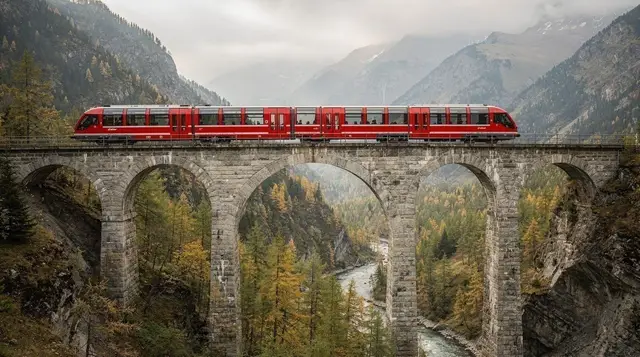
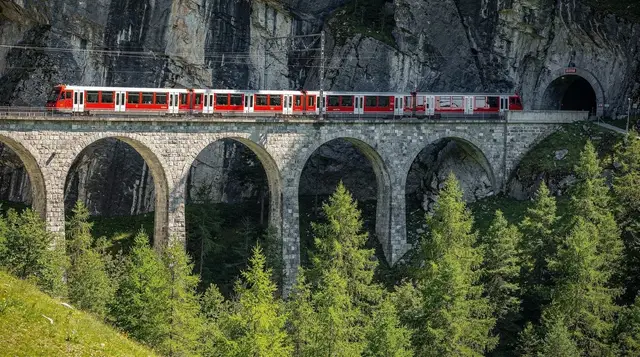
Why Swiss trains run on time
The first time I had a four-minute connection at Arth-Goldau, I assumed I’d got the timetable wrong. Four minutes to get off one train, cross to another platform, and board a second train heading up to Lucerne felt like the kind of plan that only works if nothing goes wrong. I’ve since made that exact change a dozen times. It has never failed. That’s the thing about the Swiss railway system that took me longest to trust: the tightness isn’t a risk, it’s the design.
The clock-face timetable, explained properly
Switzerland runs what’s called a Taktfahrplan, a cadenced or “clock-face” timetable. Instead of trains leaving at irregular times decided route by route, most services repeat at the same minute past the hour, all day. The Zurich HB to Bern InterCity leaves at :04 and :34 past the hour, hour after hour, from early morning to late evening. Once you’ve learned one departure, you effectively know the whole day.
This isn’t just a mnemonic trick for timetables. It’s the organising principle of the entire network. Regional trains, buses, and even some boats are built around the same repeating pattern, so that the 47-minute regional service to Winterthur and the half-hourly S-Bahn into Zurich HB are designed to meet at predictable points, not by luck.
Why four minutes is enough
The part that unsettled me at first is the connection time at hub stations, sometimes as short as three or four minutes. In most countries that would be an invitation to miss your train. In Switzerland it works because the whole system is built backwards from those meeting points. SBB calls them knot stations: Bern, Basel, Lucerne, Arth-Goldau, Olten. Trains from several directions are scheduled to arrive within a minute or two of each other, sit for a few minutes, and depart again in a burst, so that every combination of onward journeys is covered without anyone waiting 40 minutes for the next slot.
Platforms at these stations are usually close together, and departure boards show the platform well in advance, so the four minutes is walking time, not sprinting time, most days. I’ve watched a carriage full of commuters do this without hurrying. It becomes unremarkable astonishingly fast.
A day where I tested it properly
I wanted to see how much I could get away with, so I built a day around back-to-back connections rather than padding. Out of Zurich HB towards Lucerne, off at the platform, straight onto a connecting train, and out again at Rapperswil for a slower morning by the lake. If you want to see how that town looks with almost no effort, the walk up to Rapperswil’s castle and rose garden, with a photographer along the way fills exactly the gap between one train and the next without wasting either.
Back in Zurich by early afternoon, I swapped the train for two wheels instead, because the timetable discipline that gets you across the country also frees up time in the city itself: a few unhurried hours meant I could actually take the urban bike tour with a local guide along the lake and through the old town rather than rushing it between trains.
On a separate trip, heading to Lucerne with a full day planned around Pilatus, I let someone else handle the connections entirely: the private tour to Lake Lucerne and Mount Pilatus from Zurich collects you directly, which is worth knowing if you’d rather not test the four-minute changes yourself on a day when the mountain, not the timetable, is the point.
What it actually costs to ride this system
Punctuality doesn’t come cheap, and it’s worth being honest about the price before you plan a trip around unlimited hopping between trains.
| Ticket type | Roughly covers | Indicative price |
|---|---|---|
| Single, Zurich HB to Lucerne, 2nd class | One journey, no discount | Around CHF 26 |
| Half Fare Card (one month) | 50% off most fares for a month | Around CHF 120 |
| Saver Day Pass | One day, specific trains, booked ahead | From around CHF 29–39 |
| Swiss Travel Pass (3 days) | Unlimited trains, buses, boats, many museums | Around CHF 260 (2nd class) |
None of this is cheap, and Zurich is already one of the more expensive cities in Europe to be a tourist in. The Half Fare Card earns its cost back after two or three medium-distance trips; the Swiss Travel Pass only makes sense if you’re moving most days. Full details, including where the Zürich Card fits in for city-only trips, are in the rundown of ski day trips out to the Titlis area if snow sport is part of the plan, and more generally in the guide to the passes themselves.
Where the system still breaks
It isn’t infallible. SBB’s own punctuality figures put over 90% of trains within three minutes of schedule, which also means roughly one in ten isn’t. Heavy snow in the mountains, a signal fault near Zurich HB during rush hour, or a major event like Street Parade can knock the cadence out for an afternoon. When that happens, the same repeating pattern that makes the system forgiving also makes recovery fast: staff reroute you onto the next repeating slot rather than improvising from scratch. I’ve had one meaningful delay in years of using these trains, at Basel, caused by a points failure, and it added about 25 minutes rather than derailing the day.
What I’d actually tell a first-time visitor
Trust the board, not your instinct. If it says platform 3 and 4 minutes, that’s real, not optimistic. Don’t reserve seats you don’t need, most trains don’t require it and reservations only apply to panoramic routes like the Glacier Express or Bernina Express. Download the SBB app before you land, since it recalculates connections live if something shifts. And don’t schedule your only chance to see something around a single train, because while the system is reliable, “reliable” still isn’t “guaranteed,” and the one day it slips shouldn’t be the day everything else depended on it.
What changed for me wasn’t the trains themselves, it was how much less mental effort travelling around Switzerland by rail takes once you stop treating four minutes as a problem and start treating it as the whole point.
FAQ: Switzerland’s cadenced train timetable
What is a cadenced timetable?
It means trains on a given line leave at the same minute every hour, or every half hour, all day. A Zurich-Lucerne train might always leave at :04 and :34 past the hour, so once you know one departure you know them all.
Is a four-minute connection really enough?
At a Swiss hub station, yes, because the whole schedule is built around that gap. Trains from several directions are timed to arrive just before and depart just after the same minute, and platforms are usually close together.
What happens if I miss a connection?
Usually nothing serious. Because services repeat hourly or half-hourly, the next one is rarely more than 30 to 60 minutes away, and staff at the platform noticeboard or the SBB app will already show the alternative.
Do I need to reserve seats on Swiss trains?
Not for most regional and InterCity trains, which is part of how the cadence works, no boarding queues, no allocated seats to hunt for. Panoramic trains such as the Glacier Express or Bernina Express are the exception and need a seat reservation.
Does the Half Fare Card or Swiss Travel Pass change how I use the timetable?
It changes the cost, not the mechanics. With a Half Fare Card you pay roughly half the standard fare on the same trains; the Swiss Travel Pass adds unlimited travel on top. Either way, you are still working from the same clock-face schedule.
Are delays common?
Rare on the core network, and SBB publishes real-time punctuality figures that consistently sit above 90% for trains arriving within three minutes of schedule. Delays cluster around snow in the mountains and major events in Zurich.
Where does the system feel most impressive to a visitor?
At a knot station like Arth-Goldau or Bern, where trains from four or five directions arrive within the same two-minute window and leave again a few minutes later, all timed so nobody waits long and nobody misses a link.
Related reading: for the underlying mechanics of the network, see the guide to how Swiss trains work; for getting around the city itself, Zurich’s ZVV system; and for landing day, Zurich airport to the city centre.
If you’re weighing up ticket options, compare the Swiss Travel Pass against the Half Fare Card or read the full Swiss Travel Pass guide. For the scenic end of the network, the Glacier Express, Bernina Express, and GoldenPass Line all run reserved-seat panoramic services rather than the standard cadence.
For day trips that put all of this to use, see the overview of day trips from Zurich, or the specific runs to Lucerne and the Rhine Falls, and the destination pages for Lucerne, the Rhine Falls, and Basel. And if you’re still working out how long to stay, how many days in Zurich is worth reading before you build a schedule this tight around yourself.
Scenic train tours on GetYourGuide
Verified deep-linked GetYourGuide tours. Book through these links and we earn a small commission at no cost to you.
GetYourGuide does not provide a product photo for this activity — the image shows the meeting point, photographed by us.