Zurich old town walking guide: Lindenhof to Niederdorf
How long does it take to walk Zurich's old town?
The core route from Lindenhof to Niederdorf covers around 3 kilometres and takes 2 to 2.5 hours at a steady pace with a few stops. Add 45 minutes if you climb the Grossmünster tower and visit the Fraumünster windows, and a full half-day if you also want a coffee break and time to browse Niederdorf's shops.
A route that actually works on foot
Zurich’s old town is really two old towns facing each other across the Limmat: the Lindenhof side to the west, and the Niederdorf side to the east. Neither is large. The whole route below covers about 3 kilometres of walking, almost all of it flat except for two short climbs, and it can be done in a morning without rushing. This is the order locals actually walk it in, not the order tour buses stop at it.
If you would rather not navigate on your own, a small-group guided walk through the historic old town covers most of the same ground with a local guide filling in the history at each stop, which is worth it if you want context rather than just a route to follow.
| Stop | Time to allow | Cost |
|---|---|---|
| Lindenhof | 15–20 min | Free |
| Augustinergasse | 10–15 min | Free |
| Grossmünster (nave) | 15 min | Free |
| Grossmünster tower | 20–25 min | CHF 5 |
| Fraumünster (Chagall windows) | 15–20 min | CHF 5 |
| Rathaus (exterior) | 5–10 min | Free |
| Niederdorf | 30–45 min | Free (browsing) |
| Schipfe | 10–15 min | Free |
Total walking time without the paid extras is roughly 2 hours. With both the tower and the windows, budget closer to 3 hours, plus whatever time you spend sitting down for coffee, which the route practically demands by the time you reach Niederdorf.
Starting point: Lindenhof
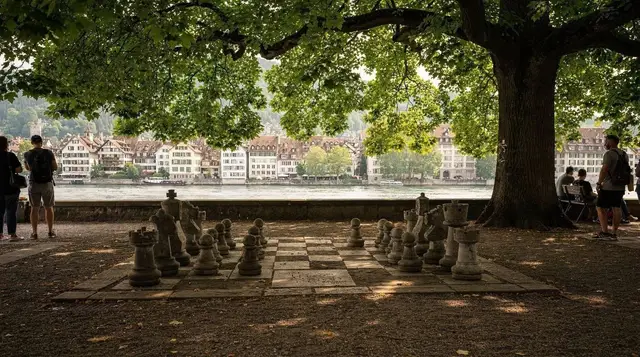
Lindenhof is a small raised square on the site of a Roman customs post and later a Carolingian palace, though nothing from either period is visible today — what you see is a plain gravel terrace with chestnut trees, a giant chess board that locals actually use, and a free view over the Limmat towards the Grossmünster’s twin towers. It’s a five-minute walk uphill from Bahnhofstrasse, reached by a short flight of steps or the sloped Fortunagasse.
There’s no ticket, no opening hours, and no gift shop, which is part of the appeal. Go early and you’ll likely have it to yourself; by mid-morning it fills with a mix of retirees playing chess and visitors taking the same photo of the river. It’s a reasonable substitute if the queue for the Uetliberg viewpoint feels like too much effort — see the guide to Zurich’s viewpoints for how the two compare.
Augustinergasse
From Lindenhof, drop down Augustinerstrasse into Augustinergasse, a narrow cobbled lane that is one of the most photographed streets in Zurich for a reason: the upper floors are lined with oriel windows (Erker) in wood and stone, several dating to the 16th and 17th centuries, painted in the mustard, rust and grey tones typical of old Zurich facades. It’s short — you’ll walk its length in under five minutes — but it’s worth doing slowly, since most of the detail is above eye level and easy to miss if you’re looking at your phone.
The lane feeds into St. Peterhofstatt, home to St. Peter’s Church and its oversized clock face, reputedly the largest church clock face in Europe at just under 8.7 metres in diameter. The church itself is free to enter and rarely has a queue, which makes it a reasonable place to sit for a few minutes before continuing to the river.
Crossing to the Grossmünster
From St. Peterhofstatt, head down to the Limmat and cross via the Rathausbrücke or continue slightly south to the Münsterbrücke, which gives the better approach shot of the Grossmünster’s twin towers rising above the east bank. The walk from Lindenhof to the Grossmünster’s main entrance takes about 15 minutes at a relaxed pace, including the stop at St. Peter’s.
The Grossmünster is Zurich’s Reformation church, where Huldrych Zwingli preached from 1519, and the interior is deliberately plain — whitewashed walls, clear glass in most windows, none of the gilding you’d find in a Catholic church of the same age. The one exception is the choir, which has modern stained glass by Augusto Giacometti installed in 1932, worth a look before you decide whether the tower climb is for you.
The tower costs CHF 5 and involves 187 steps with no lift, narrow in places, opening onto a platform with a 360-degree view over the old town and the lake. It’s the cheapest elevated view in central Zurich and less crowded than the queue for the main train station’s viewing platforms. Skip it if stairs are a problem, since there’s no alternative route up.
Fraumünster and the Chagall windows
Cross back over the Münsterbrücke to the Fraumünster, five minutes from the Grossmünster and impossible to miss given the plain green spire. The exterior is unremarkable compared to its neighbour, but the interior holds the reason most people come: five stained-glass windows designed by Marc Chagall and installed between 1970 and 1978, plus a rose window by Augusto Giacometti in the north transept.
Entry is CHF 5, photography of the windows is not permitted, and the church closes during services, which mainly affects Sunday mornings — check the noticeboard by the entrance if you’re visiting on a Sunday, since the Chagall windows have been the one part of this route that catches visitors out with unexpected closures. Outside service times, opening hours generally run from around 10am to 6pm in the warmer months and shorter in winter, so this is not a stop to save for late afternoon between November and March.
Rathaus and the river
From the Fraumünster, follow the Limmatquai north along the east bank for about ten minutes to reach the Rathaus, Zurich’s baroque town hall, built in the late 17th century and still in use by the cantonal parliament. It sits almost directly over the river on wooden piles, which is more unusual than it looks from the street. There’s no public entry unless a session is in progress and open to visitors, so this is a five-minute exterior stop rather than a destination in its own right — worth a photo from across the water more than a close look.
If seeing government buildings up close appeals to you generally, the same instinct is better rewarded at the Swiss National Museum a short walk from the main station, which covers Swiss history in far more depth than anything visible from the Rathaus steps.
Niederdorf
Immediately behind the Rathaus, the streets narrow into Niederdorf (locally just “Dörfli”), Zurich’s old town nightlife and shopping quarter, a grid of pedestrian lanes lined with independent shops, bakeries, bars and restaurants running roughly parallel to the river up to the main station. This is where the walk stops being about monuments and starts being about wandering — there’s no single route through Niederdorf that’s better than any other, so budget 30 to 45 minutes to drift and see what catches your eye.
Mornings here are quiet and good for a coffee stop before the day-trip crowds arrive; see the guide to Zurich’s coffee and bakeries for specific recommendations rather than picking at random. By evening the same lanes become the centre of Zurich’s nightlife, covered separately in the guide to Zurich’s nightlife and the one on Langstrasse’s bars and clubs, which is a different, edgier district about 15 minutes further west and not part of this walk.
Niederdorf also connects directly north to the main train station in under ten minutes, which makes it a sensible place to end the walk if you’re heading onward by train, or to continue south towards Bellevue and the lake if you have energy left.
Schipfe: the quiet finish
If you have another 15 minutes, backtrack to the west bank and finish at Schipfe, a short riverside lane below Lindenhof that was Zurich’s medieval red-light and guild district and is now one of the least visited corners of the old town despite sitting a two-minute walk from Bahnhofstrasse. Small workshops, a couple of galleries and quiet benches along the water make it a good place to end the walk without another queue or ticket.
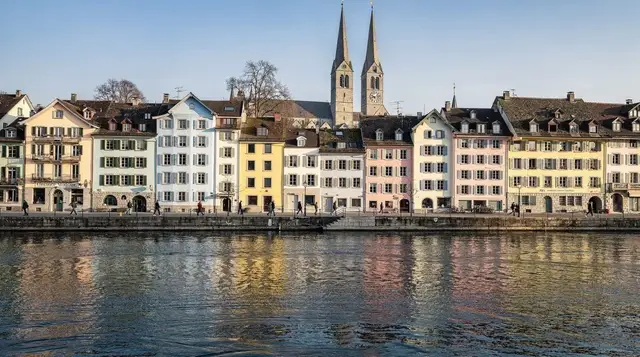
Schipfe is also the most overlooked spot on this entire route for photos of the Grossmünster towers reflected in the Limmat, largely because most visitors never realise it’s there — it’s not signposted from Lindenhof above it, and you have to actively look for the steps down.
Where to go next after the old town
The walk ends close to several other things worth knowing about, and the right follow-up depends on how much energy you have left. If the route has left you wanting more views, Zurich’s viewpoints compares the other high and low spots around the city, and the Uetliberg guide covers the hill that looks back over the whole old town. If you prefer to stay by the water, boat trips on Lake Zurich pick up where the Limmat leaves off, and the blog post on swimming in the Limmat shows how locals use the same river you have just been walking beside.
Shoppers can move straight on to the Bahnhofstrasse shopping guide, while anyone who wants to turn a walk into a food stop should look at the Zurich food tour guide and the fondue and raclette guide. For a wet or cold afternoon, the Zurich museums guide, the Kunsthaus guide and the Swiss National Museum guide give you indoor options without leaving the centre.
If the old town is only one part of a longer stay, the Zurich destination page gives the wider picture, the one-day itinerary shows how this walk slots into a single day, and how many days in Zurich helps you decide whether one walk is enough or whether you want to spread the city over several mornings. For timing the visit itself, the best time to visit Zurich explains how the seasons change the feel of these lanes, and the blog post on riding the Polybahn is a small detour for anyone who likes the city’s slower, older ways of getting around.
Putting it together with the rest of your trip
This walk works well as the opening block of a one-day visit — see the one-day Zurich guide for how to sequence the afternoon that follows it, whether that means the lake, a museum, or Bahnhofstrasse for shopping. If you’re staying longer, it also pairs naturally with the free things to do in Zurich guide, since most of this route costs nothing beyond the two small entry fees.
For a different pace through the same streets, a guided old town walk with a local guide covers the same landmarks with commentary on the Reformation history that the plain church interiors don’t explain on their own. If you’d rather cover more ground on two wheels and extend beyond the old town into the lakeside districts, the urban bike tour with a local guide is a faster way to see the wider city on the same day.
Families walking this route with young children should read the Zurich with kids guide first, since the cobbles on Augustinergasse and the steps up to Lindenhof are awkward with a pushchair, even though nothing on the route is dangerous. Anyone visiting between November and March should also check the Zurich in winter guide, since the Grossmünster tower and some Niederdorf shop hours shift outside the main season.
For getting to the start of the walk, the closest tram stops are Rennweg or Central, both served by the ZVV network — the getting around Zurich guide covers tickets and the Zürich Card if you’re combining this walk with a museum visit the same day.
Two more pages are useful before you set out: the accessibility guide for anyone who needs to plan around steps and cobbles, and the Zurich Card versus Swiss Travel Pass comparison if you are weighing up passes. The coffee and bakeries guide and the nightlife guide are the natural companions to the Niederdorf stretch of the route, and the Zurich free things to do guide lists what else costs nothing.
Common questions about walking Zurich’s old town
Is the Zurich old town walk free?
Walking the route costs nothing. The only paid stops are the Grossmünster tower climb (CHF 5) and the Fraumünster’s Chagall and Giacometti windows (CHF 5), both cash or card at the entrance.
Do I need to book anything in advance?
No booking is needed for the churches or the streets themselves. If you would rather follow a guide than navigate alone, a small-group walking tour of the old town runs several times a day and can be booked online.
Which side of the Limmat should I start on?
Start on the west bank at Lindenhof, since it sits above the river and gives you an orientation view before you head down into the lanes. Finish on the east bank in Niederdorf, which has more cafes and bars for a break at the end.
Can I see the Fraumünster and Grossmünster in the same visit?
Yes. They face each other across the Limmat and are a 5-minute walk apart, connected by the Münsterbrücke. Most people visit both within the same hour.
Is the old town walk suitable for wheelchairs or pushchairs?
Partly. Bahnhofstrasse and the riverside quays are flat and paved, but Lindenhof and Schipfe involve cobbles, steps and slopes that are difficult with wheels. The Grossmünster tower has no lift.
What time of day is best for photos without crowds?
Before 9am, when Niederdorf’s lanes are still quiet and the light on the Fraumünster spire is soft. By late morning the route fills with day-trip groups, especially outside the Grossmünster.
How does this walk fit with a one-day Zurich itinerary?
It fits as the first 3 to 4 hours of a one-day visit, leaving the afternoon free for the lake, Bahnhofstrasse or a museum. See the one-day Zurich guide for how to sequence the rest of the day.
City sightseeing tours on GetYourGuide
Verified deep-linked GetYourGuide tours. Book through these links and we earn a small commission at no cost to you.
GetYourGuide does not provide a product photo for this activity — the image shows the meeting point, photographed by us.