The Kunsthaus Zürich guide: collections, the Bührle debate and visiting after the Chipperfield extension
Is the Kunsthaus Zürich worth visiting, and how long does it take?
Yes — it is one of Switzerland's strongest art museums, with the country's largest Giacometti collection, a serious Monet and Van Gogh holding, and the Bührle collection in the new Chipperfield wing. Allow 2 to 3 hours for a proper visit, longer if a temporary exhibition is also open.
What the Chipperfield extension actually changed
The Kunsthaus Zürich roughly doubled in size in October 2021, when a new building by British architect David Chipperfield opened directly across Heimplatz from the original 1910 structure. Before that, the museum’s collection — one of the largest and best-funded in Switzerland — was squeezed into a building that could show only a fraction of what it owned. The extension is a plain, limestone-clad block that some locals think looks more like a bank than a museum, but it solved a real problem: room to actually hang the collection.
The two buildings are linked by an underground passage beneath Heimplatz, so a single ticket covers both. In practice, most visitors start in the older Moser building for the historical and Swiss collections, then cross underground to the new wing for the Bührle collection and much of the 20th-century material. If you are short on time and have to choose one half, the older building holds the bulk of what makes the Kunsthaus distinctive: the Giacometti rooms and the Hodler collection.
For context on Zürich’s museum scene more broadly, our Zürich museums guide compares the Kunsthaus with the Swiss National Museum and the smaller specialist collections around the city, which is useful if you are trying to decide how many museum mornings your trip can actually absorb.
The collection, building by building
The Moser building: Swiss art and Giacometti
The Kunsthaus holds the world’s largest public collection of works by Alberto Giacometti, the Swiss sculptor best known for his elongated bronze figures. It’s a genuinely significant reason to visit even if you have no particular interest in Swiss art generally — the rooms include sculpture, painting and drawing spanning his whole career, not just a token piece or two.
Alongside Giacometti, the older building carries a strong holding of Ferdinand Hodler, the Bernese painter whose bold, symmetrical landscapes and figure paintings define a lot of what people picture as “Swiss art” from the early 20th century. There’s also a solid run of 19th-century Swiss and European painting, and a sculpture garden that’s worth a slow walk if the weather is decent.
The Chipperfield wing: the Bührle collection and 20th century
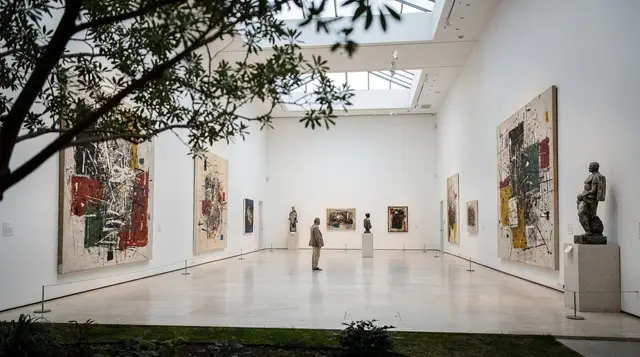
The new building’s main draw is the Bührle collection: around 170 paintings assembled by Emil Bührle, a Zürich industrialist, including Impressionist and Post-Impressionist works by Monet, Cézanne, Degas, Renoir and Van Gogh. It’s a genuinely strong run of paintings by international standards — the kind of names that would headline a special exhibition elsewhere, on permanent display here.
The Chipperfield wing also holds the Kunsthaus’s Munch works, a decent Chagall grouping, and a run of 20th-century material that stretches into Rothko, Bacon and later abstraction. None of it is huge in volume compared with, say, a national gallery in a capital city, but the quality-to-crowd ratio is unusually good — the Kunsthaus is rarely as busy as its collection would suggest.
The Bührle collection: why it’s controversial
This is worth understanding before you go, because it shapes how the museum now presents these paintings. Emil Bührle ran Oerlikon-Bührle, a Zürich arms manufacturer that sold weapons to Nazi Germany throughout the Second World War, profiting substantially from the conflict. He used part of that wealth to buy art, and some of those purchases came from Jewish collectors who were forced to sell under Nazi persecution — the kind of “flight sale” that provenance researchers now treat as tainted, even when the paperwork at the time looked legitimate.
When the Bührle Foundation’s collection moved from a private villa into the publicly visible Kunsthaus in 2021, it reopened a debate that had been simmering in Switzerland for decades: whether a public museum should display work with this kind of history without much more context than a name plate, and whether Zürich institutions had been too comfortable accepting Bührle’s money and patronage after the war. Historians, journalists and some family descendants of dispossessed collectors argued the original wall texts glossed over Bührle’s wartime dealings.
The pressure led to changes. An independent panel of historians was commissioned to dig further into the provenance of individual works, and the museum has since expanded its contextual material — longer wall texts, additional research displayed alongside the paintings, and more explicit acknowledgement of Bührle’s arms business and the disputed sales. It’s not a resolved story; provenance research on flight sales is slow and contested by nature, and some works remain the subject of ongoing claims. If you want more than the museum’s own framing, it’s worth reading up before your visit rather than relying solely on the gallery text — the topic is genuinely more interesting, and more uncomfortable, than a standard museum label conveys.
Tickets and prices
Zürich is an expensive city generally, and the Kunsthaus isn’t a bargain, though it’s not out of line with comparable European museums either. These are the current standard rates — confirm on the museum’s own site before you go, since prices and exhibition surcharges shift through the year.
| Ticket type | Approximate price |
|---|---|
| Adult, permanent collection | CHF 23 |
| Adult, permanent + temporary exhibition | CHF 32 |
| Reduced (students, apprentices, seniors 65+) | CHF 18 |
| Under 18 | Free |
| Zürich Card holders | Free, permanent collection |
| Wednesday evening, 5–8pm | CHF 5 |
There’s no combined ticket that bundles the Kunsthaus with other Zürich attractions in the way some cities package their museums, so if you’re weighing up value across a longer stay, our Zürich on a budget and Zürich travel costs guides put a museum ticket like this into the context of a full daily spend.
If you’d rather not think about queueing at the desk, a pre-booked entry ticket covers it in advance:
a combined entry ticket for the Kunsthaus ZürichOpening hours and how much time to allow
The Kunsthaus is closed on Mondays, which catches out a fair number of visitors planning a tight itinerary — check this against your dates before you build a day around it. On other days it typically opens from 10am, with a late opening on Wednesdays until 8pm (with the discounted rate mentioned above kicking in from 5pm). Sunday hours tend to run shorter than weekdays. Hours around Swiss public holidays vary, so if your visit falls near one, check the current schedule rather than assuming.
For time on site: 2 hours covers the permanent collection at a reasonable pace, 3 hours if you also want to see whatever temporary exhibition is running, and closer to 4 hours if you’re the type who reads every wall text and wants a proper look at both the Giacometti rooms and the Bührle paintings without rushing. The museum is rarely crowded enough that you’ll be fighting sightlines, which is part of why the extra time is usually worth it — you can actually stand in front of a painting rather than photograph it over someone’s shoulder.
Getting there
The Kunsthaus sits on Heimplatz, on the edge of Zürich’s Old Town. From Zürich Hauptbahnhof it’s a 15 to 20 minute walk, mostly flat, through streets that make for a reasonable orientation walk if it’s your first day in the city — our Zürich old town walking guide covers a route that passes close by. Alternatively, trams 3, 5, 8 and 9 all stop at or near Kunsthaus/Heimplatz; check the current ZVV network map for the exact stop, since tram routings do get adjusted. Details on how the ZVV network and tickets work generally are in our getting around Zürich guide.
If you’re staying anywhere in central Zürich, walking is genuinely the simplest option — the museum is close enough to the lake, the Old Town and Bahnhofstrasse that public transport rarely saves meaningful time for this specific trip.
Practical tips
Cloakroom and bags: Large bags and coats generally need to go into the cloakroom, which is free to use. Budget a few extra minutes at busier times.
Audio guide: An audio guide is available for an additional fee and covers the highlights across both buildings — worth it if you want more than the wall text on the Bührle works in particular, given how much of that story sits outside the frame of the paintings themselves.
Photography: Photography without flash is generally permitted in the permanent collection, though rules can differ for temporary exhibitions with loaned works — look for signage in each room rather than assuming blanket permission.
Café: There’s a café on site, useful for a coffee break between the two buildings rather than a destination in its own right. For a proper meal, the surrounding streets around the Old Town have more options — see eating well in Zürich without going broke for realistic pricing.
Crowds: The Kunsthaus is rarely genuinely crowded by international museum standards. Weekday mornings are the quietest; Wednesday evenings pick up because of the reduced-price late opening.
Combining the Kunsthaus with the rest of your day
Because the Kunsthaus sits right on the edge of the Old Town, it slots easily into a half-day rather than needing its own dedicated day. A reasonable pairing: a morning covering the Grossmünster and Niederdorf lanes, the Kunsthaus after lunch, then a walk down to the lake for the evening.
If you’re spending a full day mapping out central Zürich, our Zürich in one day and how many days in Zürich guides show where a museum visit like this fits against the rest of the city’s sights, and the Zürich Card vs Swiss Travel Pass comparison is worth reading if you’re trying to work out whether either pass actually saves you money on entry here.
If your day includes people less interested in Impressionist painting, Zürich has plenty else nearby that isn’t art-museum-shaped. A city bike tour covers the same central streets from a different angle: a guided city bike tour with a local guide and football fans in the group might prefer the FIFA World Football Museum over a second museum stop of the art kind:
a guided entrance ticket for the FIFA World Football MuseumFor a longer stay, the three-day and free things to do guides both give a sense of how a paid stop like the Kunsthaus balances against the city’s genuinely free attractions, several of which — the lake, the Old Town lanes, the viewpoints — cost nothing at all. If shopping is next on your list, Bahnhofstrasse is a short walk from the museum in the other direction from the Old Town.
Kunsthaus Zürich: frequently asked questions
How much does the Kunsthaus Zürich cost?
Adult admission to the permanent collection is around CHF 23, or about CHF 32 if a temporary exhibition is running alongside it. Reduced tickets (students, apprentices, seniors 65+) are around CHF 18, and under-18s go free. Confirm current prices on the museum’s own site before you go, since they do change.
What is the Bührle collection controversy about?
Emil Bührle was a Zürich-based arms manufacturer who sold weapons to Nazi Germany during the Second World War and built part of his art collection through purchases from Jewish owners forced to sell under persecution. When the Bührle Foundation’s paintings moved into the Kunsthaus in 2021, historians and campaigners argued the museum was displaying the works without adequately confronting that history, prompting an independent provenance review and expanded wall texts.
How long should I spend at the Kunsthaus Zürich?
Budget 2 hours for the permanent collection alone, or 3 hours if you also want to see a temporary exhibition. Serious Giacometti or Impressionist fans should allow closer to 3 to 4 hours, since both the older Moser building and the new Chipperfield extension are large.
Is the Kunsthaus Zürich free to visit?
Not generally, but there are ways to reduce the cost. Under-18s always go free, Zürich Card holders get free entry to the permanent collection, and the museum runs a discounted evening rate on Wednesdays between 5pm and 8pm.
Is the Kunsthaus closed on Mondays?
Yes, the Kunsthaus Zürich is closed on Mondays, in line with most Swiss museums. It opens Tuesday to Sunday, with a late opening until 8pm on Wednesdays; check the current timetable before visiting, since hours shift around public holidays.
How do I get to the Kunsthaus Zürich from Zürich HB?
It is a 15 to 20 minute walk from Zürich Hauptbahnhof, or a short tram ride (lines 3, 5, 8 or 9) to the Kunsthaus or Heimplatz stop, which sits right outside the building. The Old Town and Bellevue lakefront are both within easy walking distance afterwards.
Can I combine the Kunsthaus with other things to do in Zürich the same day?
Easily. The museum sits at Heimplatz, a few minutes from the Old Town, the lake promenade and Bahnhofstrasse, so it slots naturally into a half-day of central Zürich sightseeing rather than needing a dedicated day.
Museum & art tours on GetYourGuide
Verified deep-linked GetYourGuide tours. Book through these links and we earn a small commission at no cost to you.
GetYourGuide does not provide a product photo for this activity — the image shows the meeting point, photographed by us.