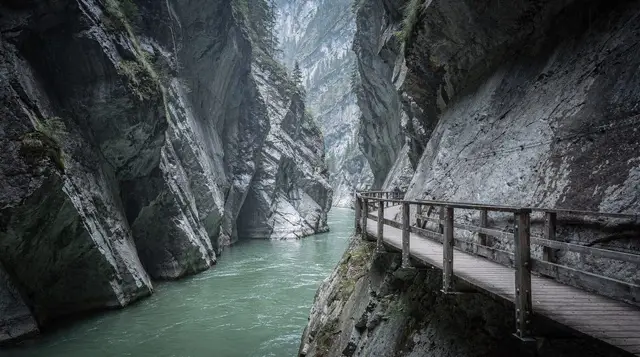
The 72 waterfalls of Lauterbrunnen valley
How many waterfalls are there in Lauterbrunnen and which ones can you actually visit?
Lauterbrunnen valley has 72 named waterfalls dropping off its glacially carved cliffs, but only a handful are set up for visitors. Staubbach falls is free and visible from the village all year; Trümmelbach falls, ten glacier-fed cascades inside the mountain, charges admission and closes from around early November to Easter.
Why one valley has 72 named waterfalls
Lauterbrunnen sits in a glacially carved trough, the kind of steep-sided U-shaped valley that geology textbooks use as the textbook example. The cliffs on either side rise close to 300 metres almost straight up, and every stream that used to join the main valley at ground level now has to fall off the top of it instead. That is the entire explanation for the 72 waterfalls: it is what happens to a river network when a glacier removes the valley floor out from under it.
Most visitors arrive knowing about exactly one of the 72, the Staubbach falls, because it is the one you can see from the main street of Lauterbrunnen village without walking anywhere. The other 71 range from substantial, named cascades to seasonal trickles that only run for a few weeks after snowmelt. This guide covers the two you can actually plan a visit around — Staubbach and Trümmelbach — plus the valley floor walk that strings several more together, and what closes when.
Staubbach falls: the one everyone sees, free of charge
Staubbach falls drops 297 metres off the eastern cliff directly above Lauterbrunnen village, and by the time the water reaches the bottom it has mostly turned to spray — “Staubbach” translates roughly as “dust stream,” which is an accurate description rather than a marketing name. It is free, permanently visible from the main road through the village, and needs no ticket, no booking and no walking beyond wherever you happen to park or step off the train.
It photographs best in the morning when the sun is on the cliff face rather than behind it, and it is genuinely more dramatic after rain or during peak snowmelt in late May and June, when the flow thickens noticeably. By late summer in a dry year it can shrink to a much thinner ribbon. There is a short, steep path partway up towards the base of the fall if you want a closer look, but most people are satisfied with the village view, since the upper sections are not accessible without a proper hike.
Trümmelbach falls: ten glacier waterfalls inside the mountain
Trümmelbach falls is the reason this valley is worth a dedicated trip rather than a five-minute stop. It is a series of ten glacier-fed waterfalls that drain meltwater from the Eiger, Mönch and Jungfrau down through a gorge carved so deep into the rock that most of the falls are not visible from outside at all — you go in through a tunnel and a lift, then follow galleries and walkways bolted to the rock face as the water crashes past at close range.
It is loud, it is cold even in summer, and the walkways get wet from spray, so this is not a polished visitor attraction in the usual sense — bring a layer and shoes with grip. The volume of water is genuinely impressive because it is carrying glacial meltwater rather than rainfall runoff, which means flow is highest on warm days in June, July and August rather than after a storm.
Trümmelbach falls is a paid attraction and it closes for the season, typically from early November to shortly before Easter, because the walkways and lift are not maintained through winter conditions in the gorge. If you are visiting Lauterbrunnen outside that window, check the posted opening dates before building a day around it — this is the single most common way visitors get caught out here, turning up in December to find the gates shut.
a guided hike from Lauterbrunnen to Mürren that includes entry to Trümmelbach falls covers the admission and adds a walk up towards Mürren on the same day, which is a reasonable way to combine the two if you are not driving yourself and would rather not work out the postbus timetable.
The valley floor walk: which falls you pass on foot
Below Trümmelbach, a mostly flat path runs the length of the valley floor from Lauterbrunnen village to Stechelberg, a stretch of around 9 kilometres that most people cover in two to two and a half hours at an easy pace. It follows the river, passes underneath both Staubbach and the entrance to Trümmelbach, and gives you sight of several of the smaller, unnamed falls dropping off the cliffs on both sides without ever needing to leave the valley floor.
This walk is free, needs no booking, and is one of the few genuinely easy long walks in the region — no significant climbing, well-signed, and it can be shortened at either end using the postbus that runs along the same road. It is also the best way to appreciate the scale of the valley itself, since standing at the bottom looking straight up 300 metres of rock face is a different experience from seeing the same cliffs from a train window.
an e-bike tour through the 72 waterfalls valley covers the same ground faster, which is worth considering if you are combining Lauterbrunnen with a same-day visit to somewhere else, such as Interlaken or Grindelwald.
The falls worth knowing by name
| Waterfall | Height | Access | Best season |
|---|---|---|---|
| Staubbach falls | 297 m | Free, visible from village | Late May–July, after rain |
| Trümmelbach falls | 10 falls, ~200 m total drop | Paid, tunnel and lift | May–September |
| Mürrenbach falls | 417 m | Visible from valley floor path | June–August |
| Schmadribach falls | ~200 m | Seen from higher trails towards Stechelberg | June–August |
| Unnamed cliff-face falls (dozens) | Varies | Seen in passing along the valley road/path | Peak in late May–June snowmelt |
What’s open depends on the season — this is what catches people out
Two separate seasonal patterns collide in this valley, and mixing them up is what ruins the most day trips. First, the waterfalls themselves are strongest with spring and early-summer snowmelt and thin out by late summer in a dry year — so a photo taken in July can look markedly different from the same spot in September.
Second, the built attractions and lifts around the valley, including Trümmelbach falls and the cable cars up to Mürren and the Schilthorn, close for scheduled maintenance in spring and again in autumn — typically a window in November and sometimes a shorter one in April or May, though exact dates shift year to year and are only confirmed a season ahead.
The practical takeaway: if a specific cable car or the Trümmelbach falls interior is central to your plan, check current opening dates directly before travelling, especially if your trip falls in April, May or November. The waterfalls on the valley floor and Staubbach itself are always visible — it is the paid, mechanised attractions that have a closed season.
| Attraction | Typical season | Notes |
|---|---|---|
| Staubbach falls | Year-round | Free, no infrastructure to close |
| Trümmelbach falls | Easter–early November | Closes for winter; confirm exact dates before visiting |
| Valley floor walk | Year-round | Can be icy underfoot in winter |
| Schilthorn cable car | Year-round with maintenance closures | Spring and autumn service windows |
Getting to Lauterbrunnen from Zurich
Lauterbrunnen has no airport and no motorway running into it — everyone arrives by train or by road through Interlaken. From Zurich HB, the standard route is a direct or one-change train to Interlaken Ost, then a change onto the Bernese Oberland Railway up the valley.
| Leg | Duration | Notes |
|---|---|---|
| Zurich HB → Interlaken Ost | ~50 min–1 h 10 min | Direct or one change, hourly |
| Interlaken Ost → Lauterbrunnen | ~20 min | Bernese Oberland Railway, at least hourly |
| Total, Zurich to Lauterbrunnen | ~1 h 45 min–2 h | No reservation needed |
A Swiss Travel Pass covers this whole route, and the valley floor walk needs no separate ticket once you are there. If you are staying near the falls rather than day-tripping, Lauterbrunnen village itself has more affordable lodging than Wengen or Mürren higher up the valley, since it sits at the valley floor rather than requiring a funicular or cable car to reach.
Combining the waterfalls with a longer day
Because Lauterbrunnen sits directly below Mürren and on the approach to Jungfraujoch, most visitors treat the waterfalls as part of a longer day rather than the sole destination. If you want a full day covering both the falls and a hike up towards Mürren, a guided combination avoids working out three separate cable car and postbus connections yourself.
a winter day trip pairing Grindelwald and Lauterbrunnen is the better option outside the hiking season, when Trümmelbach is closed and the valley floor walk is the main activity along with a look at the frozen cliffs. In summer, a small-group day trip that adds Mürren and its cable car onto the same itinerary makes more sense of the whole valley in one visit than the falls on their own.
Whichever way you approach it, keep the best mountain excursions from Zurich guide in mind if you are trying to decide between Lauterbrunnen and the other classic day trips out of the city, since travel time is the real constraint and the round trip from Zurich alone takes most of a day.
Practical planning
| Item | Detail |
|---|---|
| Currency | Swiss franc (CHF); Trümmelbach falls admission is a modest per-adult fee, cheaper for children |
| Getting there from Zurich | ~2 hours by train via Interlaken Ost |
| Free to see | Staubbach falls, the valley floor walk |
| Paid attraction | Trümmelbach falls (closed roughly November–Easter) |
| Time needed | Half a day for Staubbach plus Trümmelbach; a full day if walking to Stechelberg or up towards Mürren |
| Best months for flow | Late May to July |
| What to bring | A waterproof layer for Trümmelbach’s spray; good walking shoes for the valley floor path |
If waterfalls are only part of your Bernese Oberland plans, see the best hikes near Zurich guide for trails that connect logically with this valley, and day trips from Zurich for how Lauterbrunnen compares in travel time against alternatives like Lucerne. For a broader sense of costs across a Swiss trip, the Zurich travel costs guide gives a realistic per-day budget, and Swiss trains explained covers how the connections through Interlaken actually work if you have never changed trains in Switzerland before.
Questions about Lauterbrunnen’s waterfalls
How many waterfalls does Lauterbrunnen valley actually have?
The figure usually quoted is 72, counted across the whole valley from the Staubbach at the village end to the smaller falls up towards Stechelberg. Most are seasonal trickles fed by snowmelt and only visible clearly in late spring and early summer.
Is Trümmelbach falls worth the entry fee?
Most visitors think so, because it is the only glacier waterfall system in Europe you can walk into and it is genuinely wet, loud and cold rather than a polished attraction. The lift and walkways are basic and the falls are best from May to September when meltwater volume is highest.
Can you see the waterfalls without paying for anything?
Yes. Staubbach falls is visible free from the village of Lauterbrunnen and from the valley floor path, and the walk between Lauterbrunnen and Stechelberg passes several smaller falls without any admission charge. Trümmelbach is the one paid attraction.
What time of year has the most waterfalls flowing?
Late May to July, when snowmelt from the surrounding glaciers and high pastures is at its peak. By late August several of the smaller seasonal falls have thinned to almost nothing, and by winter most are frozen or reduced to ice formations.
Is Trümmelbach falls open in winter?
No. It typically closes in early November and reopens around Easter, because the walkways and lift inside the gorge are not maintained through the snow season. Check the posted dates before planning a winter or early spring visit.
How long does the valley floor walk between the falls take?
Walking from Lauterbrunnen village to Stechelberg along the valley floor, passing Staubbach and several smaller falls, takes around two to two and a half hours at an easy pace over roughly 9 kilometres, mostly flat.
How do you get to Lauterbrunnen from Zurich?
Take the train from Zurich HB to Interlaken Ost, then change onto the Bernese Oberland Railway to Lauterbrunnen. The whole journey takes around two hours with one change, and trains run at least hourly through the day.
Do you need a car to see the waterfalls?
No. Lauterbrunnen village, Staubbach falls and Trümmelbach falls are all reachable on foot or by the local postbus, and the valley is largely car-free above Stechelberg. A car adds nothing here and parking in the village is limited.
Hiking & nature tours on GetYourGuide
Verified deep-linked GetYourGuide tours. Book through these links and we earn a small commission at no cost to you.
GetYourGuide does not provide a product photo for this activity — the image shows the meeting point, photographed by us.