Swiss trains explained: reservations, supplements and tickets
Do you need to reserve a seat on Swiss trains?
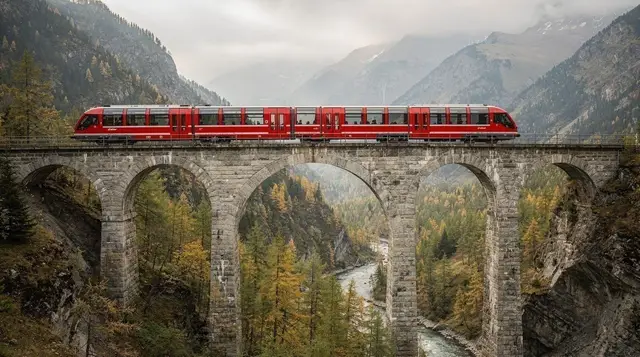
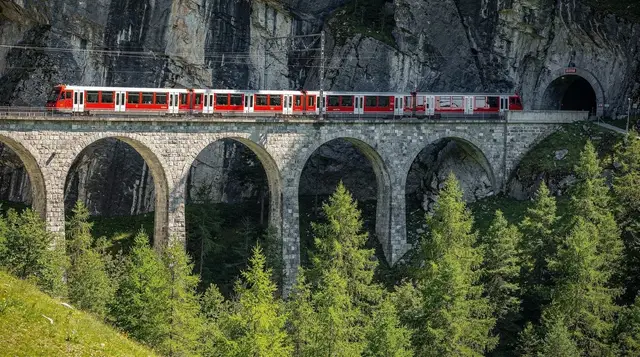
No, not on ordinary InterCity, InterRegio or S-Bahn trains — you just board with a valid ticket or pass. Reservation becomes compulsory only on named panoramic trains such as the Glacier Express and Bernina Express, where it comes with a seat supplement on top of the ticket.
Switzerland’s trains have a reputation for running on time, and mostly they earn it, but the ticketing system underneath is less intuitive than the reputation suggests. Reservations are sometimes compulsory and sometimes impossible to buy at all. A ticket that looks identical to the one your neighbour is holding can cost half as much. This guide works through what actually happens at the station, not the marketing version.
Who runs the trains, and what the initials mean
The national operator goes by three names depending on which official language you’re reading: SBB in German (Schweizerische Bundesbahnen), CFF in French (Chemins de fer fédéraux) and FFS in Italian (Ferrovie Federali Svizzere). All three refer to the same company, and you will see all three painted on the same rolling stock as it crosses language regions — a train leaving Zürich HB signed “SBB” can arrive in Lausanne still wearing the same livery under a “CFF” sign. Around Zurich itself, day-to-day city and suburban trains run as the S-Bahn under the ZVV network; see getting around Zurich on the ZVV for how that fits together with trams and buses.
Regional narrow-gauge lines — the ones that climb into the mountains, including the Rhaetian Railway that operates the Bernina and Glacier routes — are separate companies from SBB, which is one reason their reservation and pricing rules diverge from the main network.
Do you need to reserve a seat
On the trains you’ll use for most day trips from Zurich — InterCity, InterRegio, RegioExpress and S-Bahn services — seat reservation isn’t offered and isn’t needed. You buy or validate a ticket, board any second-class or first-class carriage matching your fare, and sit anywhere unoccupied. There’s no assigned seat, no reservation fee, and nothing to book in advance beyond the ticket itself. This is true whether you’re heading to Lucerne, Bern or Basel.
The exception is the small set of named panoramic trains built for the scenery rather than the commute, where a reserved seat and supplement are compulsory:
| Train | Reservation | Typical supplement (2nd class) |
|---|---|---|
| Glacier Express | Compulsory | CHF 33–38 (higher in peak season) |
| Bernina Express (train) | Compulsory | CHF 15–30 depending on season |
| GoldenPass Panoramic | Not compulsory in standard class | Prestige class only, higher fee |
| GoldenPass Belle Époque | Not compulsory | — |
| Gotthard Panorama Express | Reservation recommended | Included with the boat+train package |
Details on each route are in the Glacier Express guide, the Bernina Express guide, the GoldenPass Line guide and the Gotthard Panorama Express guide. If you’d rather let someone else handle the timing and seat booking on the Bernina route, the Bernina and Albula red trains day trip books the reserved seat as part of the package.
Panoramic trains: what the supplement actually buys
The supplement on the Glacier Express and Bernina Express isn’t a scenic-view tax on an otherwise identical seat — it funds a dedicated, reservation-only carriage with large windows, at-seat service (on the Glacier Express) and a guaranteed seat during the busiest months, when regular trains on the same corridor can be standing-room only. Outside July and August, the same route is often ridden on ordinary regional trains along parts of the line for a fraction of the price, with no reservation and the same window glass, just without the branding or the at-seat lunch service.
Worth knowing before booking a panoramic supplement: cable cars and mountain railways connecting to these routes close for scheduled maintenance in spring and again in autumn, typically for two to four weeks each time. Check the specific lift’s status before combining a panoramic train with a summit visit — this is the single most common way a planned day gets derailed, and it’s covered in more detail on the destination pages for Zermatt and St Moritz and the Engadine.
Buying tickets: full fare, Supersaver, and passes
A standard point-to-point ticket bought at the counter or via the app on the day of travel is the most expensive way to ride. Below that, three discount routes exist, and they don’t combine the same way for everyone:
Supersaver tickets (Sparbillet) are sold for specific trains in limited quantity, released roughly two to three months ahead and often cheapest six to eight weeks out. A same-day full fare from Zurich to Lucerne runs around CHF 27 second class; a Supersaver on a specific off-peak train can drop to CHF 19–24. They are non-refundable and non-exchangeable, so only book one once your plans are fixed.
The Half Fare Card costs around CHF 190 for one calendar month (a permanent version exists for residents) and cuts most point-to-point tickets, mountain railways and boat fares by half. For a Zurich-based stay of five days or more with two or three day trips planned, it typically pays for itself; for a two-day city visit, it usually doesn’t. Compare it directly against the alternative in Swiss Travel Pass versus Half Fare Card.
The Swiss Travel Pass bundles unlimited SBB travel, most lake boats, and free entry to over 500 museums, for a fixed number of consecutive or flexible days. It suits itineraries with several day trips already planned rather than a slow single city stay — full breakdown in the Swiss Travel Pass guide and set against the city-only alternative in Zurich Card versus Swiss Travel Pass.
Saver Day Pass (Sparbillet Tageskarte) and standard day passes for a fixed route also appear on sbb.ch at set prices from around CHF 29, useful for a single round trip on a fixed date without needing a multi-day pass.
| Option | Best for | Rough cost |
|---|---|---|
| Full-fare single ticket | Spontaneous, unplanned trips | Zurich–Lucerne ≈ CHF 27 (2nd class) |
| Supersaver ticket | Fixed date, booked weeks ahead | From ≈ CHF 19 for the same route |
| Half Fare Card (1 month) | 5+ days, several trips planned | ≈ CHF 190, halves most fares |
| Swiss Travel Pass (3-day) | Several day trips, museums included | ≈ CHF 230 (2nd class) |
| Saver Day Pass | One fixed round trip | From ≈ CHF 29 |
None of this changes what it costs to simply get around within Zurich itself day to day — for that, see Zurich travel costs and Zurich on a budget.
The apps that actually work
SBB Mobile is the operator’s own app and the one to install first: live timetables, real-time platform changes, ticket purchase, and an EasyRide mode that lets you check in and out of the network with your phone’s location and bills you the cheapest applicable fare afterwards, capped at the price of a day pass. It also shows disruption alerts as they’re published, which matters more in winter when snow occasionally affects mountain branch lines.
Fairtiq is a third-party check-in app that works the same way — tap to start, tap to end — across a wider net of regional buses and trams that don’t always show inside SBB Mobile. Either app removes the need to work out a fare in advance for a single one-off journey; you simply travel and let the app calculate it.
Both apps display live departures from Zurich HB, useful for connections onward to Zurich Airport, which sits roughly 10 minutes away by train and has its own dedicated platforms beneath the terminal.
What happens when a train is late
SBB’s punctuality figures typically sit around 90 to 93 percent of trains arriving within three minutes of schedule, which is high compared with most of Europe, and one reason why Swiss trains run on time is a network built with tight, engineered connection windows rather than slack. That same tightness means a short delay on one train can ripple into a missed connection at Zurich HB or Bern, so build in a five-to-ten-minute buffer at interchange stations during your own planning, particularly for the day trips from Zurich that involve one change.
Compensation for domestic delays is limited: SBB does not automatically refund a ticket for a short late arrival the way some EU operators do. Passenger-rights compensation applies mainly to international tickets once a delay reaches 60 minutes, claimable via a form on sbb.ch. For a same-day disruption, staff at any staffed station will usually rebook you onto the next available service on the same ticket without an extra fee — ask rather than assume the ticket has become invalid.
Taking a bicycle on Swiss trains
Bicycles ride in trains marked with a bicycle symbol on the printed and app timetables, and you buy a separate bike day pass (Velo-Tageskarte) alongside your own ticket, priced from around CHF 18 up to roughly CHF 32 depending on the zone and route. Space on regional trains is unreserved and limited — during Saturday mornings and summer weekends it fills quickly. Certain panoramic and mountain trains, including sections that run alongside routes like the Bernina Express, require a compulsory bike reservation rather than a simple day pass, so check before turning up with wheels.
Folding bicycles are the exception to all of this: fully collapsed and bagged, they travel free as ordinary hand luggage at any time, no pass required.
Practical tips for first-time riders
Buy or activate a ticket before boarding wherever possible; conductors do check, and a ticket bought after being asked, without a documented reason, comes with a surcharge. Second class is entirely adequate for the length of most day trips from Zurich — first class buys quieter carriages and slightly more space, not a faster train. Platform numbers at Zurich HB can change up to a few minutes before departure, so check the departure board rather than relying on a printed itinerary. If you’re combining a train with a lift or cable car further along the route, confirm the lift is actually running that week — spring and autumn maintenance closures are the most common reason a well-planned day trip falls apart, more so than any train delay.
For itinerary planning with several rail-based days built in, see the rail-only 7-day Zurich itinerary, and for a broader sense of how train days fit around food and culture stops, the cheese and chocolate day trip from Lucerne and the Swiss chocolate safari both run as guided alternatives to arranging the connections yourself. If mountain scenery by road rather than rail suits your day better, the Swiss Alps panoramic bus tour covers similar ground without needing a rail pass at all.
Swiss train travel: frequently asked questions
Do I need to reserve a seat on Swiss trains?
On regular SBB/CFF services — InterCity, InterRegio, RegioExpress and S-Bahn — no, reservation is neither possible nor needed; every valid ticket or pass boards any seat. Reservation is compulsory only on named panoramic trains: Glacier Express, Bernina Express and GoldenPass Panoramic/Prestige carriages.
What is the difference between SBB, CFF and FFS?
They are the same national rail operator in three of Switzerland’s languages: SBB (Schweizerische Bundesbahnen, German), CFF (Chemins de fer fédéraux, French) and FFS (Ferrovie Federali Svizzere, Italian). You will see all three initials on the same rolling stock depending on the region.
What is a Supersaver ticket?
A Supersaver (Sparbillet) is a discounted point-to-point ticket sold in limited quantity for a specific train, bookable in the SBB Mobile app or at sbb.ch. Prices start around CHF 19 to CHF 29 in second class and can undercut the full fare by 50 to 70 percent, but the ticket is valid only on the exact train and date booked.
Is the Half Fare Card worth it for a short trip?
The Half Fare Card costs around CHF 190 for a calendar month and halves the price of point-to-point tickets, most Swiss Travel Pass upgrades and many mountain railways. It pays for itself after roughly two to three return trips of an hour or more, so it suits a stay of five days or longer rather than a two-day city break.
What happens if my Swiss train is delayed?
Swiss trains run close to schedule — SBB’s own punctuality figure hovers around 90 to 93 percent of trains arriving within three minutes — so short domestic delays are uncommon and rarely compensated individually. Compensation exists mainly for international tickets under EU/Swiss passenger-rights rules once a delay reaches 60 minutes; check sbb.ch for a refund claim form.
Which app should I use for Swiss trains?
SBB Mobile is the primary app: timetables, live platform numbers, ticket purchase and the EasyRide check-in/check-out feature that calculates the cheapest fare automatically. Fairtiq is a third-party alternative that works the same way across most Swiss public transport, useful if you also want it to cover buses and trams outside the SBB network.
Can I take a bicycle on Swiss trains?
Yes, on trains marked with a bicycle symbol on the timetable, with a day pass for the bike (Velo-Tageskarte, roughly CHF 18 to CHF 32 depending on the zone) bought alongside your own ticket. Space is limited and unreserved on regional trains, while some panoramic and mountain trains require a compulsory bike reservation; folding bicycles travel free at any time as hand luggage.
Is the Swiss Travel Pass better than buying individual tickets?
It depends on how much ground you cover. A Swiss Travel Pass bundles unlimited travel on SBB, most boats and many town trams for a fixed number of days, and it is worth it once your combined single-fare journeys would exceed the pass price — typically true for anyone doing three or more day trips from Zurich. For a couple of short hops, single tickets or a Half Fare Card usually cost less.
Scenic train tours on GetYourGuide
Verified deep-linked GetYourGuide tours. Book through these links and we earn a small commission at no cost to you.
GetYourGuide does not provide a product photo for this activity — the image shows the meeting point, photographed by us.