Day trips from Zurich: the 15 that are worth it
What is the best day trip from Zurich?
Lucerne is the best all-round day trip from Zurich: 45 minutes by direct train, a walkable old town, and lake and mountain excursions on top if you want to extend the day. Rhine Falls is the best choice if you have less time or children in tow.
Fifteen day trips, ranked by how long you sit on a train
Zurich HB sits at the centre of the Swiss rail network, which is why almost anywhere in the country counts as a plausible day trip. The trade-off is time: a trip that eats three hours each way leaves you three or four hours at the destination before you have to turn around. This guide ranks fifteen realistic day trips by travel time, from a 20-minute hop to Winterthur to a genuine 3 hour 15 minute haul out to Zermatt, with what each one actually costs and when it works.
Prices below are full-price second-class one-way fares from Zurich HB, the number you’d pay buying a ticket at the machine with no discount card. A Half Fare Card cuts every fare in this table by roughly 50%, and a Swiss Travel Pass covers most of them outright plus museum entry, so treat these as the ceiling rather than what most visitors actually pay. All are approximate 2026 fares and can shift a few francs with SBB’s seasonal pricing.
| Destination | Train time from Zurich HB | One-way fare (2nd class, full price) | Best season |
|---|---|---|---|
| Winterthur | ~20 min | CHF 9 | Year-round |
| Zug | ~25 min | CHF 13 | Year-round |
| Rapperswil | ~35 min | CHF 14 | May–September |
| Lucerne | 45 min | CHF 26 | Year-round |
| Rhine Falls | ~50 min | CHF 28 | April–October |
| Schwyz-Einsiedeln | ~50 min | CHF 24 | Year-round |
| Bern | ~1 h | CHF 51 | Year-round |
| Basel | ~1 h | CHF 39 | Year-round |
| St Gallen | ~1 h | CHF 37 | Year-round |
| Appenzell | ~1 h 15 | CHF 45 | May–October |
| Chur | ~1 h 15 | CHF 41 | Year-round |
| Liechtenstein | ~1 h 15 | CHF 43 | Year-round |
| Engelberg-Titlis | ~1 h 20 | CHF 33 | Skip late April & November |
| Interlaken | ~2 h | CHF 66 | Year-round |
| Lugano | ~2 h | CHF 79 | April–October |
Under 30 minutes: Winterthur and Zug
Winterthur is a proper Swiss town rather than a tourist stop: a compact old town, a strong museum cluster including the Kunstmuseum and the Fotomuseum, and none of the crowds that Lucerne gets. Twenty minutes each way makes it the easiest half-day option if the weather turns or you just want to see somewhere that isn’t performing for visitors.
Zug sits on its own lake with a red-and-gold clock tower and a genuinely good waterfront promenade, and it’s rich enough (low corporate tax, famously) that the old town is well kept without being twee. It pairs well as a half-day trip, leaving time for a Zurich evening.
30 to 50 minutes: Rapperswil, Lucerne, Rhine Falls, Einsiedeln
Rapperswil sits at the far end of Lake Zurich and is best reached by boat rather than train if you have the extra hour — see our Lake Zurich boat trips guide for timetables. The castle, rose garden, and lakeside promenade make it a relaxed half-day, best from May to September when the boats run their full schedule.
Lucerne is the strongest all-rounder on this list: 45 minutes by direct train, the Chapel Bridge and old town walkable in a couple of hours, and Lake Lucerne right there if you want to extend the day with a cruise (see our Lake Lucerne boat trips guide).
It’s also the gateway to three mountain excursions — Mount Pilatus, Mount Rigi, and Mount Titlis — each of which turns a Lucerne day trip into a full mountain day if you start early. If you’d rather not juggle three separate tickets and a timetable, a guided day trip to Lucerne handles the connections for you.
Rhine Falls, Europe’s largest waterfall by volume, is close to Zurich but not actually fast — the direct train takes about 50 minutes and most connections involve a change at Winterthur. It’s worth doing regardless: the boat trips that go right up to the rock in the middle of the falls are the best part, and our Rhine Falls visiting guide covers which viewpoint is actually free. April to October is the sensible window; the falls run lower and greyer in winter.
Einsiedeln, in the Schwyz-Einsiedeln area, centres on a baroque Benedictine monastery and basilica that’s genuinely striking rather than a minor stop tacked onto a bigger itinerary. It works year-round and rarely feels crowded even in summer.
Around an hour: Bern, Basel, St Gallen
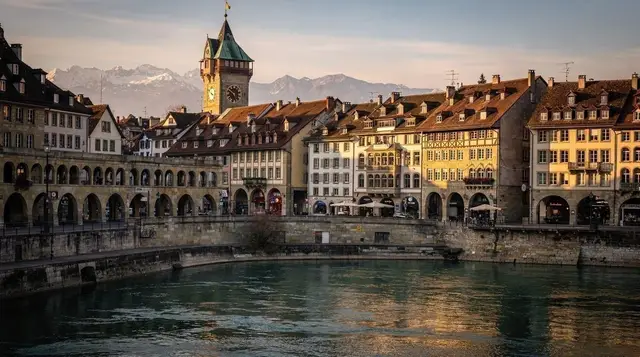
Bern, Switzerland’s federal capital, is an hour away and one of the best-preserved old towns in Europe — arcaded streets, the Zytglogge clock tower, and bear pits by the river. A full day here is comfortable without feeling rushed. If you’d rather have someone else handle the driving and route, a private day trip to Bern is worth the extra cost for a small group.
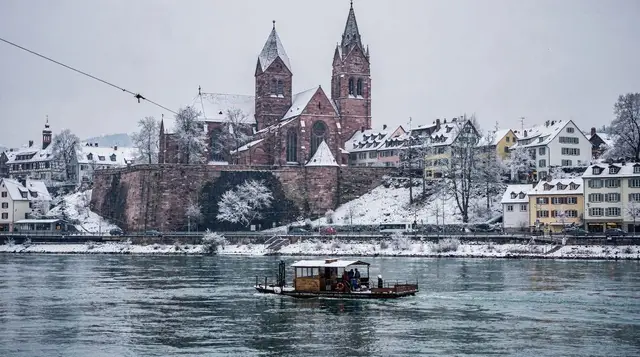
Basel sits where Switzerland, France, and Germany meet, and that border position shows in the architecture and the museums — the Kunstmuseum Basel alone justifies the trip for anyone interested in art. It’s also the practical starting point if you want to stretch the day into France; see our Basel, Colmar and Little Venice combination.
St Gallen is underrated: a UNESCO-listed abbey library with a genuinely spectacular rococo interior, and an old town with more painted oriel windows per street than anywhere else in Switzerland. It also opens the door to Appenzell on the same day if you start early, though that stretches the trip toward eight or nine hours door to door.
1 to 1.5 hours: Appenzell, Chur, Liechtenstein, Engelberg-Titlis
Appenzell, reached via St Gallen and a change onto the narrow-gauge Appenzell railway, is rural Switzerland at its most stereotypical — cowbells, embroidered costumes on festival days, and the jagged Säntis massif behind the village. The Säntis guide covers the cable car up if you want to extend into a proper hike. May to October is the realistic window; the village itself is fine in winter but the mountain views are hit or miss.
Chur, Switzerland’s oldest town, is mostly known as the gateway to Graubünden and the starting point of the Glacier Express and Bernina Express (see our Glacier Express guide), but the old town itself is worth an hour or two of wandering before you connect onward.
Liechtenstein is a genuine country, not a Swiss village, reached by train to Sargans and a short bus into Vaduz. It’s an oddity worth ticking off — a capital with no train station, a princely castle you can’t enter, and one main street — but budget realistically for what’s a small, quiet town rather than a major sight.
Engelberg-Titlis combines a scenic valley train (via Lucerne) with Switzerland’s highest-altitude cable car and a glacier you can walk on at the top, ice caves included. This is the clearest case in this whole guide for checking the lift schedule before you leave: Titlis cable cars close for maintenance for roughly two to three weeks each in spring and again in autumn, and the exact dates move year to year. Our Mount Titlis guide has the current closure window; skip late April and November if you can.
Two hours or more: Interlaken and Lugano
Interlaken, sitting between Lake Thun and Lake Brienz with the Eiger, Mönch, and Jungfrau visible from the platform, is 2 hours away and worth the trip on the strength of the scenery alone, even before you factor in the Jungfraujoch or Schilthorn extensions.
Doing Jungfraujoch itself as a day trip from Zurich is possible but long — over 4 hours of travel each way once you add the mountain railway — so most people either stay overnight or accept that Interlaken town and one lake cruise is the realistic version. A day trip to Interlaken that handles the connections is a reasonable option if you’re not confident stitching together three train changes on the way back.
Lugano, on the Italian-speaking side of the Alps, is 2 hours away via the Gotthard Base Tunnel and feels like a different country: palm trees, Italian spoken on the street, and a lakefront that looks more like Lake Como than anything in German-speaking Switzerland. April to October is the sensible window — Ticino’s appeal is largely outdoor and lakeside, and it loses most of its charm in winter drizzle.
Further out, on paper: Zermatt and Gruyères
Two destinations don’t make the ranked fifteen above but come up constantly, so it’s worth being honest about them. Zermatt is 3 hours 15 minutes each way, which means a 6.5-hour round trip before you’ve done anything at the destination — genuinely spectacular, but only worth it as a day trip if you leave on the first train and accept a short visit, or better, stay a night.
Gruyères, the medieval hilltop town behind the cheese and the chocolate factory, sits roughly 2.5 hours away by train with a change at Fribourg or Bern, which pushes it past most people’s comfortable day-trip threshold on public transport alone. If you want both towns and the cheese dairy without managing three separate train changes, a chocolate and cheese day trip to Gruyères covers the whole loop in one day.
Choosing between a rail pass and single tickets
The maths is straightforward once you know how many day trips you’re doing. A Swiss Travel Pass for consecutive days starts making sense at around three day trips in a short visit, especially if any of them are the pricier long-haul ones like Bern, Interlaken, or Lugano, and it throws in free entry to most Swiss museums as well. For one or two trips — say, Lucerne and Rhine Falls — a Half Fare Card plus single tickets usually comes out cheaper, since you’re not paying for days you don’t use.
Our Swiss Travel Pass vs Half Fare comparison runs the actual numbers against this list’s fares. Either way, Swiss trains run on a fixed clock-face timetable — the same departure minute every hour — so there’s no advantage to booking in advance the way there is with, say, French or British rail.
Mountain excursions and the spring/autumn maintenance trap
Rigi, Pilatus, and Titlis are the three mountain excursions that turn up constantly on “best day trips from Zurich” lists, and all three share the same seasonal problem: the cable cars and cogwheel trains close for scheduled maintenance, typically for one to three weeks in spring (often April) and again in autumn (often November), with exact dates set by the operator each year and published only a few months ahead.
This is the single most common way a Zurich day trip gets ruined — someone books trains to Engelberg or Vitznau months in advance, only to find the summit lift shut for maintenance on arrival. The valley towns themselves stay open and are pleasant regardless, but if the whole point of the day is standing on the summit, check the specific lift’s maintenance calendar before you commit to train tickets. Our best mountain excursions from Zurich guide links to each operator’s current schedule.
How many of these should you actually do
Trying to cram more than one longer trip into a short stay usually backfires — a Lucerne morning followed by a rushed Rhine Falls afternoon sounds efficient on paper but leaves almost no slack if a connection runs late. If you’re planning a full trip rather than picking one or two trips, our day-by-day itineraries build day trips into a realistic week around time in Zurich itself, and the first-time mistakes in Zurich guide covers the timing errors that come up most often, over-scheduling included.
Best day trips from Zurich on GetYourGuide
Verified deep-linked GetYourGuide tours. Book through these links and we earn a small commission at no cost to you.
GetYourGuide does not provide a product photo for this activity — the image shows the meeting point, photographed by us.