Lucerne day trip from Zurich: what to see in one day
Is Lucerne doable as a day trip from Zurich?
Yes. The train from Zurich HB to Lucerne takes about 45 minutes and runs at least twice an hour, so you get a full day in the old town with time left over for a lake cruise or a mountain trip up Rigi or Pilatus. Doing both the old town and a mountain properly in one day is tight; pick one focus and treat the other as a reason to come back.
Lucerne is the easiest good day trip out of Zurich. The train takes 45 minutes, the old town is compact enough to see properly without a car or a taxi, and the lake sits right at the edge of it, which means you can add a boat ride or a mountain without much extra planning. The catch is that Lucerne rewards a slower pace than most people give it — treating it as a two-hour photo stop at Kapellbrücke and then rushing back to the station is the most common way to waste the trip.
This guide sets out a realistic order for the day, what the boat-plus-mountain combination actually costs and how long it takes, and where to eat that isn’t the lakefront terrace charging CHF 38 for a schnitzel.
Getting from Zurich to Lucerne
Direct trains run from Zurich HB roughly every 30 minutes, and the journey takes 45 to 48 minutes on the InterCity or InterRegio line. There’s no need to book ahead and no seat reservation system on domestic Swiss trains — you just turn up and board. If you’re staying in Zurich the night before, an 8am or 8:30am departure gets you into Lucerne with the whole day ahead of you.
A standard second-class return costs around CHF 44 per adult without any discount. If you already hold a Half Fare Card, that drops to about CHF 22. A one-day Swiss Travel Pass covers the train plus most Lucerne-area boats and mountain railways at a reduced rate, but it only pays for itself if you’re also doing a mountain excursion or a lake cruise the same day — for the old town alone, buy a point-to-point ticket instead. If you haven’t decided which pass suits your trip, the comparison in our Zürich Card versus Swiss Travel Pass guide is worth five minutes before you leave.
Lucerne’s train station (Luzern) sits directly on the lakefront, a two-minute walk from the old town and the covered wooden bridges. There’s no transfer needed and nothing to figure out on arrival.
A sensible order for the day
Lucerne is small enough that you don’t need a rigid itinerary, but a few things work better in a particular order because of opening hours, light, and crowd patterns.
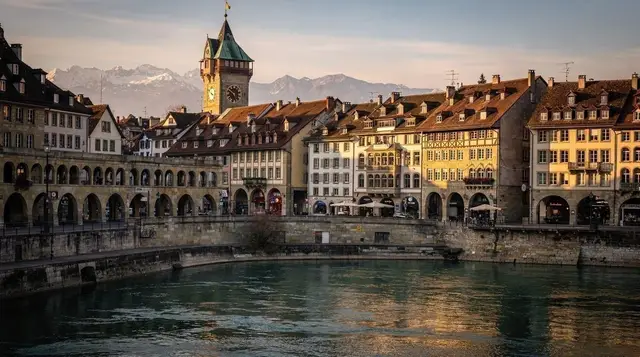
Morning: the old town and the bridges. Start at Kapellbrücke, the covered wooden footbridge with the octagonal Wasserturm, then walk the short loop through the Altstadt to see the painted facades on Hirschenplatz and Weinmarkt. Cross the river again at Spreuerbrücke, the quieter and less crowded of Lucerne’s two historic bridges — most visitors only see Kapellbrücke and miss it. This whole loop takes about 90 minutes at an unhurried pace, less if you’re not stopping for photos.
Late morning: the Lion Monument. A ten-minute walk from the old town, carved into a sandstone cliff face, commemorating the Swiss Guards killed defending Louis XVI in 1792. It’s free and takes ten minutes to see properly. Mark Twain called it the saddest and most moving piece of stone in the world, which is more than the monument itself will tell you if you don’t already know the story — worth reading up on beforehand.
Midday: lunch, away from the water. See the eating section below. Budget 45 minutes to an hour.
Early afternoon: choose one — a lake cruise, a museum, or a mountain. This is the decision point that determines the shape of the rest of your day, and it’s worth being honest about which one you actually have time for.
- A short Lake Lucerne cruise of 1 to 2 hours gives you the paddle-steamer experience and views back at the old town and the surrounding peaks, without committing the whole afternoon.
- The Swiss Museum of Transport is one of the better transport museums in Europe and genuinely needs 2.5 to 3 hours to do justice — it’s a 10-minute walk or a short bus ride from the old town.
- A return trip up Mount Rigi or Mount Pilatus (see below) takes the rest of the day.
Trying to do all three of these in an afternoon is the single most common way people leave Lucerne disappointed — you end up seeing none of them properly. Pick one.
The boat and mountain combo, and whether it’s worth it
Lucerne’s signature outing is combining a lake steamer with one of the mountains on the shoreline — Rigi, Pilatus, or the smaller Stanserhorn. Each has a different time cost.
| Route | Total round trip | Approx. cost (2nd class, no discount) | Verdict |
|---|---|---|---|
| Boat to Vitznau + Rigi cogwheel railway | 4 to 4.5 hours | CHF 80–85 | Best half-day add-on; realistic with a morning old-town visit |
| Boat to Alpnachstad + Pilatus cogwheel railway + cable car (Golden Round Trip) | 5 to 6 hours | CHF 110–118 | Spectacular but leaves almost no time for the old town |
| Cable car to Stanserhorn from Kriens (bus from Lucerne) | 2.5 to 3 hours | CHF 72–78 | Quieter, less crowded than Rigi or Pilatus, good if you’ve already done both |
Mount Rigi is the one to pick if you want a mountain and the old town in the same day. The boat across the lake to Vitznau takes about 50 minutes, the cogwheel railway to the summit another 30, and you’re standing above the cloud line with views to the Bernese Alps on a clear day. Budget the full return trip at 4 to 4.5 hours including summit time, which fits after a morning in the old town if you’re moving efficiently.
a guided Rigi day trip with the lake cruise and cable car included removes the ticket logistics if you’d rather not work out boat and rail timetables on the day.
Mount Pilatus is the more famous of the two, and rightly so — the Golden Round Trip (boat, cogwheel railway, aerial cableway) is one of the more memorable transport experiences in Switzerland. But it’s a five-to-six-hour commitment once you include waiting times, which means choosing Pilatus effectively means giving up the old town for the day, or seeing it only in the early morning before the boat departs. If Pilatus is the priority, treat it as the entire day and skip the “one day, two things” plan.
For something quieter than either, the Cabrio open-top cable car to Stanserhorn sees a fraction of the crowds Rigi and Pilatus get in high season, and the round trip from Lucerne including the connecting bus from Kriens runs closer to three hours — a realistic add-on even in the afternoon.
the Stanserhorn cable car half-day trip is worth considering if Rigi and Pilatus both sound overrun — it’s a genuinely different, calmer alternative on the same lake.
One seasonal note that catches people out: mountain cable cars and cogwheel railways around Lucerne, like elsewhere in Switzerland, close for scheduled maintenance in spring and again in autumn, usually for one to two weeks at a time and not always at the same dates each year. If a Rigi or Pilatus trip is the whole point of your visit, check the operator’s live status before you build the day around it — a maintenance closure is the single most common way a mountain day gets ruined, and it isn’t announced far in advance.
If you’d rather have someone else handle the whole day end to end, including transport from Zurich, a guided day trip to Lucerne and the Bürgenstock ridge covers the old town plus a viewpoint most independent day-trippers never get to, since Bürgenstock requires its own funicular and timing that’s fiddly to arrange solo.
Where to eat in Lucerne
The restaurants directly on Rathausquai and on Kapellbrücke itself charge for the view, not the food — expect CHF 32 to CHF 40 for a main course that would cost CHF 22 to CHF 26 two streets back. A few honest options:
- Two streets back from the river, around Hirschenplatz and Kornmarkt, you’ll find Swiss and Italian places charging closer to CHF 24 to CHF 28 for a main, with far less tourist markup than the waterfront.
- Self-service and casual lakefront options near the Bourbaki Panorama or along Löwenplatz keep lunch to around CHF 18 to CHF 24 without sacrificing the lake view entirely.
- If you want a proper Swiss meal rather than a quick lunch, look for a restaurant serving Lucerne’s own version of Kügelipastete (a veal and mushroom vol-au-vent) rather than the more generic fondue and rösti aimed squarely at day-trippers — fondue is a winter dish and feels slightly performative on a warm afternoon in a lakefront tourist restaurant.
Water is safe straight from the tap everywhere in Lucerne, so there’s no need to buy bottled water — a real saving in a city where a small bottle at a kiosk can run CHF 4 to CHF 5.
What to skip
Lucerne’s souvenir shops along Löwenstrasse selling cuckoo clocks and Swiss Army knives are aimed entirely at cruise-style day-trippers and mark up both items well above what you’d pay at a proper watch or knife retailer elsewhere. If you want a Swiss watch, our Swiss watches buying guide covers where prices are actually competitive.
The Musegg Wall, Lucerne’s medieval city wall with its nine towers, is free to walk and gives good views, but several of the towers are only open seasonally (typically April to November) and close earlier than the rest of the sights. It’s worth 30 to 45 minutes if you’re passing, not a special trip.
Practical notes
Luggage: Lucerne station has lockers if you’re stopping en route to somewhere else rather than returning to Zurich the same night. See our guide to luggage storage if you’re doing this as part of a longer rail loop rather than a there-and-back day trip.
Weather: Lucerne sits at low altitude and rarely gets snow disruption itself, but the mountain excursions above it are weather-dependent — Rigi and Pilatus summits can be in cloud even on a clear day in the city. Check the summit webcam before committing to the mountain half of your day.
Getting around once there: the old town, station, and Lion Monument are all within a 15-minute walk of each other — there’s no need for local transport unless you’re heading to the Swiss Museum of Transport or to Kriens for the Stanserhorn cable car, both reachable by a short bus ride from outside the station.
If you want more than a day: Lucerne anchors Lake Lucerne and sits within easy reach of Engelberg-Titlis and the wider central Switzerland region, so it’s a reasonable base for two or three nights rather than a single day trip if your schedule allows it. For a longer loop, a Zurich day trip to Lucerne with an optional yacht cruise is a slower-paced version of the standard day trip if you’d rather not self-navigate the boat timetables.
If you’re weighing Lucerne against Zurich’s other classic day trips, our day trips from Zurich overview and the Pilatus versus Rigi versus Titlis comparison both help narrow down whether Lucerne is the right pick for the day you have available, and how it stacks up against a direct Zurich versus Lucerne comparison if you’re deciding where to spend more of a longer trip.
For the wider transport logistics, Swiss trains explained and getting around Zurich on the ZVV cover the basics if this is your first rail trip in the country, and our Zurich in one day itinerary is the natural pairing if you’re doing Zurich and Lucerne back to back on a short visit.
Frequently asked questions about a Lucerne day trip
How long is the train from Zurich to Lucerne?
About 45 minutes on the direct InterCity or InterRegio service from Zurich HB, with departures roughly every 30 minutes throughout the day. There’s no need to reserve a seat.
Do I need a Swiss Travel Pass for a Lucerne day trip?
Not just for the train. A standard second-class return from Zurich costs around CHF 44 without a discount card, which is cheaper than a one-day Swiss Travel Pass unless you’re also using it for the mountain railways or a boat cruise the same day.
Is Mount Rigi or Mount Pilatus better as an add-on from Lucerne?
Rigi is the easier half-day add-on: boat or train to Vitznau or Weggis, cogwheel train up, and you’re back in Lucerne by mid-afternoon. Pilatus via the Golden Round Trip (boat plus cogwheel railway plus cable car) is more dramatic but takes closer to five hours round trip, which leaves little time for the old town.
Is the Lion Monument worth seeing?
It’s free, takes ten minutes, and is genuinely moving if you know the story of the Swiss Guards it commemorates. It’s not worth a special detour on its own, but it sits two minutes from the old town so there’s no reason to skip it.
Can I do Lucerne and a mountain in the same day?
You can, but only one mountain and only if you start early. Take the first train after 8am, do the old town in the morning, then a Rigi round trip in the afternoon. Pilatus is too long to combine comfortably with a proper look at the old town.
Where should I eat lunch in Lucerne?
Avoid the restaurants directly on Kapellbrücke and Rathausquai, which charge tourist prices for average food. Walk two streets back into the old town, or eat lakeside near the Bourbaki Panorama, where a main course runs CHF 22 to CHF 28 rather than CHF 35 and up.
What’s the biggest mistake people make on a Lucerne day trip?
Trying to fit in the old town, a mountain, and the Swiss Museum of Transport in one day. Each deserves at least half a day on its own. Pick two of the three at most, or accept that you’ll be rushing through all three without really seeing any of them.
Best day trips from Zurich on GetYourGuide
Verified deep-linked GetYourGuide tours. Book through these links and we earn a small commission at no cost to you.
GetYourGuide does not provide a product photo for this activity — the image shows the meeting point, photographed by us.