Aare Gorge and Giessbach Falls: the Oberland's built waterfalls
What are the Aare Gorge, Reichenbach Falls and Giessbach Falls, and how do I see them from Zurich?
They are three separate sights around Meiringen and Lake Brienz, each reachable from Zurich HB in roughly two hours via Interlaken Ost. The Aareschlucht is a walkway through a limestone gorge, Reichenbach Falls is a funicular-accessed waterfall with a Sherlock Holmes connection, and Giessbach Falls is a cascade beside a historic funicular and hotel on Lake Brienz. Doing all three in one day from Zurich is tight but possible with an early start.
Three waterfalls, one valley, different kinds of visit
The Bernese Oberland around Meiringen and Lake Brienz has three sights built around moving water, and they get lumped together in itineraries more often than they should be. The Aareschlucht is a gorge you walk through on metal and wooden walkways. Reichenbach Falls is a single, dramatic drop reached by a heritage funicular, best known for a fictional death.
Giessbach Falls is a cascade tumbling past a nineteenth-century hotel on the shore of Lake Brienz, reached by boat and its own funicular. None of them takes an entire day on its own, which is exactly why people try to combine two or three and end up rushing all of them. This guide sets out what each one actually involves, what it costs, and how to string them together sensibly from Zurich without wasting half the day on connections.
For context on the wider region, see the guide to the best mountain excursions from Zurich and the overview of day trips from Zurich. This particular trio sits closest to Lake Brienz and Interlaken, rather than to Zurich itself, so realistic planning matters more than usual.
Aareschlucht: the gorge walk at Meiringen
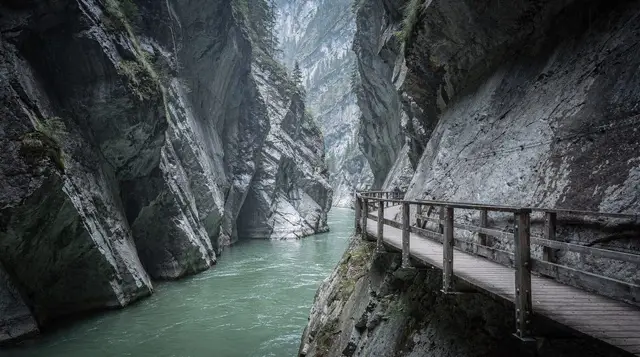
The Aare Gorge (Aareschlucht) is a 1.4 km limestone canyon just outside Meiringen, cut by the river over roughly the last hundred thousand years, though the walkways through it are much more recent, built from the 1880s onward and repeatedly rebuilt since. Boardwalks, metal bridges and short tunnels carry the path along and sometimes through the rock face, a few metres above the water, with the walls closing in to only a few metres apart in places.
Walking the full length takes 45 to 60 minutes at an unhurried pace, longer if you stop often for photographs, since the light inside the gorge changes constantly and the water is a distinctive turquoise-green on a clear day. There are two entrances: the west entrance near Meiringen station, a short walk from the town centre, and the east entrance near Innertkirchen, reachable by postbus. Most day visitors enter at one end and either walk back the same way or arrange transport at the other end.
Adult entry runs around CHF 10, with reduced rates for children, and the gorge is generally open from April to November. It closes over winter because ice on the walkways and rockfall risk make it unsafe, and unlike a cable car this isn’t a lift that can simply run a reduced service in poor conditions. If you’re visiting in April or late October, it’s worth checking the operator’s site the morning of your visit, since opening dates shift slightly year to year with snowmelt and maintenance.
Walkers connect the gorge to a longer route toward Rosenlaui, and hikers already working through the region’s trails may want to cross-check the best hikes near Zurich guide, though this particular stretch is well beyond a Zurich day hike in the strict sense.
Reichenbach Falls and the funicular Conan Doyle used
Reichenbach Falls sits a short walk from Meiringen’s centre, and the easiest way up to the main viewing platform is the Reichenbachfall-Bahn, a funicular built in 1899 that climbs a genuinely steep gradient in a few minutes. A return ticket costs around CHF 12 to 14 for adults; the Half Fare Card typically brings a discount, but this is a privately operated heritage line, not part of the standard SBB network, so don’t assume a Swiss Travel Pass covers it free of charge without checking first.
The falls themselves are the reason Arthur Conan Doyle set the apparent death of Sherlock Holmes here in his 1893 story The Final Problem, after visiting the area on a trip through Switzerland. A memorial plaque near the top marks the spot, and it’s a minor pilgrimage site for readers rather than a major tourist crush, which keeps it pleasant even in summer. The funicular runs seasonally, roughly early May to late October, and like most Swiss mountain lifts can also close briefly in spring or autumn for scheduled maintenance — worth checking before building a shoulder-season day around it specifically.
Combined with the gorge, Reichenbach Falls adds maybe an hour including the funicular ride and time at the platform, and the two sights sit close enough together in Meiringen that doing both in a morning is realistic.
Giessbach Falls: the funicular and the hotel above Lake Brienz
Giessbach Falls is a different kind of visit. The cascade drops in stages down a wooded hillside on the north shore of Lake Brienz, and the classic way to reach it is the passenger boat from Brienz or Interlaken, landing directly below the Giessbachbahn funicular. That funicular, opened in 1879, is one of the oldest still operating in Switzerland, and the short ride up to the Grandhotel Giessbach terrace is worth doing even without a room booked there.
The falls and the surrounding paths are publicly accessible; the funicular is a convenience rather than a requirement, and a return ticket costs somewhere in the region of CHF 5 to 8, occasionally included free with certain lake-boat tickets. Walking up instead is possible on a marked path but adds a genuinely steep 20 to 30 minutes each way. In summer, the falls are floodlit some evenings, which is a reason some visitors choose to stay in Brienz rather than day-trip through quickly.
Getting to Giessbach without a car generally means a train to Brienz followed by the boat crossing, which fits naturally with a wider look at Lake Brienz and Lake Thun boat trips. A car route around the lake exists too, though parking near the hotel is limited and the boat is usually the more relaxed option regardless.
If you’d rather not plan the logistics yourself, a guided option covering Giessbach and nearby Iseltwald removes the boat-timetable juggling: a combined boat-and-funicular tour taking in Iseltwald and the Giessbach Falls runs from the Interlaken area and handles the connections for you.
Getting there from Zurich
All three sights sit beyond Interlaken on or near the Brünig line, which is the main reason a same-day round trip from Zurich takes real planning rather than a casual add-on to another itinerary.
| From Zurich HB | Route | Approx. journey time |
|---|---|---|
| Interlaken Ost | Direct or one change | around 2 h |
| Meiringen (Aareschlucht, Reichenbach Falls) | Via Interlaken Ost, then Brünig line | around 2 h 15–2 h 30 |
| Brienz (for Giessbach by boat) | Via Interlaken Ost | around 2 h |
That means a realistic day trip from Zurich to any one of these sights involves roughly four to five hours of travel alone, out of a day that also needs to include the visit itself and a buffer for missed connections. If you’re combining more than one site, the order matters: Meiringen (gorge and Reichenbach Falls) then back through Brienz for Giessbach on the way home works better than the reverse, since it avoids doubling back past Interlaken Ost twice.
For travellers already holding a Swiss Travel Pass, the SBB legs of this journey are covered; it’s specifically the two heritage funiculars where coverage needs checking case by case. The Swiss Travel Pass guide and the explainer on how Swiss trains actually work are worth reading before buying tickets, and anyone still deciding on a pass at all should see Zurich Card vs Swiss Travel Pass.
When each site is open, and what it costs
| Site | Typical season | Adult price |
|---|---|---|
| Aareschlucht (Aare Gorge) | April–November | around CHF 10 |
| Reichenbach Falls funicular | Early May–late October | around CHF 12–14 return |
| Giessbach Falls funicular | Seasonal, roughly April–October | around CHF 5–8 return |
Prices and dates move slightly year to year, and all three operators publish current figures on their own sites closer to the season, so treat these as planning estimates rather than fixed numbers. None of these are Zurich prices exactly, but they sit in line with the rest of Switzerland’s paid natural attractions: not cheap, but not in the same bracket as a full-day mountain lift ticket at Jungfraujoch or Titlis.
Which one is worth the day, and which to skip
If you only have time for one, the Aareschlucht is the easiest recommendation: it’s inexpensive, doesn’t depend on a funicular running to schedule, and the gorge itself is genuinely distinctive rather than a viewing platform bolted onto a car park. Reichenbach Falls is worth adding on if you’re already in Meiringen and have an extra hour, particularly for anyone with an interest in the Conan Doyle connection, though as a waterfall alone it doesn’t outrank the falls elsewhere in the region.
Giessbach Falls is the one to prioritise if lake scenery matters more to you than the gorge itself, since the boat crossing on Lake Brienz is arguably as much the point as the falls. It’s a poor fit for a rushed itinerary, though, because the boat timetable dictates your schedule far more than a train station does.
Travellers weighing this trio against other Oberland options should also look at Jungfraujoch, the Lauterbrunnen waterfalls, and Grindelwald as alternatives or additions, and anyone building a multi-day plan around the region rather than a single day trip should see the five-day summer Alps itinerary.
Doing it without planning the logistics yourself
For visitors who would rather not manage two train changes and a boat timetable on the same day, several guided options cover this ground directly from the Zurich or Interlaken side. a day trip from Zurich that includes the Aareschlucht and the wider waterfalls valley covers the gorge itself with transport handled end to end, which removes the two-hour-each-way train planning entirely.
For a shorter regional option based out of Interlaken, a morning waterfalls tour through the valleys around Interlaken takes in several cascades in the area without requiring a full day.
Whichever way you arrange it, check the getting around Zurich (ZVV) guide only if you need the city-side connections to the main station — once you’re past Interlaken Ost, you’re on regional Bernese Oberland services rather than Zurich’s own transport network. Anyone travelling with children should also glance at family day trips from Zurich before committing to the Meiringen-plus-Giessbach combination in a single day, since the walking and waiting involved adds up for younger children faster than it does for adults.
Frequently asked questions about the Aare Gorge, Reichenbach Falls and Giessbach Falls
Can I visit the Aare Gorge, Reichenbach Falls and Giessbach Falls in one day from Zurich?
Yes, but it is a full day, not a relaxed one. Count on leaving Zurich HB before 8am, around two hours to Meiringen for the gorge and the falls funicular, then a boat or short drive on to Giessbach, before a train back that arrives in Zurich late evening. Most visitors find two of the three more comfortable than all three.
Is the Aareschlucht gorge walk suitable for children or people with limited mobility?
The path is a mix of boardwalks, metal walkways and short tunnels cut into the rock, with handrails throughout, so most children manage it easily with supervision. It is not step-free: there are uneven sections, some spray from the water, and no wheelchair access along the full 1.4 km length.
Does the Swiss Travel Pass cover the Reichenbach Falls funicular and the Giessbachbahn?
Coverage varies and both are privately run heritage funiculars, so do not assume a blanket free ride. The Half Fare Card typically gets a discount on both; check current terms at the ticket window, since operators change pass arrangements between seasons.
What is the Sherlock Holmes connection at Reichenbach Falls?
Arthur Conan Doyle set the apparent death of Sherlock Holmes at Reichenbach Falls in his 1893 story The Final Problem, after visiting the area himself. A memorial plaque near the upper platform marks the spot, and the funicular that carries visitors up to it dates from 1899.
When do the gorge and the funiculars close for the season?
The Aareschlucht generally closes over winter, roughly from November to March, because ice and rockfall make the walkways unsafe. The Reichenbachfall-Bahn funicular runs from around early May to late October. Both funiculars, like most Swiss mountain lifts, can also close briefly in spring or autumn for scheduled maintenance, so check the operator’s site before a shoulder-season visit.
Is Giessbach Falls worth visiting if I am not staying at the Grandhotel?
Yes. The falls and the viewing paths around them are open to anyone arriving by boat, funicular or on foot, and the terrace in front of the Grandhotel is a public spot to look at the cascade even without a room booked. The funicular ride itself, one of the oldest still working in Switzerland, is a reason to visit in its own right.
How do I get from Brienz to Giessbach Falls?
The most straightforward way is the passenger boat from Brienz pier, a short crossing of Lake Brienz that lands directly below the Giessbachbahn funicular. There is also a road route around the lake for drivers, though the boat is quicker and avoids parking near the hotel.
Hiking & nature tours on GetYourGuide
Verified deep-linked GetYourGuide tours. Book through these links and we earn a small commission at no cost to you.
GetYourGuide does not provide a product photo for this activity — the image shows the meeting point, photographed by us.