Lake Thun and Lake Brienz boat cruises
Should I cruise Lake Thun or Lake Brienz from Interlaken?
Lake Thun has castle-lined shores and the St Beatus Caves, reached by BLS boats from Thun or Interlaken West. Lake Brienz has clearer turquoise water, the Giessbach Falls funicular and the village of Iseltwald, reached from Interlaken Ost. With one day, most visitors choose Brienz for the scenery; with a Swiss Travel Pass, both boats are already covered, so it is worth riding each.
Lake Thun and Lake Brienz sit end to end, separated only by the town of Interlaken, and it is easy to assume they are the same trip. They are not. Thun is the wider, older-money lake, its shores dotted with castles and vineyards; Brienz is the narrower, colder, far more turquoise one, closed in by cliffs and glacier-fed streams. Both are served by proper lake steamers rather than tourist pontoons, both connect directly into the Swiss rail network, and both are an easy add-on to a trip built around Interlaken, Grindelwald or Lauterbrunnen.
Getting there from Zurich
Zurich HB to Interlaken Ost takes around two hours on the direct InterRegio, with a change at Bern or via Lucerne on some services. From Interlaken Ost you are already at the Lake Brienz pier; for Lake Thun, either ride two stops back to Interlaken West or continue to Thun itself, about 20 minutes further. If you are basing yourself in Zurich rather than staying overnight near the lakes, this is a long day out — realistically eight to nine hours door to door once you add boat time, so it suits a fixed itinerary better than a spontaneous half-day.
Anyone building a broader Bernese Oberland trip should read best mountain excursions from Zurich and the general day trips from Zurich overview first, since the lakes are usually paired with a mountain excursion rather than visited alone.
Because the trip depends on trains at both ends, it helps to understand how the Swiss network handles connections before you commit to a tight schedule. Swiss trains explained covers the logic of the timetable, and the blog piece on why Swiss trains run on time explains why a short change at Bern or Interlaken is usually safe. If you would rather not return to the city the same evening, the Zurich 3-day itinerary shows how a lake day can slot between city days without turning the whole trip into a rush.
Lake Thun: castles, caves and slow water
The BLS boat routes
BLS Schiff runs the Lake Thun steamers, calling at Thun, Hilterfingen, Oberhofen, Spiez, Merligen, Beatenbucht and Interlaken West, among smaller stops. The full lake crossing, Thun to Interlaken, takes about two hours fifteen minutes; a shorter hop, such as Interlaken to Spiez, is closer to 55 minutes. Some boats are heritage paddle steamers from the early 1900s, others modern diesel vessels — the timetable tells you which, and the difference matters if you specifically want the older boat.
Thun Castle and the lakeside villages
Thun’s old town is worth the walk up to Schloss Thun (Thun Castle), a 12th-century keep with a small museum and a genuinely good view back down over the rooftops and river. Along the lake, Oberhofen Castle sits almost in the water and is the more photogenic of the two, with gardens open to wander even if you skip the museum inside. Spiez Castle, further round, has vineyards running down to its own small harbour. None of these are essential stops if your day is short, but any one of them turns a boat ride into an actual outing rather than transit.
St Beatus Caves
The St Beatus Caves (Beatushöhlen), reached from the Beatenbucht pier and a short uphill walk, are a limestone cave system with a lit walking trail, a small waterfall at the entrance, and a legend attached to an early Christian hermit. It is a reasonably touristy stop, but a fair one — allow about an hour including the walk from the boat, and note the caves close for the winter, typically November to March.
a guided day trip from Basel that combines Thun’s old town, the caves and a lake cruise in one booking is worth comparing against doing it independently by train and boat — it costs more but removes the timetable-juggling for a one-day visit from further afield.
Choosing a seat and a boat
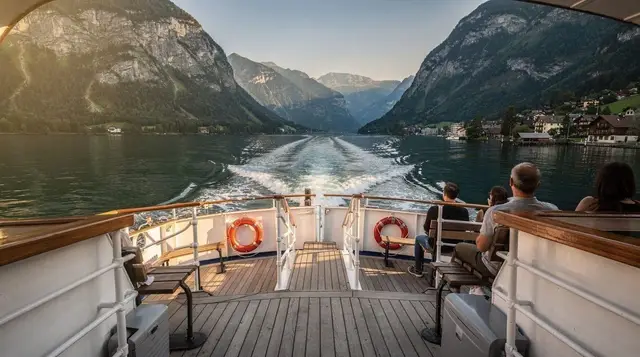
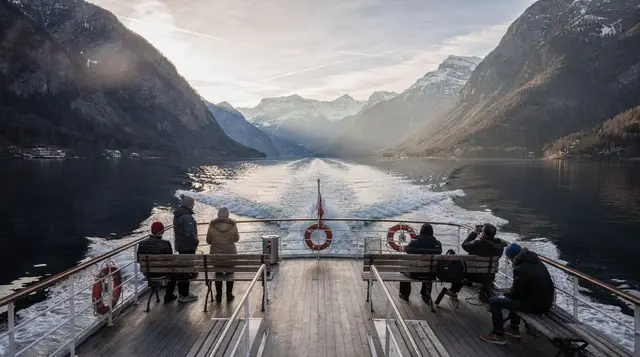
On a clear day the sensible place to sit is outside on the open deck, on the side facing the shore you most want to see; the castles and vineyards are the main entertainment on Lake Thun, so it is worth checking the stop list and picking the side before the boat leaves the pier. Indoor saloons are pleasant when the wind picks up, and on the older steamers the engine room windows are a small attraction in themselves. If the weather turns, the lake is still worth the ride: low cloud on the water gives the shoreline a moody look that sunny photographs rarely capture. For a wider picture of what the area offers beyond the water, the Lake Thun destination page lists the villages along the shore.
Lake Brienz: turquoise water and the Iseltwald effect
Lake Brienz is glacier-fed and noticeably colder and clearer than Lake Thun, which is what gives it that strong turquoise colour on a sunny day. It is also smaller and, in places, busier, largely because of one village.
Giessbach Falls and its funicular
The Giessbach Falls drop in a series of steps almost directly into the lake, and a funicular — one of the oldest still running in Switzerland, dating to 1879 — carries visitors up from the pier to the Grandhotel Giessbach and a network of short trails past the individual cascades. The funicular runs roughly May to October and closes for the rest of the year along with the falls trail’s staffed sections, so this is a summer stop, not a year-round one. Combined with the boat, allow about two hours for the round trip and a walk to the upper falls.
Iseltwald: small village, huge queue
Iseltwald is a genuinely small lakeside village — one pier, one row of chestnut trees, a handful of guesthouses — that became an internet-famous photo spot after appearing in a popular Korean drama. The result is a village built for a few hundred residents now handling coach-loads of day visitors converging on the same short pier for the same photo. It is still worth seeing, especially outside the late-morning and early-afternoon coach window, but go in expecting a queue for the classic shot rather than a quiet fishing village.
a quad-bike tour out to Iseltwald along the lake is one way to see the village on your own schedule rather than the boat’s, at the cost of losing the cruise itself.
Brienz village and wood carving
Brienz, at the eastern end of the lake, is quieter than Iseltwald and known for woodcarving — several workshops in and around the village still sell hand-carved pieces, and the Swiss wood-carving school (Schnitzlerschule) is based here. It also connects to the Rothorn steam railway for anyone extending the day into the mountains rather than back to Interlaken.
Faster on the water
Not everyone wants a slow steamer. a scenic jetboat ride across Lake Brienz trades the leisurely pace of the scheduled boats for speed and spray, and suits visitors who like their sightseeing a little more active. It is a different experience from the regular cruise rather than a replacement for it, so many travellers do the timetabled boat to Giessbach and keep the jetboat for a second visit or a different day. More background on the village and its surroundings is on the Lake Brienz destination page.
Prices, passes and timetables
| Route | Approx. one-way time | Approx. return fare (2nd class) |
|---|---|---|
| Interlaken West–Spiez (Lake Thun) | 55 min | CHF 30–36 |
| Interlaken West–Thun (full lake) | 2 h 15 | CHF 45–55 |
| Interlaken West–St Beatus Caves | 30 min | CHF 24–28 |
| Interlaken Ost–Giessbach | 55 min | CHF 32–38 |
| Interlaken Ost–Iseltwald | 25 min | CHF 20–24 |
| Interlaken Ost–Brienz (full lake) | 1 h 15 | CHF 34–40 |
Fares vary by season and vessel, and the figures above are a general guide rather than a live tariff — check the BLS Schiff website close to your date. A combined Lake Thun-Brienz day pass covering both lakes’ regular boats costs roughly CHF 65 to 75 and is worth it from about three legs onward. The Swiss Travel Pass covers both lakes’ scheduled boats at no extra charge; the Half Fare Card halves the fare rather than making it free. Anyone unsure which pass suits their whole trip should read the dedicated Swiss Travel Pass guide.
a combined Lake Thun and Brienz boat day pass booked in advance avoids queuing at the ticket window at Interlaken on a busy summer morning, which is a real bottleneck in July and August.
Planning a day: three ways to do it
Lake Brienz only, half day. Interlaken Ost to Giessbach, funicular up to the falls, boat back, with a stop at Iseltwald if timing allows. This is the single best-value half-day and needs no car.
Lake Thun only, half day. Interlaken West to Spiez or Thun, a castle visit, boat back via the St Beatus Caves stop. Slower-paced and less crowded than Brienz.
Both lakes, full day. Start early on Brienz (Giessbach, skip Iseltwald or accept the queue), train or walk between Interlaken Ost and West, then a shorter Thun-side leg such as Oberhofen Castle before the last boat back. This works but it is a full day, not a relaxed one, and it leaves no slack for weather delays or a missed connection.
Anyone spending several days in the region rather than a single day trip should look at the Zurich summer Alps 5-day itinerary, which spreads the lakes, Oeschinensee and a mountain excursion across separate days instead of compressing them into one.
What to bring and how to pace the day
Pack for changeable weather even in summer: a light waterproof layer, sunglasses for the glare off the water and comfortable shoes for the walks up from the piers to the castles, the caves and the falls. Food on board is limited, so a picnic bought in town works well, and the lakeside villages have plenty of places to sit down for a meal if you plan a longer stop. Keep the day loose enough to absorb a late boat or a slow queue; the lakes reward people who linger rather than people who tick off every pier.
Rail-heavy travellers will find the Swiss Travel Pass versus Half Fare comparison useful for deciding whether the boats justify a pass at all, and anyone weighing this trip against other mountain days can compare it with the Jungfraujoch guide and the Lauterbrunnen waterfalls guide. For families, the Zurich with kids guide has general advice that applies equally to a boat day, and Lake Lucerne boat trips is the natural comparison if you are deciding between lake regions.
Common mistakes
Booking a Lake Thun boat when the plan was actually Lake Brienz, or vice versa, happens more often than you would think, since both depart near Interlaken and both timetables look similar at a glance — double-check the pier (West for Thun, Ost for Brienz) before buying. Arriving at Iseltwald between 11am and 2pm and expecting an empty pier is another one. And travelling outside May to September without checking which boats and funiculars are actually running is a third — the shoulder-season timetable on both lakes is noticeably thinner, and the Giessbach funicular in particular shuts down completely over winter.
For excursions further into the mountains above these two lakes, Adelboden and Kandersteg and the wider things to do: lakes and cruises category cover routes that combine well with a Thun or Brienz boat day, and Zurich in summer has broader seasonal notes if the lakes are one stop in a longer trip.
a private day trip running between Lucerne and Interlaken that takes in Lake Thun suits travellers based in Lucerne rather than Zurich who want both lakes without managing the train connections themselves.
Lake Thun and Lake Brienz cruises: frequently asked questions
How much does a Lake Thun or Lake Brienz cruise cost?
A short return hop, such as Interlaken to Spiez on Lake Thun or Interlaken to Giessbach on Lake Brienz, runs roughly CHF 30 to 45 second class return. A full-lake round trip costs more, and the combined Lake Thun-Brienz day pass is priced around CHF 65 to 75, which pays for itself after two or three legs.
Is the boat covered by the Swiss Travel Pass or Half Fare Card?
The Swiss Travel Pass covers both lakes’ boats at no extra cost, the same as it covers CFF trains. The Half Fare Card gives 50% off boat fares rather than free travel. Neither the Zürich Card nor the ZVV network extends this far, since both lakes sit outside greater Zurich.
What is the best one-day cruise from Interlaken?
Interlaken to Giessbach Falls and back on Lake Brienz is the single best value trip: around an hour each way, a funicular ride included at the pier, and a waterfall view most people only see from a train window. Add Iseltwald on the way back if you do not mind queuing for the photo stop.
Why is Iseltwald so crowded?
A single pier and a row of chestnut trees at Iseltwald became known worldwide after appearing in a Korean drama, and the village now gets more day-trip traffic than its narrow lanes and one car park were built for. Coach groups tend to arrive late morning; the first or last boat of the day avoids most of them.
When do the Lake Thun and Brienz boats stop running for winter?
Both lakes run a reduced timetable roughly from late October to late March, with some routes suspended entirely and the Giessbach funicular closed. Check the BLS Schiff timetable before travelling outside May to September, since the full network of stops only runs in summer.
Can I combine both lakes in a single day?
Yes, using Interlaken as the hinge: Interlaken West serves Lake Thun boats, Interlaken Ost serves Lake Brienz boats, and the two stations are a 20-minute walk or a short train ride apart. A realistic combined day means one shorter leg on each lake rather than a full circuit of both.
Lake cruises & boat tours on GetYourGuide
Verified deep-linked GetYourGuide tours. Book through these links and we earn a small commission at no cost to you.
GetYourGuide does not provide a product photo for this activity — the image shows the meeting point, photographed by us.