Bad Ragaz and the Tamina Gorge
What is there to see in Bad Ragaz and the Tamina Gorge?
Bad Ragaz is built around a thermal spring that monks from Pfäfers Abbey first tapped inside the Tamina Gorge in the 12th century. You can walk into the gorge to the ruins of that original bathhouse, then soak in the same water at the modern Tamina Therme in the village or at the five-star Grand Resort Bad Ragaz.
Bad Ragaz is a small spa town in the canton of St Gallen, part of the wider Heidiland and Walensee region, and it exists entirely because of one thing: a warm spring that rises inside a narrow limestone gorge above the village. The story of how that water went from an inaccessible crack in the rock to a five-star hotel complex is unusually well documented, and it’s more interesting than most spa-town backstories, mostly because the original bathhouse involved lowering people into the gorge on ropes.
Where Bad Ragaz’s hot water actually comes from
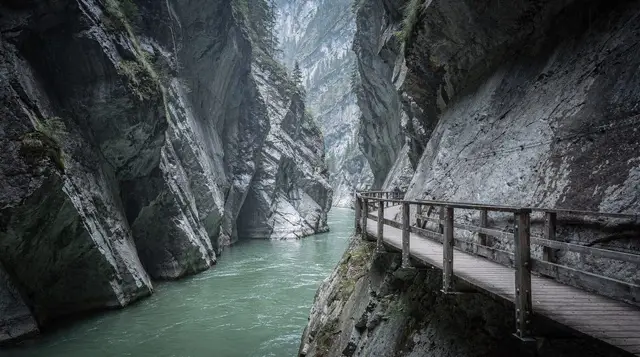
The spring sits inside the Tamina Gorge (Taminaschlucht), a narrow cleft cut by the Tamina stream through the limestone above Bad Ragaz. The water emerges at a fairly constant 36.5°C, having been warmed deep underground before rising back to the surface through the fault line that also carved the gorge. It’s mineral-rich but low in sulphur, which is why it’s historically been marketed as gentle rather than pungent, unlike some other Alpine thermal sources.
Monks from the Benedictine abbey at Pfäfers, on the plateau above the gorge, are recorded as having found the spring in the early 12th century. What they found wasn’t a convenient pool at ground level. The water rises from a point deep inside the gorge walls, reachable only by climbing down the cliff face itself, which set the terms for how the spring was used for the next seven hundred years.
The old bath at Pfäfers, lowered into the rock
The monastery built its bathhouse directly against the gorge wall next to the spring, and for centuries the only way in was to be lowered down the cliff on a rope, sitting in a basket or a sling, with the roar of the Tamina below. Patients stayed at the abbey and were brought down for treatment, sometimes for weeks at a stretch, an arrangement that reads less like a spa holiday and more like an ordeal prescribed by a physician. Later renovations added ladders and, eventually, walkways, but the basic problem never went away: the water was in a place people were not.
That original bathhouse building, known locally as the Alte Badi, survives today as ruins visible from the gorge path. It’s a genuinely striking sight, a stone structure wedged into the rock face with the stream running past it, and it’s worth pausing at rather than walking straight past on the way to somewhere else. Information panels along the walkway explain the rope-and-basket system in more detail, with old engravings showing just how exposed the whole operation was.
Walking into the Tamina Gorge today
The gorge itself is now the easiest part of the whole story. A wooden boardwalk, bolted to the rock in places, follows the stream from an entrance point a short walk from Bad Ragaz up to the old bathhouse ruins and a little beyond. The walk is flat, takes around an hour there and back at an unhurried pace, and is free to enter, which makes it one of the better free things to do in this part of Switzerland if you’re already in the area for the spa.
The path narrows considerably in the gorge’s tightest sections, with rock on one side and a drop to the stream on the other, so it isn’t the place for a pushchair or a wheelchair despite the otherwise level surface. It’s also not a hiking-boots-required walk, though grippy shoes help, since parts of the boardwalk stay damp even in dry weather. If you’re building a longer hiking day around it, the gorge pairs naturally with routes covered in the wider guide to the best hikes near Zurich, several of which start from towns within easy reach of Bad Ragaz.
One practical note: the gorge path can close temporarily after heavy rain or rockfall, since the walkway sits directly against an active rock face. It’s worth checking locally on the day if you’ve had a wet few days beforehand, rather than assuming it’s always open.
From gorge to village: the pipeline and Bad Ragaz’s spa boom
For most of the spring’s history, bathing meant going up to the gorge, not down to the village. That changed in 1840, when a wooden pipeline was built to carry the water roughly four kilometres down from the gorge to Bad Ragaz, replacing the older, shorter pipe that had connected the spring to Pfäfers Abbey itself. Once the water reached the valley floor, the village had what it needed to build proper bathing infrastructure without asking guests to be lowered down a cliff first.
The Grand Hotel Quellenhof opened soon afterwards, and Bad Ragaz grew through the 19th century into the kind of formal spa town that appears in old European sanatorium literature, complete with promenades, a casino and a clientele that included European nobility. That hotel eventually grew into today’s Grand Resort Bad Ragaz, still drawing on the same Tamina spring, now delivered by modern pipeline rather than wooden trough.
Where to actually soak: Tamina Therme vs Grand Resort Bad Ragaz
Two very different options exist in the village today, and which one makes sense depends on budget and how you want to spend the day.
| Tamina Therme | Grand Resort Bad Ragaz | |
|---|---|---|
| Type | Public thermal bath | Five-star hotel spa complex |
| Typical price | Around CHF 35-40 for a few hours | Day spa access from roughly CHF 90-120, hotel guests separate |
| Atmosphere | Family-friendly, local crowd | Formal, wellness-clinic style |
| Booking | Walk-in, busier at weekends | Advance booking strongly recommended |
| Extras | Saunas, some outdoor pools | Medical spa, golf course, fine dining |
Tamina Therme is the sensible choice for most day-trippers: it’s the same spring water, a fraction of the price, and there’s no need to book ahead outside peak weekends. The Grand Resort is a different proposition altogether, closer to a medical wellness retreat than a swimming pool, and its pricing reflects that. If you’ve already tried Zurich’s own hot-water option, it’s worth comparing notes with the guide to the Hürlimannbad thermal spa, and the broader roundup of thermal baths near Zurich puts Bad Ragaz alongside the other options in the region.
Getting from Zurich to Bad Ragaz
Trains run roughly hourly from Zurich HB, either direct or with a change at Sargans, and the journey takes about an hour and a quarter. It’s a straightforward SBB route with no reservations needed, and if the details of ticketing feel unfamiliar, the guide to how Swiss trains work covers the basics before you set off. Anyone already holding a Swiss Travel Pass can use it for the whole journey at no extra cost, which makes Bad Ragaz an easy add-on to a pass-based itinerary rather than a trip that needs separate tickets bought.
From Bad Ragaz station, the Tamina Gorge entrance is a walk of about 20-25 minutes, or a short hop on the local postbus if you’d rather save your legs for the gorge itself.
Making a day of it: what else is nearby
Bad Ragaz sits at a genuinely useful junction for extending the day. Heidi’s fictional village of Maienfeld is a short distance away, and a private day trip from Zurich covering both is a reasonable way to combine the gorge with something more obviously aimed at families:
If caves are more your thing than cliffside bathhouses, a guided trip that pairs the Tamina Gorge with the Hölloch cave system runs directly from Zurich by train, which removes the need to plan connections yourself:
For a longer regional loop, Chur is Switzerland’s oldest town and only a short hop further along the same rail line, while St Gallen and Appenzell sit within reach for anyone building a two- or three-destination day. Some tours package several of these together, including one that runs from Bad Ragaz through Chur, Davos and St Moritz in a single private day:
a private day trip taking in Bad Ragaz alongside Chur, Davos and St Moritz.
Liechtenstein is also close enough to fold into the same region, and a private tour covering the wider Appenzell-Liechtenstein-Heidiland triangle is worth considering if you’d rather not self-drive between borders:
a private tour covering Appenzell, Liechtenstein and the wider Heidiland region.
Families weighing up whether Bad Ragaz fits into a broader trip can check the general roundup of family day trips from Zurich, and anyone still deciding between destinations for that day might also compare it against the Rhine Falls, which sits in the opposite direction from Zurich and suits a very different kind of day out. The general day trips from Zurich overview lines up Bad Ragaz alongside the rest of the region’s options if you’re still choosing.
Practical tips and mistakes to avoid
Switzerland is expensive, and Bad Ragaz doesn’t buck that trend: a coffee in the village costs what a coffee costs everywhere else in the country, and spa entry, food and transport add up quickly across a full day out. If cost is a concern, the guide to Zurich travel costs and the tips in Zurich on a budget apply just as well to day trips as they do to the city itself, and choosing Tamina Therme over the Grand Resort’s day-spa rate is the single biggest saving available here.
A few other things worth knowing before you go. The gorge path can close after heavy rain, so don’t build a trip around it without a fallback if the weather’s been poor. Weekends at Tamina Therme get busy with local families, so arriving early in the day avoids the longest queues. And the Grand Resort’s day-spa slots are limited and frequently booked out well in advance, particularly on weekends, so it’s not somewhere to turn up on spec expecting a space. Bring or buy a swim cap if required for certain pools, as some Swiss thermal baths still enforce this rule more strictly than visitors expect.
Frequently asked questions about Bad Ragaz and the Tamina Gorge
Can you still bathe in the Tamina Gorge itself?
No. The spring inside the gorge is fenced off and the original bathhouse is a ruin you can only view from the walkway. The water is piped down to Bad Ragaz village, where you bathe at Tamina Therme or the Grand Resort Bad Ragaz instead.
How long is the walk into the Tamina Gorge?
The main gorge path from the entrance near Bad Ragaz to the old bathhouse ruins and back takes around an hour at a gentle pace. It’s flat and mostly on a wooden boardwalk, though the rock walls close in narrowly in places.
What’s the difference between Tamina Therme and Grand Resort Bad Ragaz?
Tamina Therme is the public thermal bath in the village, open to anyone for a few hours at a time and priced like a normal Swiss swimming pool with hot springs. The Grand Resort Bad Ragaz is a five-star hotel complex with its own thermal areas, medical wellness clinic and golf course, and its day-spa access costs several times more.
How do you get from Zurich to Bad Ragaz?
Direct or one-change SBB trains run roughly hourly from Zurich HB to Bad Ragaz, taking around an hour and a quarter. The Tamina Gorge entrance is then a short walk or a few minutes on the local postbus from Bad Ragaz station.
Is the Tamina Gorge walk suitable for children or wheelchairs?
It suits most children fine, since the path is flat and short, but it isn’t wheelchair or pushchair friendly in its narrower sections, where the boardwalk is squeezed between rock and water. Sturdy footwear is worth it, since parts of the walkway can be damp.
Is Bad Ragaz worth it as a day trip, or better as an overnight stay?
A day trip covers the gorge walk and a few hours at Tamina Therme comfortably. An overnight stay only makes sense if you want to book time at the Grand Resort Bad Ragaz’s medical spa or golf course, both of which reward a slower pace and a higher budget.
Hiking & nature tours on GetYourGuide
Verified deep-linked GetYourGuide tours. Book through these links and we earn a small commission at no cost to you.
GetYourGuide does not provide a product photo for this activity — the image shows the meeting point, photographed by us.