Thermal baths near Zurich: Hürlimannbad, Baden, Bad Ragaz, Rigi and Leukerbad
Which thermal baths near Zurich are worth visiting?
Hürlimannbad in Zurich itself has a rooftop pool and needs no train. For a proper day trip, Bad Ragaz (just over an hour) and Rigi Kaltbad (with a mountain view) are the best value. Baden is closer but expensive for what it offers, and Leukerbad is the furthest but the biggest and warmest option.
Five soaks, five very different price tags
Switzerland does thermal water well, and Zurich sits within reach of five places that use it properly: a rooftop pool inside the city, a historic spa town, a mineral-rich valley resort, a mountain-top pool with alpine views, and the biggest thermal complex in the Alps. None of them are cheap. Entry runs from around CHF 30 for two hours to over CHF 100 for a full spa day, and the trip itself ranges from a ten-minute tram ride to a three-hour train-and-bus combination. This guide sets out what each one actually costs, how long it takes to get there, and which is worth the money for the time you have.
| Bath | Where | Journey from Zurich HB | Typical entry (2–3 hrs) |
|---|---|---|---|
| Hürlimannbad & Spa | Zurich, Enge district | 15 min by tram | CHF 39 (weekday) / CHF 49 (weekend) |
| Baden thermal baths | Baden, Aargau | 17 min by train | CHF 90–110 (day pass) |
| Bad Ragaz – Tamina Therme | Bad Ragaz, St Gallen | 1 h 05 by train | CHF 39–46 |
| Rigi Kaltbad – Mineralbad & Spa | Mount Rigi | 1 h 40–2 h with cable car | CHF 28–34 |
| Leukerbad – Walliser Alpentherme / Burgerbad | Leukerbad, Valais | 2 h 40–3 h with postbus | CHF 26–39 |
Prices move year to year and by season, so treat these as a starting point and check the operator’s own site before you book a specific date.
Hürlimannbad & Spa: the rooftop pool in Zurich itself
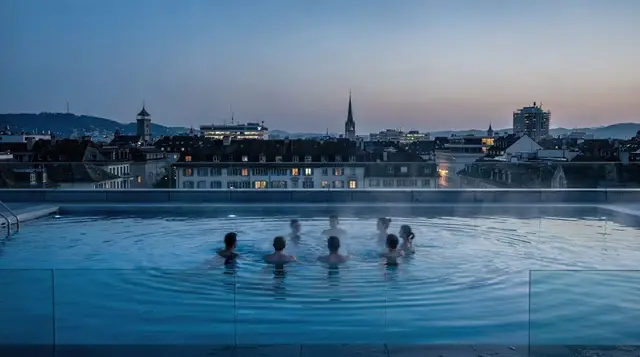
Hürlimannbad sits in a converted brewery in the Zurich district of Enge, a short tram ride from the old town. Its selling point is the outdoor rooftop pool, warmed year-round, with a view over rooftops towards the lake and hills — genuinely pleasant at dusk in winter with steam rising off the water. Indoors there is a Roman-Irish bath sequence, several saunas at different temperatures, and a relaxation area, but the whole wellness floor is modest in size and fills up quickly.
Entry for two hours costs around CHF 39 on weekdays and CHF 49 at weekends; a day ticket costs more and is only worth it if you plan to stay four hours or longer. Bathrobe and towel rental adds CHF 12–15 on top. Because there is no train involved, this is the easiest of the five to fit into an evening — pair it with dinner nearby rather than trying to combine it with sightseeing in the same afternoon, since the changing rooms and sauna sequence take longer than you expect.
Booking a timed slot online is worth doing on Friday and Saturday evenings, when walk-ins are sometimes turned away. If you are staying in the city and want a taste of the Swiss spa culture without committing to a train journey, this is the practical choice — just don’t expect it to compete with the mountain or valley options on scenery once you’re indoors.
Baden: the original Swiss spa town, at a price to match
Baden, in the canton covered by Aargau and Solothurn, has been a bathing town since Roman times, and its thermal water still feeds a cluster of modern spa hotels along the river Limmat. The trouble is the price: a day pass at Baden’s main thermal complex typically runs CHF 90–110, which puts it well above Bad Ragaz or Rigi Kaltbad for a comparable few hours in the water. You are paying for the hotel-spa polish — robes, multiple pool levels, a wider sauna landscape — rather than for anything the water itself does that the other four don’t.
The train from Zurich HB takes 17 minutes, which makes Baden the fastest genuine day-trip bath on this list, and the old town along the river is worth an hour’s walk either side of your spa visit. But if budget matters, this is the one to skip or downgrade to a shorter visit — the two-hour rate, where offered, is a noticeably better deal than the full day pass. Families in particular tend to find better value at Bad Ragaz or Leukerbad, where the outdoor pools have more room to spread out.
Bad Ragaz: Tamina Therme and the gorge behind it
Bad Ragaz is roughly an hour and five minutes from Zurich HB by direct train, and its Tamina Therme draws water from the Tamina Gorge, a narrow limestone canyon a short walk from the resort. The pool complex itself is straightforward — indoor and outdoor thermal pools linked by a swim-through, a sauna area, and a separate section for children — with none of Baden’s hotel-spa styling but a noticeably fairer price. Two and a half hours cost around CHF 39 on weekdays and CHF 46 at weekends; a day pass adds roughly CHF 15–20 more.
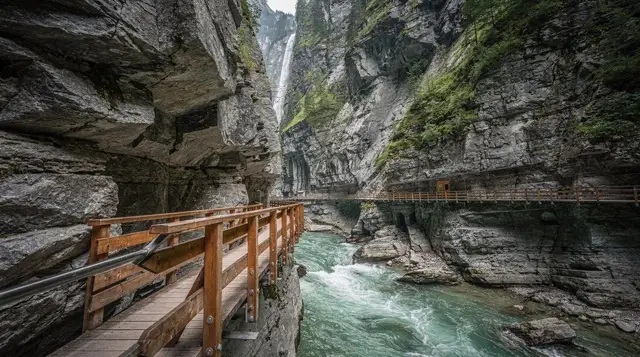
What makes Bad Ragaz worth the full day rather than a quick soak is the gorge walk itself: a wooden walkway bolted into the cliff face leads back into the canyon where the thermal spring rises, and it’s free to walk if you skip the therme, or a natural add-on if you go before or after your bath. Combine the two and you get a half-day of scenery for the price of the pool ticket alone.
Bad Ragaz also works as a base for reaching further into the mountains. If you’d rather have someone else handle the driving and route between valley towns, a private day tour from Bad Ragaz through Chur, Davos and St Moritz covers ground that would otherwise take a full day of separate trains and buses to string together — worth considering if you’re combining the bath with a wider look at Davos and Klosters or the St Moritz and Engadine area on the same trip.
Rigi Kaltbad: a mountain-top soak with a view
Rigi Kaltbad is the only bath on this list where the scenery is the whole point. Reached by cable car from Weggis or the cogwheel railway from Vitznau or Arth-Goldau, Mount Rigi sits at roughly 1,450 metres, and its Mineralbad & Spa has an outdoor pool positioned to look straight out over Lake Lucerne and the surrounding peaks. Entry for two hours costs around CHF 28–34, cheaper than Baden or a Hürlimannbad weekend rate, though you’re also paying separately for the cable car or train up the mountain, which adds roughly CHF 40–60 return depending on where you join it.
The full journey from Zurich HB takes 1 hour 40 minutes to 2 hours depending on the route, so this is a proper day trip rather than an after-work outing. It also comes with the caveat that applies to every mountain excursion from Zurich: the cable cars and cogwheel lines that serve Rigi close for scheduled maintenance for roughly one to two weeks in spring and again in autumn, and this is what ruins more visits than bad weather does. Check the Rigi Bahnen timetable for your travel dates before you commit, particularly in April, May, November or early December.
If the plan is to fold Rigi Kaltbad into a wider look at central Switzerland — Lucerne, the lake, and a bath at the end of the day — this is a natural way to close out a day trip rather than the whole point of it. It is the pick on this list for anyone who wants the pool experience to include a view worth photographing, not just a soak.
Leukerbad: the Valais giant, and the furthest worthwhile trip
Leukerbad, in the canton of Valais, holds the largest volume of thermal water in the Alps and two separate public bath complexes: the Walliser Alpentherme & Spa, aimed at adults and quieter, and the Burgerbad, larger, family-oriented, and with more outdoor pool space and slides. Two hours at either costs roughly CHF 26–29; a full day at the Alpentherme runs to about CHF 39. Given how much pool space you get, it’s the best value per hour on this list — if you can justify the journey.
That journey is the catch. There is no train station in Leukerbad itself: the route from Zurich HB runs by train to Visp or Leuk, then a postbus climbs into the valley, adding 20 to 40 minutes on top of a rail journey that already takes roughly 2 hours 15 minutes to 2 hours 30 minutes. All told, budget 2 hours 40 minutes to 3 hours each way. That makes Leukerbad a poor fit for a half-day plan and a genuinely good one for a full day, or better still, an overnight — the town has enough hotels built around the baths that staying over removes the pressure of a last train back.
Because Valais is also where Zermatt and the higher Alps sit, some travellers use Leukerbad as one stop on a longer swing through the region rather than a dedicated round trip from Zurich. If a soak after dark under the stars sounds better than a daytime pool, Zermatt’s private night spa experience is a different kind of evening entirely — a private night spa session in Zermatt — worth knowing about if your itinerary already has you that far south.
Booking, towels and the small print
A few practical points apply across all five:
- Swimwear: normal swimsuits and trunks are expected everywhere on this list; none of these are naturist facilities, unlike some traditional Central European spas.
- Towels and robes: renting one costs CHF 8–15 at each venue. Bringing your own saves money and avoids queuing at busy times, particularly at Baden and Leukerbad on weekends.
- Lockers: most use electronic wristband systems that also charge any food or drink to your visit, settled on the way out — keep the wristband on at all times.
- Sauna etiquette: mixed-gender, no swimsuits, in most Swiss saunas (as opposed to the pools themselves) — signage at each venue makes local rules clear, and it’s worth reading before undressing.
- Getting there: for the four out-of-town baths, check how the ZVV network connects to national trains and whether a Swiss Travel Pass or Half Fare Card saves you money over single tickets — this matters more on the Bad Ragaz and Leukerbad routes than on the short Baden hop. If you already hold a Zürich Card, check whether it extends any discount at Hürlimannbad specifically, since coverage varies by season.
- Timing: Swiss trains run close to schedule, so connections with tight margins for the Rigi cogwheel train or the Leukerbad postbus are generally reliable — but build in a 15–20 minute buffer on the way there so a bath booking with a fixed entry time doesn’t get missed over a delayed connecting train.
If you’d rather not manage trains, cable cars and postbus timings yourself, especially in winter when connections can be affected by snow, a guided day trip removes the logistics. A nature-focused wellness day in Crans-Montana is a Valais alternative worth comparing against Leukerbad if you want mountain air and a slower pace rather than a large pool complex specifically.
Thermal baths near Zurich: your questions answered
Is Hürlimannbad worth it if I only have one evening in Zurich?
Yes for the rooftop pool and the view over the city, less so for the wellness area, which is small and often busy. Two hours is enough; book the timed entry slot online in advance, especially on weekends.
Which is cheaper, Bad Ragaz or Leukerbad?
Bad Ragaz’s Tamina Therme is cheaper for a two to three hour visit, around CHF 39 to 46. Leukerbad’s Walliser Alpentherme and Burgerbad cost less per hour if you stay a full day, but the train and bus journey there takes at least twice as long.
Do I need to bring my own towel and swimsuit?
Bring your own swimsuit everywhere; trunks-only or nudity rules do not apply in these public thermal baths. Towels and bathrobes can usually be rented for CHF 8 to 15, but it is cheaper to bring your own, especially at Baden and Leukerbad where rental queues build up.
Can I do a thermal bath as a day trip from Zurich without a car?
Bad Ragaz, Baden and Rigi Kaltbad are all straightforward by train, with Rigi Kaltbad needing a cogwheel train or cable car connection at the end. Leukerbad has no station of its own; you take the train to Leuk or Visp and then a postbus, which adds 20 to 40 minutes each way.
Are the mountain baths open all year?
Rigi Kaltbad’s Mineralbad & Spa stays open year-round, but the cable cars and cogwheel trains that reach it can close for scheduled maintenance for one to two weeks in spring and again in autumn. Check the Rigi Bahnen timetable before booking a specific date.
Do I need to book in advance?
Hürlimannbad and Bad Ragaz’s Tamina Therme both sell timed online tickets that sell out on weekends and public holidays. Rigi Kaltbad and Leukerbad are more flexible with walk-ins on weekdays, but weekend afternoons get busy at all five.
Which thermal bath is best for families with children?
Leukerbad’s Burgerbad has the most pool space and shallow areas for children, and Bad Ragaz’s outdoor pool is gentle for families. Hürlimannbad’s rooftop pool and Rigi Kaltbad’s spa are quieter, adults-oriented spaces with fewer child-friendly facilities.
Wellness & spa experiences on GetYourGuide
Verified deep-linked GetYourGuide tours. Book through these links and we earn a small commission at no cost to you.
GetYourGuide does not provide a product photo for this activity — the image shows the meeting point, photographed by us.