What makes Bern different from Zurich
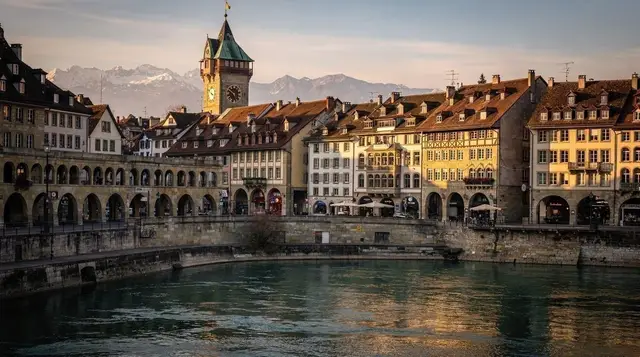
Bern has been Switzerland’s federal capital since 1848, but it looks nothing like a modern seat of government. The old town sits on a tight loop of the River Aare, built almost entirely from the same grey-green sandstone, and it has changed so little since the 15th century that UNESCO listed the whole peninsula as a World Heritage Site in 1983. Where Zurich trades on banking and lake promenades, Bern trades on arcades, fountains and a slower pace. It is also, unusually for a capital city, a place where people swim to work in summer — office workers float down the Aare in the current on their lunch break, a habit locals treat as entirely unremarkable.
For anyone based in Zurich, Bern is one of the easiest day trips on the map: a direct train, no transfers, and an old town small enough to cover on foot without a map.
Getting there from Zurich
Trains from Zurich HB to Bern run every half hour on the direct line and take close to an hour. There is no faster or cheaper way to make the trip, and driving gains nothing — Bern’s old town is largely car-free and parking near the centre is expensive.
| Option | Journey time | Typical one-way price | Notes |
|---|---|---|---|
| Direct train, 2nd class | 56–66 min | CHF 51 full fare | Half Fare Card cuts this to about CHF 26 |
| Direct train, 1st class | 56–66 min | CHF 87 full fare | Quieter, wider seats, same speed |
| Swiss Travel Pass | 56–66 min | Included | Also covers city transport and many museums |
| Driving | 1h to 1h20 depending on traffic | Fuel plus tolls | Old town parking from CHF 3–4/hour |
A Swiss Travel Pass makes sense if Bern is one stop on a wider rail itinerary; for a single trip, buying a point-to-point ticket with a Half Fare Card is usually cheaper. Anyone unsure how the ticketing system fits together should read our guide to how Swiss trains work before buying anything at the machine — Bern’s own station can be confusing at peak times because it also serves regional and long-distance platforms on the same concourse.
The old town and its six kilometres of arcades
Bern’s defining feature is not any single building but the Lauben — covered stone arcades that run along both sides of the main shopping streets (Spitalgasse, Marktgasse, Kramgasse, Gerechtigkeitsgasse) for roughly six kilometres in total. They were built into the ground floors of the houses from the 15th century onward, partly for fire safety, and the effect today is that most of the old town can be walked in the rain or under summer sun without ever stepping into it. Shops, cafés and the occasional cellar bar occupy the arcaded frontages; the upper floors are still largely lived in, which keeps the centre from feeling like an open-air museum.
Kramgasse is the prettiest stretch, lined with painted fountains from the 1540s depicting figures from Bernese legend and history — the Zähringer Fountain, the Samson Fountain, the Ogre Fountain eating children, which sounds worse than it is meant to be. Albert Einstein lived at Kramgasse 49 while working at the Bern patent office and developing special relativity; the flat is now a small museum (Einsteinhaus), modest and easy to miss, entry around CHF 8.
The Zytglogge
The Zytglogge is Bern’s medieval clock tower and the most photographed thing in the city, partly because it is genuinely striking and partly because every tour group stops beneath it four minutes before the hour. An astronomical clock face shows the time, date, zodiac sign and moon phase, and a small mechanical parade of bears, a rooster and a jester performs briefly before each hour strikes. It is worth seeing once and not worth waiting twenty minutes for a second time — the show lasts under a minute and looks much like it did the first time.
Guided tower tours (in German, with other languages by arrangement) climb the internal clockwork mechanism and run a few times daily for around CHF 20; they need booking in advance at the tourist office rather than turning up on spec, and the stairs are narrow and unsuitable for anyone with mobility concerns.
Bern Minster
Bern Minster (Berner Münster) is the tallest cathedral in Switzerland, a late-Gothic sandstone building finished in stages between 1421 and 1893. The main portal’s tympanum, a carved Last Judgement scene with a genuinely unsettling depiction of hell, survived the 1528 Reformation iconoclasm that stripped most of the interior bare — worth stopping to look at closely before going in.
Climbing the tower is the better reason to visit: 312 steps to a platform above the bells with a view over the old town’s roofs, the Aare loop and, on a clear day, the Bernese Alps on the horizon. Entry to the tower costs around CHF 6, cash only at the till inside, and it closes for lunch and on Sundays before services — check the noticeboard by the entrance rather than assuming it is open.
The Bear Pit
The Bärengraben (Bear Pit) sits just across the Nydeggbrücke bridge from the old town, on the far bank of the Aare. Bern’s coat of arms and its name both derive from bears — legend says the city’s founder named it after the first animal he killed while hunting nearby — and live bears have been kept here in some form since the 1850s. The old stone pit was replaced in 2009 by a larger, more naturalistic riverside enclosure (BärenPark) with access to the Aare itself, after years of criticism that the original pit was too small and bare for the animals.
It is worth being honest about this stop: it is free, easy to reach, and the bears (usually two or three, depending on the year) are genuinely there, but the enclosure is still modest by the standards of a proper wildlife park, and animal welfare groups continue to raise concerns about space and stimulation. Visitors uneasy about captive animals may prefer to skip it and spend the time on the Rose Garden instead, a five-minute walk uphill with a free panoramic view over the old town that rivals anything the bear pit offers.
Swimming in the turquoise Aare
This is the thing about Bern that photographs undersell: the Aare genuinely runs a bright glacial turquoise, and between roughly May and September, locals swim in it in numbers. The classic spot is the Marzili area below the Parliament building, where a riverside lawn, changing rooms and a heated outdoor pool (Marzili Bad, entry a few francs) sit right on the water.
Swimmers walk upstream, get in, and let the current carry them back down — the Aare moves fast, faster than it looks from the bank, and every summer it catches out people who underestimate it. Locals treat it casually because they know the exit points; visitors should not assume the same confidence, should never swim after heavy rain when the current picks up further, and should get out well before any weir or bridge support.
For a gentler comparison, our piece on swimming in the Limmat covers Zurich’s own version of the same habit — the Aare in Bern is colder and faster, not a like-for-like swap. Anyone who would rather be on the water than in it can book a guided rafting trip down the Aare from Zurich, which covers a longer stretch of river with safety gear and a guide doing the current-reading for you.
Zentrum Paul Klee
A twenty-minute bus ride (line 12 from the station) east of the centre, the Zentrum Paul Klee is a striking building by Renzo Piano — three glass-and-steel waves set into a green hillside — holding the largest collection of Paul Klee’s work anywhere, around 4,000 pieces rotated through temporary exhibitions since the permanent collection is too large to show at once. Entry runs about CHF 20, less with a Swiss Travel Pass or museum discount card, and it closes on Mondays. It is a genuine detour from the old-town core and only worth the trip for visitors with a real interest in Klee or 20th-century art; casual sightseers on a tight day should skip it in favour of the free viewpoints closer to the centre.
Viewpoints and a quieter alternative: the Gurten
Beyond the Rose Garden, Bern’s other well-known viewpoint is the Gurten, a forested hill on the southern edge of the city reached by a short funicular (around CHF 8 return) from Wabern station, itself a few minutes by tram from the centre. The summit has walking trails, a small restaurant, a children’s railway in summer, and a view back over the city and, on clear days, south to the Alps.
It is a good half-day add-on for anyone staying past the core sights, and works well as a picnic stop. Travellers who would rather have the logistics handled can book a guided outing to the Gurten’s viewing platform, slide and a Swiss cheese picnic rather than working out bus and funicular connections alone.
Where to eat
Bern is not a cheap city to eat in, and it does not pretend otherwise. A sit-down lunch of Bernese rösti with a fried egg and bacon typically runs CHF 24–32; a full plate of Bernese Platte (a cured-meat and sauerkraut classic) at a traditional Beizli can reach CHF 38–45. Bakeries along the arcades sell decent sandwiches and pastries from CHF 8–12, which is the realistic budget option for lunch rather than a sit-down restaurant. The covered arcades mean there is always somewhere dry to eat regardless of weather, which is more than can be said for cities without them.
| Meal type | Typical price (CHF) |
|---|---|
| Bakery sandwich or pastry | 8–12 |
| Café lunch (soup, salad) | 18–25 |
| Rösti with egg and bacon | 24–32 |
| Bernese Platte, sit-down restaurant | 38–45 |
| Coffee, standing at a café counter | 4.50–5.50 |
A realistic one-day plan
- Morning: arrive by train, walk the arcades from the station down Spitalgasse and Marktgasse to the Zytglogge, then on to Kramgasse for the fountains and the Einsteinhaus.
- Midday: climb Bern Minster’s tower before it closes for lunch, then eat in or near the arcades.
- Afternoon: cross the Nydeggbrücke to the Bear Pit or skip straight to the Rose Garden viewpoint above it; in summer, head down to Marzili to swim or at least watch the current.
- Late afternoon: either the Zentrum Paul Klee by bus for art, or the Gurten funicular for a hillside view, depending on interest and remaining energy.
- Evening: train back to Zurich — the last useful direct departure for a same-day return is usually well after 10pm, but check the timetable rather than assuming.
Travellers who prefer not to plan the logistics themselves can join a private guided day trip to Bern with cheese tasting, which runs from Basel and covers the old town with a guide handling the walking route and timing.
Beyond Bern
Bern’s own hinterland is well placed for further excursions, and travellers with more than a day sometimes base themselves here rather than in Zurich. Gruyères, with its own hilltop castle and cheese dairy, is under two hours away by regional train and connecting bus. Lucerne and Interlaken are both reachable within an hour to ninety minutes, making Bern a plausible midpoint for a wider Bernese Oberland loop rather than a strict there-and-back from Zurich. Basel sits under an hour to the northwest on the same main line, which is why several Bern day tours are run from there rather than Zurich.
For evenings with clear skies, the Gantrisch nature park south of the city is one of the few officially recognised dark-sky reserves in Switzerland, and a guided night hike and stargazing session in the Gantrisch dark-sky reserve is a genuinely different way to end a Bern visit for anyone staying past sunset rather than catching the last direct train back.
Practical notes
- Money: Switzerland uses the Swiss franc (CHF); euros are sometimes accepted in tourist-facing spots at a poor rate, so it is not worth relying on them.
- Opening hours: many old-town shops close on Sundays; museums generally close on Mondays — check specific opening times before building a day around one.
- Left luggage: Bern’s main station has lockers if arriving with bags before a same-day return, similar in setup to those covered in our Zurich luggage guide.
- Mobility: the old town’s arcades have level stone floors, but many of the connecting lanes down to the Aare are steep or stepped, and cobbles throughout the centre are uneven.
- Combining trips: Bern pairs awkwardly with a same-day Jungfraujoch or Zermatt run — both are long trips in their own right — but works well alongside a rail-only Switzerland itinerary or a slower multi-day Zurich stay with Bern as one of several day trips from Zurich.
Bern day trip questions
Is Bern worth visiting if I’ve already seen Zurich’s old town?
Yes — Bern’s old town is larger, more architecturally uniform, and UNESCO-listed, and the arcades are a genuinely different way of experiencing a historic centre. The two cities complement rather than duplicate each other.
How much does a day trip to Bern from Zurich cost?
Budget roughly CHF 50–60 return on the train with a Half Fare Card, plus CHF 40–70 for food and any museum or tower entries — call it CHF 90–150 per person for a full day without booking a guided tour.
Can I swim in the Aare as a day visitor?
Yes, and it is one of the better reasons to time a visit for summer. Bring a swimsuit and a dry bag or waterproof pouch, use the Marzili area’s marked entry and exit points, and never swim after heavy rain or high water — the current is genuinely strong.
Do I need to book the Zytglogge tower tour in advance?
Yes. Tours run only a few times a day, are limited in group size because of the narrow internal stairs, and are usually arranged through the Bern tourist office rather than sold on the spot.
Is one day enough to see Bern properly?
For the old town, Zytglogge, cathedral and Bear Pit, yes. Adding the Zentrum Paul Klee or a proper afternoon by the Aare stretches it into a fuller day, and a second day allows a side trip to the Gurten or Gantrisch.
Is Bern more expensive than Zurich?
Broadly similar, and both rank among Europe’s most expensive cities. Restaurant meals in Bern’s old town run comparably to central Zurich; self-catering from bakeries and supermarkets narrows the gap considerably.
What’s the best time of year to visit Bern?
May to September for river swimming and long evenings on the Gurten; the old town, cathedral and museums are equally accessible in winter, when the arcades come into their own for keeping dry in the rain or snow.