Chapel Bridge is the postcard, not the whole story
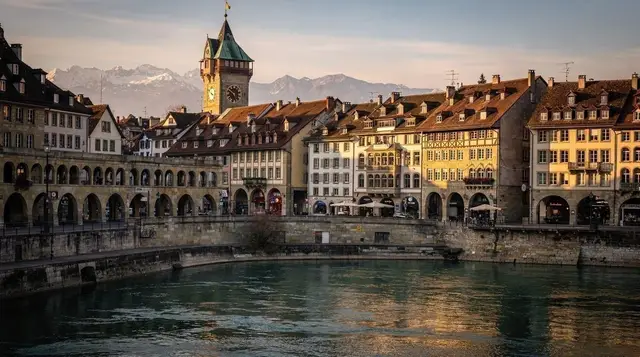
Chapel Bridge (Kapellbrücke) is the wooden, roofed footbridge that appears on every photograph of Lucerne, and it is genuinely worth the two minutes it takes to cross. Built in 1333 and largely rebuilt after a 1993 fire, it angles across the Reuss where the river leaves the lake, with the octagonal Water Tower (Wasserturm) sitting beside it on its own pier. Neither charges admission. The triangular panels under the roof carry 17th-century paintings of Lucerne’s history and its patron saints — most are copies of originals lost in the fire, but they still reward a slow walk rather than a photo-stop dash across.
The bridge gets crowded between 10am and 4pm in summer, when tour groups from the Rigi and Pilatus boats funnel through. Crossing before 9am or after 6pm gives an almost empty bridge and better light for photos. The Water Tower itself is not open to the public; it was once a prison and archive, and today functions as a Lucerne Pistol Club clubhouse, which is a stranger fact than most guidebooks mention.
For a fuller route through the surrounding streets, the old town walking guide covers Zurich’s equivalent circuit if you are comparing the two cities’ historic cores before deciding how to split your days.
The Lion Monument earns its reputation
The Lion of Lucerne (Löwendenkmal) sits in a former sandstone quarry a 15-minute walk northeast of the old town, and it is one of the few “famous monuments” that holds up once you are standing in front of it. Carved directly into the rock face in 1821, it shows a dying lion pierced by a spear, commemorating the Swiss Guards killed defending the Tuileries Palace in Paris in 1792. Mark Twain called it the most mournful piece of stone in the world, and the scale — the lion itself is over six metres long — makes that reaction understandable rather than overstated.
Entry is free and the site is never closed, though it is more atmospheric early or late when the tour buses have not yet arrived or have already gone. The small reflecting pool in front adds to the effect; skip the adjacent Glacier Garden museum unless you have a specific interest in Ice Age geology, since the CHF 18 entry buys a fairly modest collection for the price.
The Musegg Wall gives Lucerne’s best free view
Above the old town, the Musegg Wall (Museggmauer) is the surviving stretch of Lucerne’s 14th-century fortifications, with nine towers still standing. Three of the towers — Männliturm, Zytturm and Wachtturm — are open to climb, free of charge, typically from April to early November (the wall closes over winter; check current dates before planning a visit outside summer). The walk along the ramparts between towers takes 30–45 minutes and gives a rooftop-level view over the old town’s red roofs to the lake and the mountains beyond, without paying for a single attraction.
The Zytturm clock tower has the oldest working clock face in the city and, unusually, is allowed to strike the hour a full minute before every other clock in Lucerne — a historic privilege nobody has bothered to correct.
Swiss Museum of Transport: worth a half-day, not a quick stop
The Swiss Museum of Transport (Verkehrshaus der Schweiz) sits on the lakeshore a short walk or one stop by bus from the centre, and it is the largest museum in Switzerland by visitor numbers. Full adult entry is around CHF 35, which covers the transport halls, an aviation section with real aircraft, a planetarium, and the separate Swiss Chocolate Adventure ride housed in the same complex. Families with children under about 12 tend to get the most out of it; the hands-on exhibits and full-size locomotives hold attention far longer than a typical museum visit.
Budget three to four hours if you want to see the whole site properly, which makes it a poor fit for a tight one-day itinerary that also includes Chapel Bridge, the Lion Monument and a mountain trip. It works better as the focus of an afternoon on its own, or as a wet-weather alternative when cloud rules out Rigi or Pilatus.
KKL Lucerne: architecture and acoustics, not just concerts
The Culture and Convention Centre Lucerne (KKL), designed by Jean Nouvel and finished in 2000, sits directly opposite the train station on the lake. Its cantilevered steel roof extends nearly 45 metres beyond the building itself, and the roof edge is worth walking under even if you are not attending anything inside. The concert hall is regarded as one of the best acoustic spaces in Europe and hosts the Lucerne Festival each summer (mid-August to mid-September), when ticket prices and hotel rates both climb noticeably.
Outside festival season, the building’s art museum, the Kunstmuseum Luzern, occupies the top floor and is a reasonable option on a rainy afternoon, with entry around CHF 15–20 depending on the current exhibition.
Using Lucerne as a base for the mountains
Lucerne’s real advantage over a straight Zurich day trip is that three mountain excursions and the lake itself are all reachable directly from the town, without a return to Zurich in between.
| Excursion | Getting there from Lucerne | Round-trip time needed |
|---|---|---|
| Mount Rigi | Train to Vitznau or Arth-Goldau, then cogwheel train | Half day |
| Mount Pilatus | Boat to Alpnachstad, then cogwheel railway (summer) | Full day |
| Lake Lucerne cruise | Boats depart from the pier by the station | 1–4 hours depending on route |
| Engelberg / Titlis | Direct train, around 45 minutes each way | Full day |
a guided round trip up the Rigi from Lucerne handles the train, boat and cogwheel connections as one ticketed itinerary, which removes the timetable-matching that trips up a lot of independent visitors on their first attempt. For the steeper, more dramatic ascent, a scenic railway tour up Mount Pilatus covers the boat crossing and the cogwheel train in one booking.
Both mountains close their summit lines for scheduled maintenance in spring and again in late autumn — this is the single most common reason day trips from Lucerne go wrong, since the mountain itself looks fine from the valley while the lift sits closed. Always check the current operating calendar on the operator’s own site before building a day around either summit, particularly outside June to September.
The lake itself is worth time on its own terms, not just as transport to a mountain. a private boat cruise on Lake Lucerne is one way to see the shoreline villages and the Bürgenstock cliffs without fitting around a scheduled timetable. For visitors coming from Zurich who would rather not manage the connections themselves, a day trip to Lucerne from Zurich with an optional yacht cruise bundles the return train with a lake segment.
For the full comparison of which mountain suits which traveller, see the Pilatus versus Rigi versus Titlis guide, and for a Rigi-specific walkthrough, the Mount Rigi guide and the Mount Pilatus guide cover ticket options and timings in more detail than fits here.
Getting to Lucerne from Zurich
Direct trains run from Zurich HB roughly every 30 minutes and take 45 minutes, arriving at Lucerne’s station on the lakeshore, a five-minute walk from Chapel Bridge. There is no need to book ahead or reserve a seat. If you are flying in, the Zurich airport to city centre guide covers the connection into Zurich HB, from which Lucerne trains depart from the same station.
A standard second-class point-to-point ticket costs around CHF 27 return with a Half Fare Card, or roughly CHF 54 without one. Anyone planning several excursions during their trip should compare this against a multi-day pass before buying single tickets each time; the Swiss Travel Pass guide and the Zürich Card versus Swiss Travel Pass comparison both break down where each pass pays for itself.
What a day in Lucerne actually costs
| Item | Typical cost (CHF) |
|---|---|
| Return train from Zurich | 27–54 |
| Coffee and pastry | 8–10 |
| Restaurant lunch | 25–35 |
| Swiss Museum of Transport entry | 35 |
| Rigi round trip (train, cable car, cogwheel) | 80–100 |
| Pilatus round trip (boat and cogwheel railway) | 90–110 |
| One-hour lake cruise | 35–45 |
These are rack-rate prices without a Swiss Travel Pass or Half Fare Card; both cut the mountain and boat figures substantially, which is where they usually justify their cost over a short trip.
Where the old town rewards slow walking
Beyond the headline sights, Lucerne’s old town on the north bank of the Reuss is small enough to wander without a map. The Weinmarkt and Kornmarkt squares are lined with painted facades, many dating from the 16th and 17th centuries, and the covered Spreuerbrücke — Lucerne’s other historic bridge, less photographed than Chapel Bridge but equally old — carries its own cycle of Dance of Death paintings under its roof. It sees a fraction of the foot traffic, which makes it a better choice if the crowds on Chapel Bridge have become tiresome.
For anyone treating Lucerne as one stop within a broader Central Switzerland itinerary rather than a single day, the day trips from Zurich guide and the Lucerne day trip guide both set out how to sequence it against Rigi, Pilatus and the Engelberg–Titlis area without doubling back on the same trains. The how many days in Zurich guide is also useful if Lucerne is competing for time against Zurich’s own sights rather than being an obvious add-on.
Frequently asked questions about visiting Lucerne
Is Lucerne worth visiting as a day trip from Zurich?
Yes, and it is one of the easiest day trips from Zurich. The direct train takes 45 minutes, and the old town, Chapel Bridge and lakefront are all within a 10-minute walk of the station, so there is no wasted travel time once you arrive.
How long does the train from Zurich to Lucerne take?
45 minutes on the direct InterRegio service from Zurich HB, departing roughly every half hour. There are no reservations to make; any valid ticket or pass covers the ride.
Is Chapel Bridge free to visit?
Yes. Chapel Bridge (Kapellbrücke) and the Water Tower next to it are open to walk across at any time, free of charge. The painted roof panels inside the bridge can also be viewed without paying anything.
Should I visit Rigi or Pilatus from Lucerne?
Rigi is gentler and better for families or anyone short on time, reached by cogwheel train and cable car with a full loop possible in half a day. Pilatus has the steeper, more dramatic cogwheel railway and suits a full day, ideally combined with the boat crossing from Lucerne.
Is the Swiss Museum of Transport worth the entry fee?
For most visitors, yes, particularly with children or a general interest in trains and aviation. Full adult entry is around CHF 35, which is steep for a single museum, but it easily fills three to four hours and includes a planetarium and the Swiss Chocolate Adventure inside the same building.
Is Lucerne expensive?
It is expensive by most standards, though slightly less so than Zurich for food. A basic restaurant meal runs CHF 25–35, a coffee CHF 4.50–5.50, and a half-day mountain excursion with cable car or cogwheel train typically costs CHF 60–100 return.
Do I need the Swiss Travel Pass to visit Lucerne from Zurich?
Not for the train itself, which is inexpensive on a point-to-point ticket. The pass earns its cost mainly on the mountain excursions and lake boats, which are otherwise paid separately and add up quickly if you visit more than one.