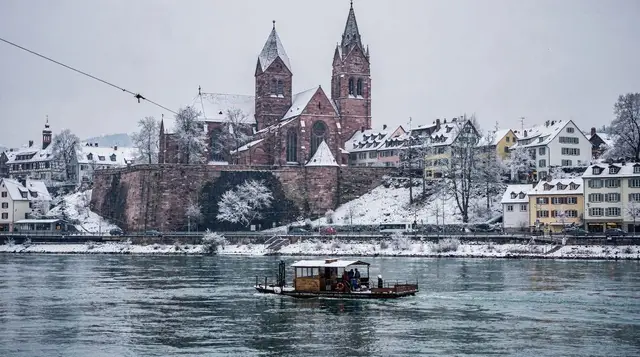
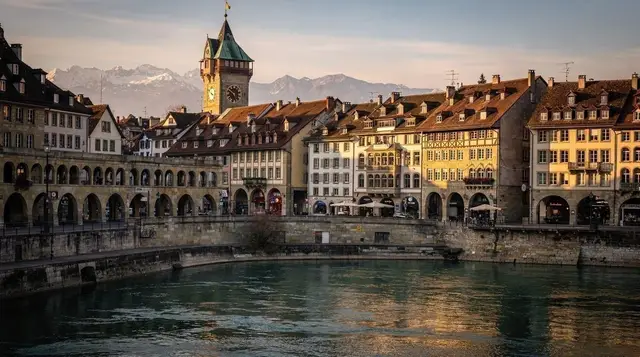
Basel doesn’t try to be Zurich. There’s no lake promenade, no Bahnhofstrasse of watch boutiques, and the nightlife is quieter. What Basel has instead is one of the highest concentrations of serious art museums in Europe, a compact old town built from red sandstone rather than grey stone, and a river you’re actually meant to swim in. It’s an hour from Zurich by direct train, which makes it one of the easiest destinations in this guide to justify — you don’t need to plan around it, you just need a free day.
What makes Basel worth the trip
Basel sits where Switzerland, France and Germany meet, on a bend of the Rhine that’s wide enough for cargo barges but calm enough for swimmers. The city has used its wealth — chemical and pharmaceutical industry money, mostly — to build and endow an unusual number of museums for a place of only around 180,000 people. That’s the draw for most visitors, and it’s also where this guide focuses: the Fondation Beyeler, the Kunstmuseum, the Museum Tinguely, and the old town and river that sit between them.
It is not a cheap city. Basel runs close to Zurich on restaurant and hotel prices, and museum tickets add up fast if you’re doing more than one. Budget accordingly rather than assuming a “smaller city” discount that doesn’t exist here.
Getting there from Zurich
| From | Journey | Frequency |
|---|---|---|
| Zurich HB | ~55 min direct to Basel SBB | Every 30 min |
| Zurich Airport | ~1 hr direct to Basel SBB | Every 30–60 min |
| Basel SBB to old town | 10 min on tram 1, 8, 14 or 15 | Every few minutes |
Basel actually has three train stations — Basel SBB (Swiss side), Basel Bad Bf (German side, across the river), and Basel SNCF (French side, inside the SBB building) — but nearly everyone arriving from Zurich lands at Basel SBB. It’s a Swiss Travel Pass and Half Fare Card route like any other; see the Swiss Travel Pass guide if you’re deciding which pass covers your trip, and how Swiss trains work if this is your first time on the SBB network.
The three museums the trip is built around
Fondation Beyeler
In Riehen, a tram ride north of the centre (tram 6 to Fondation Beyeler, about 20 minutes from the old town), this is the museum most people come to Basel specifically for. The Renzo Piano building sits in a park with a lily pond that nods deliberately to Monet, and the permanent collection runs through Monet, Cézanne, Picasso, Giacometti and Rothko. Adult entry is around CHF 35, more for special exhibitions. Go in the morning if you can — the light in the garden is better and the crowds are thinner.
Kunstmuseum Basel
The Kunstmuseum, in the old town, is Switzerland’s oldest public art collection and one of its largest, split across the main building and a newer wing across the street, connected by an underground passage. Holbein, Witz and other Northern Renaissance work form the historic core; the collection then runs forward through the 19th and 20th centuries. Adult entry is around CHF 26, and it easily takes two to three hours if you’re not rushing.
Museum Tinguely
On the Rhine east of the centre, this museum is built entirely around Jean Tinguely, the Fribourg-born sculptor known for kinetic scrap-metal machines that move, clatter and sometimes spray water at visitors. It’s less conventionally beautiful than the other two and more genuinely fun — worth the detour even if you don’t think of yourself as a modern art person. Entry is around CHF 18.
| Museum | Entry (adult) | Time needed | Location |
|---|---|---|---|
| Fondation Beyeler | ~CHF 35 | 2–3 hrs | Riehen, tram 6 |
| Kunstmuseum Basel | ~CHF 26 | 2–3 hrs | Old town |
| Museum Tinguely | ~CHF 18 | 1–1.5 hrs | Rhine, east side |
Doing all three in one day is possible but tight, and it turns Basel into a museum sprint rather than a city visit. If you only have a day, pick two and leave time to actually walk the old town. For comparison against Zurich’s own collection, see the Kunsthaus Zurich guide or the broader Zurich museums guide.
The red old town
Basel’s Altstadt is built largely from red sandstone quarried in the region, which gives it a distinctly warmer colour than Zurich’s or Bern’s old towns. The Marktplatz is the obvious starting point, dominated by the Basel Rathaus — a town hall with a painted red facade and an inner courtyard covered in murals, free to walk into during the day.
From there, the streets climb gently toward Basel Münster, the sandstone cathedral overlooking the Rhine from the Pfalz terrace. The cathedral itself is free to enter; climbing the tower costs a few francs and gives a proper view over the river bend and the rooftops. The Pfalz terrace next to it is free, always open, and arguably the best vantage point in the city — worth the short detour even if you skip the tower.
Spalentor, one of the old city gates, survives at the western edge of the old town and is one of the better-preserved medieval gates in Switzerland. It’s a ten-minute walk from the Münster and easy to fold into a walking loop.
Crossing the Rhine on the Fähri
Basel’s four historic cable ferries — locally the Fähri — are one of the more distinctive things about the city and cost almost nothing to experience. Each is a small wooden boat attached to a cable strung across the Rhine, using only the current to pull itself from bank to bank; there’s no motor. Ferrymen (Fährimaa) steer using the angle of the boat against the cable. A crossing costs around CHF 1.80, paid into a box on board, and takes about two minutes.
The four crossings — Vogel Gryff, Ueli, Wilde Maa and Leu — are spread along the river through the centre, and riding at least one is a natural way to see both banks of the old town without a long walk around. They’re not a novelty built for visitors; locals use them daily as a shortcut.
Swimming in the Rhine
From June to September, swimming in the Rhine is a normal part of Basel life, not a tourist activity. The current is strong enough that swimmers drift with it rather than swim laps — the standard approach is to walk upstream along the bank, get in, and let the current carry you back down past the old town, sometimes towed by a Wickelfisch, a waterproof dry-bag shaped like a fish that Baslers use to keep their clothes dry while they swim. You can buy one at the tourist office or a sports shop for around CHF 25.
This is worth planning around if you’re visiting in summer — it’s genuinely one of the best free things to do in the city, and unlike a museum it can’t be moved indoors if you run out of time. Check the current before getting in; Basel publishes real-time Rhine conditions, and swimming isn’t recommended when the water is running unusually high or fast after heavy rain upstream.
How much time to give it
One focused day covers two museums and a loop of the old town, including a Fähri crossing. It’s a long day and you’ll be moving the whole time. Two days is more comfortable: split the museums across both, add the Rhine swim if it’s summer, and leave room for slower meals rather than eating standing up between sights.
| Time available | What fits |
|---|---|
| Half day | Old town, Münster, one Fähri crossing, one museum |
| Full day | Two museums, old town walk, Fähri crossing |
| Two days | All three museums, old town, Rhine swim, slower pace |
If Basel is one stop on a longer Switzerland trip, our how many days in Zurich guide and the 3-day Zurich itinerary both cover how to slot a Basel day into a wider plan without overloading it.
Where Basel fits with other day trips
Basel is one of the more distant day-trip options from Zurich on the rail network — closer than Zermatt or Lugano, but further than Lucerne. If you’re comparing it against other options, our day trips from Zurich guide lays out the full list, and the dedicated Basel day trip guide covers logistics for doing it in a single day from Zurich specifically.
Basel is also a genuine gateway rather than an endpoint. The Rhine Falls sit roughly on the way if you’re coming from the Zurich side (see the Rhine Falls guide and the Rhine Falls day trip guide), and the German border is a short tram ride from the centre — the Black Forest is within reach for those extending into Germany, with more detail in the Black Forest day trip guide.
Bern and the Aargau and Solothurn region also sit within this part of Switzerland, and Bern makes a reasonable second stop if you’re touring the region rather than doing a single out-and-back from Zurich.
For travellers who want to see more of the wider area beyond Basel itself, a few tours run from the city:
a small-group day trip to Mount Pilatus and Lake Lucerne covers ground that isn’t realistic to reach independently in a day from Basel, and a private walking tour of Bern’s old town is worth considering if you’re combining the two cities. Closer to Basel itself, a brewery museum and beer tasting in nearby Rheinfelden fills a half day for visitors interested in Switzerland’s brewing history rather than another art museum. There’s also a combined Zurich and chocolate-tasting day tour for those based in Basel who want to see Zurich the other way round.
Practical notes
Basel uses the same CHF 230V/Type J setup as the rest of Switzerland, and tap water is drinkable throughout the city, including from the public fountains in the old town. Trams and buses run on the BVB network; single tickets and day passes are sold at machines on the platforms, and Swiss Travel Pass holders travel free on the local network within the city. If you’re arriving from outside Switzerland, check the entry rules in the Switzerland visa and ETIAS guide before you book. Emergency number is 112, as everywhere in Switzerland.
Basel’s Art Basel fair, held each June, pushes hotel prices sharply higher and makes last-minute rooms hard to find — worth checking the dates before booking if you’re visiting that month for reasons unrelated to the fair.
Basel FAQ
How do I get from Zurich to Basel by train?
Direct trains run from Zurich HB to Basel SBB roughly every 30 minutes and take about 55 minutes. From Zurich Airport, the journey is closer to an hour, also direct in most cases. Standard SBB fares apply, and the route is covered by the Swiss Travel Pass and Half Fare Card.
How much does it cost to visit Basel’s museums?
Expect around CHF 35 for the Fondation Beyeler, CHF 26 for the Kunstmuseum, and CHF 18 for the Museum Tinguely, all for standard adult entry. Special exhibitions can add to the Fondation Beyeler price. Visiting all three in one day means budgeting close to CHF 80 on entry fees alone.
Can you swim in the Rhine in Basel?
Yes, from around June to September, when the water is warm enough and the current is at a manageable level. Locals swim by entering upstream and drifting with the current back through the city centre, often using a Wickelfisch dry-bag to keep clothes dry. Check the current published Rhine conditions before getting in, especially after heavy rain.
What are the Rhine ferries (Fähri) in Basel?
They’re four small cable-guided boats — Vogel Gryff, Ueli, Wilde Maa and Leu — that cross the Rhine using only the river’s current, with no engine. A crossing costs around CHF 1.80, takes about two minutes, and is a normal part of daily transport for Basel residents, not a tourist ride.
Is one day enough for Basel, or should I stay overnight?
One day is enough to see two museums and walk the old town, but it’s a full day with little slack. Staying overnight, or giving it two days, allows time for all three major museums plus the Rhine swim in summer without rushing between stops.
Is Basel expensive compared to Zurich?
Basel runs close to Zurich on hotel and restaurant prices, so budget on a similar scale — this guide suggests CHF 150 to 220 per person per day. It is not a cheaper alternative to Zurich, though museum-heavy days can be planned around a fixed, predictable entry cost rather than open-ended spending.
What is the best time of year to visit Basel?
May to September covers both the Fondation Beyeler garden at its best and the Rhine swimming season. November to March works well for a museum-focused visit without river swimming, and with smaller crowds at the major collections. Avoid booking accommodation around the June Art Basel fair unless you’re attending it, since prices rise sharply that week.
Do I need a museum pass in Basel?
Not necessarily. With only three major museums covered in this guide, paying individual entry is usually simpler and not much more expensive than a combined pass, unless you’re planning to visit several smaller museums as well. Check current pass options against your planned itinerary before assuming it saves money.