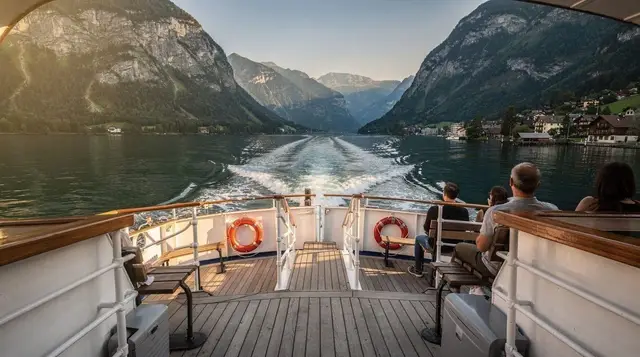
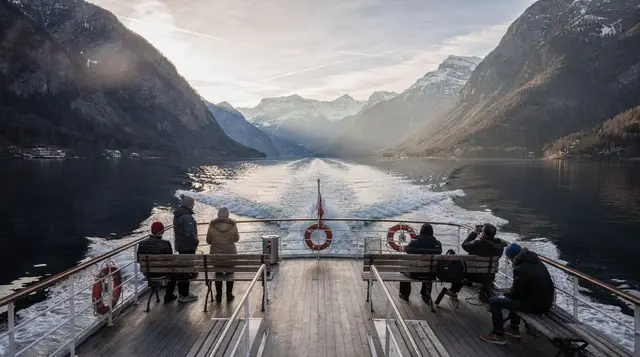
Lake Lucerne boat trips: routes, steamers and mountain combos
What is the best boat trip on Lake Lucerne?
The classic run is Lucerne to Vitznau or Weggis, both starting points for the Rigi cogwheel railway, taking around an hour by boat. For a longer day, the Lucerne–Flüelen crossing covers the whole lake in roughly 3 hours and passes the Rütli meadow. Historic paddle steamers cover some but not all departures, mainly from April to October.
Why the lake is worth a full morning, not a photo stop
Lake Lucerne, the Vierwaldstättersee, is not one straight sheet of water but three arms meeting at odd angles, which is why the boat routes zigzag rather than run in a line. From Lucerne the lake bends south-east towards Vitznau and Weggis under the Rigi, then narrows into the Urnersee, the arm that carries on to Flüelen and Altdorf. That geography is the whole reason boats matter here more than in most Swiss lake towns: several of the lake’s best access points, including the Rütli meadow, have no road at all, and the boat is not a scenic extra but the actual way in.
The company running almost everything on the water is SGV, the Schifffahrtsgesellschaft des Vierwaldstättersees, whose boats leave from the pier directly in front of Lucerne’s railway station. Nothing needs booking days ahead for a standard sailing; you buy a ticket, or show a pass, and walk on. The planning question that actually matters is which of the five or six regular routes suits the day you have, and whether you catch one of the paddle steamers or a modern boat.
Paddle steamers versus the modern fleet
SGV operates five historic paddle steamers — DS Schiller, DS Gallia, DS Unterwalden, DS Stadt Luzern and DS Uri — alongside a larger fleet of diesel-electric motor vessels. The steamers date from between 1901 and 1928, still run on their original engines, and are the reason people photograph the boats rather than just ride them: brass fittings, a visible engine room on some routes, and a slower, more deliberate crossing than the modern boats.
The catch is that steamers are assigned to specific sailings, not to the whole timetable, and mostly between April and October. Check the departure board or the SGV timetable for the little steamer icon next to a sailing; if it is not there, that crossing is a standard motor vessel. Both cover the same routes and both are covered by the same tickets and passes, so there is no need to chase a steamer specifically unless the boat itself is the point of the day.
Lucerne to Vitznau and Weggis, for the Rigi
This is the most-used route on the lake, because Vitznau and, a little further round, Weggis are the two lakeside starting points for the Rigi cogwheel railways. The sailing from Lucerne to Vitznau takes about 40 minutes on a direct boat, a little more if it stops at Weggis, Hertenstein or Küssnacht first. Boats run roughly hourly through the day in the main season, less often in winter.
Combined with the train up from Vitznau, or the cable car from Weggis, this is the standard “Golden Round Trip to Rigi”: boat one way, mountain railway up, and either the same way back or down the other side to Arth-Goldau for the train home. It is a full day rather than a half-day once the mountain time is added, so leave Lucerne by mid-morning if you want more than an hour on the summit. Full detail on the mountain itself is in the Rigi guide, and the wider comparison against Pilatus and Titlis is covered in Pilatus vs Rigi vs Titlis.
Lucerne to Alpnachstad, for Pilatus and the Golden Round Trip
The route to Alpnachstad, at the southern tip of the lake, exists mainly for one reason: it connects to the world’s steepest cogwheel railway, which climbs to Pilatus Kulm. The boat takes around 1 hour 30 minutes and runs less frequently than the Vitznau service, so check the return time before committing to the crossing.
The well-known version of this day is the “Golden Round Trip”: boat from Lucerne to Alpnachstad, cogwheel train up Pilatus, then the aerial cableway and gondola down the far side to Kriens, followed by a bus back into Lucerne. It only works one direction in summer, since the cogwheel railway to Alpnachstad closes for the winter while the cableway side stays open with adapted timetables. Full route timing is in the Pilatus guide.
a guided round trip that combines the boat crossing with the Pilatus railway removes the timetable-matching, which is useful on a first visit when missing one connection can cost an hour.
Lucerne to Flüelen, the full lake crossing
This is the longest scheduled sailing on the lake, running the length of all three arms from Lucerne to Flüelen at the southern end, close to Altdorf. On the direct paddle steamer service it takes about 3 hours 10 minutes; boats that call at more piers along the way take closer to 4. It is a genuinely different kind of trip from the short hops to Vitznau or Alpnachstad — this one is the destination, not a means of getting to a mountain railway.
The scenery changes noticeably partway through: the open, populated stretch past Weggis and Vitznau narrows into the Urnersee, with steeper, more enclosed cliffs and far fewer lakeside villages. Return by boat the same way if you have the day for it, or take the train back from Flüelen to Lucerne in around 40 minutes, which is the more common way to do it as a one-way trip.
Lake Uri and the Rütli meadow
The Urnersee, the southernmost arm, is also called Lake Uri, and it carries the shorter Brunnen–Flüelen–Brunnen service alongside the full Lucerne–Flüelen route. Its main stop of interest is the Rütli meadow, traditionally marked as the founding site of the Swiss Confederation in 1291. There is no road to Rütli; the only ways in are by boat or on foot along the lakeside path from Seelisberg or Bauen.
a shorter cruise on this stretch of water is a reasonable way to see Rütli and the narrower Urnersee without committing to the full Lucerne crossing, useful if your base for the day is Schwyz or Einsiedeln rather than Lucerne itself. The meadow itself has little beyond a flagpole, an information hut and the view; it rewards someone interested in the history rather than anyone expecting a built attraction.
Fares, passes and where the discounts actually come from
Boat tickets are priced by distance, the same as SBB trains, and the standard fares below are approximate for the 2026 season — SGV adjusts prices yearly, so check the current timetable before travelling if the exact figure matters to your budget.
| Route | Approx. one-way duration | Approx. 2nd class fare |
|---|---|---|
| Lucerne–Vitznau | 40 min | CHF 29 |
| Lucerne–Weggis | 55 min | CHF 33 |
| Lucerne–Alpnachstad | 1 h 30 min | CHF 38 |
| Lucerne–Flüelen (direct) | 3 h 10 min | CHF 66 |
| Brunnen–Flüelen (Lake Uri) | 35 min | CHF 20 |
The Swiss Travel Pass covers every one of these routes in full, no supplement, which makes it the better option than buying single tickets if you are already using it for trains elsewhere on the trip — see the full breakdown in the Swiss Travel Pass guide. The Half Fare Card gives 50% off the fares above rather than covering them outright. A Zürich Card does not extend to Lake Lucerne, since it is a Zurich-region product; if your trip is Zurich-based with one day out to Lucerne, the best mountain excursions from Zurich guide covers how the two systems interact.
The season, and when a sailing simply will not happen
The full timetable, with steamers and frequent departures, runs from around Easter to late October. Outside that window sailings thin out considerably, some routes drop to a handful of departures a day, and the paddle steamers mostly stop altogether in favour of the modern boats. This overlaps with the period when the connecting mountain railways at Rigi and Pilatus close for spring or autumn maintenance, typically a few weeks in November and again in spring before the summer season starts — check both the boat timetable and the mountain railway’s maintenance dates together if you are planning a combined day outside peak summer, since a working boat connecting to a closed railway wastes the trip.
Winter still has boats running on the core routes, just less often and without steamers, and the lake itself rarely freezes enough to affect the schedule. Fog on cold, still mornings is more likely to delay a sailing than ice is.
On board: classes, food and taking a bike
Most boats have first and second class seating, the difference being mainly indoor cabin space and, on some steamers, the panoramic saloon near the stern. On a short hop like Lucerne–Vitznau the difference barely matters; on the 3-hour Flüelen crossing, a first-class seat away from a crowded open deck is worth the small supplement in poor weather.
Larger boats run an onboard restaurant serving simple Swiss food — rösti, sausage, a daily special — priced for a captive audience rather than for value, so it suits a coffee and a pastry more than a full meal if the budget matters. Bicycles and e-bikes travel for a small extra fee on most boats, which is what makes routes like a Lucerne shoreline ride, ending with a return sailing, workable without cycling back the way you came; an e-bike day paired with a lake cruise is built around exactly that combination. Folding bikes are usually carried free, standard bikes at a supplement charged on board.
Mistakes worth avoiding
The most common one is treating “a boat trip on Lake Lucerne” as a single fixed excursion, when it is really five or six different routes of very different lengths, and picking the wrong one for the time available. A Flüelen return by boat both ways is the better part of a full day; a Vitznau hop is under an hour each way and leaves room for a mountain in the same afternoon.
The second is assuming every departure is a paddle steamer, then being disappointed by a modern boat, or the reverse — booking around a steamer sailing without checking it is actually running that day. The third is skipping the mountain railway maintenance dates in the shoulder season and arriving at Alpnachstad or Vitznau to find the connecting railway closed while the boat runs as normal.
Which route to pick with one day from Zurich
If the day starts in Zurich, travel time to Lucerne itself is about 45 minutes by direct train, which leaves a full day for the lake. For a first visit, Lucerne–Vitznau combined with the Rigi railway is the more forgiving choice: shorter boat time, gentler mountain, and a wide margin if a connection is missed. The Pilatus combination via Alpnachstad suits a second visit or anyone specifically drawn to the steeper railway and the cableway descent.
The full Flüelen crossing is worth setting aside as its own day rather than squeezing it alongside a mountain, and pairs well with a private boat charter if the point of the day is the water itself rather than reaching a specific pier.
For anyone building a longer stay around Lucerne rather than a single day trip from Zurich, the Lucerne day trip guide and the wider day trips from Zurich overview cover how this fits against Rhine Falls, Bern and the other standard options, and getting around by Swiss trains explains how the rail and boat networks connect for the return leg.
Cyclists planning a longer shoreline route should also check cycling and e-biking around Zurich for how boat-assisted one-way rides are usually structured, and anyone building a multi-day itinerary can slot a Lake Lucerne day into a 3-day Zurich itinerary without much reshuffling, since Lucerne sits close enough to treat as a single day out rather than an overnight move.
The wider category of lake sailings across the region, including Lake Zurich boat trips and the shorter runs on Lake Thun and Brienz, is gathered under lakes and cruises if Lucerne is one stop among several on a longer Swiss trip, and Lake Lucerne itself has the fuller destination picture beyond the boats.
Questions about Lake Lucerne boat trips
Is the Swiss Travel Pass valid on Lake Lucerne boats?
Yes. The Swiss Travel Pass covers all standard SGV boat routes on Lake Lucerne in full, including the paddle steamers, so you only need to reserve if you want first class or a specific seating area. The Half Fare Card gives 50% off the standard fare instead.
How long does the Lucerne to Flüelen boat take?
The full lake crossing from Lucerne to Flüelen takes about 3 hours on the direct paddle steamer service and a little longer on boats that call at every pier. It is the longest scheduled route on the lake and covers all three arms of water.
Do the paddle steamers run all year?
No. The five historic paddle steamers operate mainly from April to October, with a reduced timetable either side of summer. Outside that window, and on some winter dates entirely, modern diesel boats cover the same routes instead.
Can I take a bike or e-bike on the boat?
Most Lake Lucerne boats carry bicycles and e-bikes for a small supplement, space permitting, which is why the lake is popular for one-way cycling routes that finish with a return sailing. Folding bikes usually travel free.
Which boat trip goes to the Rütli meadow?
Boats on the Lucerne–Flüelen route and the shorter Lake Uri services from Brunnen and Flüelen stop at Rütli. There is no road to the meadow, so a boat, or a lakeside hiking trail, is the only way to reach it.
Is it better to combine the boat with Rigi or with Pilatus?
Both work as a one-day round trip from Lucerne, but they suit different moods. The Rigi combination via Vitznau is gentler and better for families; the Pilatus combination via Alpnachstad includes the steeper cogwheel railway and the aerial cableway down, and reads as more of an outing in itself.
Lake cruises & boat tours on GetYourGuide
Verified deep-linked GetYourGuide tours. Book through these links and we earn a small commission at no cost to you.
GetYourGuide does not provide a product photo for this activity — the image shows the meeting point, photographed by us.