The GoldenPass line from Lucerne to Montreux, explained
Do I need to change trains on the GoldenPass line from Lucerne to Montreux?
Not if you book a GoldenPass Express service with Prisma carriages: the train changes wheel gauge automatically at Zweisimmen, so you stay seated from Interlaken Ost to Montreux. Older GoldenPass Panoramic and regional trains still split the journey at Zweisimmen, so the answer depends on which train is on your ticket.
Two railways joined by a bogie that changes width
For most of its history, the GoldenPass line was really two separate railways that happened to share a marketing name. From Lucerne, the Zentralbahn line climbs over the Brünig Pass to Interlaken on standard-gauge track shared with SBB. From Interlaken Ost onward, the old Bernese Oberland-Bahn and Montreux-Oberland Bernois (MOB) network ran on metre-gauge track all the way to Montreux, on Lake Geneva. Two different gauges meet at Zweisimmen station, and for decades that meant everyone doing the full trip got off one train, walked across the platform, and got on another.
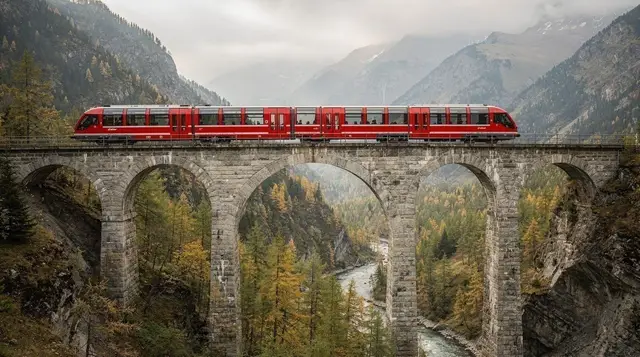
That changed in December 2022, when MOB and BLS put the first “Prisma” carriages into service. These panoramic trains sit on variable-gauge bogies: as the train rolls slowly through a short section of track at Zweisimmen, the wheels themselves slide inward or outward to match whichever gauge comes next. Passengers stay in their seats. It’s a genuinely unusual piece of engineering for a scenic route that most visitors ride for the view rather than the mechanics, but it’s also the reason this guide exists — the GoldenPass line finally does what its branding always promised.
This guide covers the whole route from Lucerne to Montreux: what each leg looks like, what’s changed with the new trains, what a seat actually costs, and where it’s worth breaking the journey rather than treating it as a one-day transit.
The route, leg by leg
The GoldenPass line runs in two distinct halves, and it helps to think of them separately even though the newest trains join them into one continuous ride.
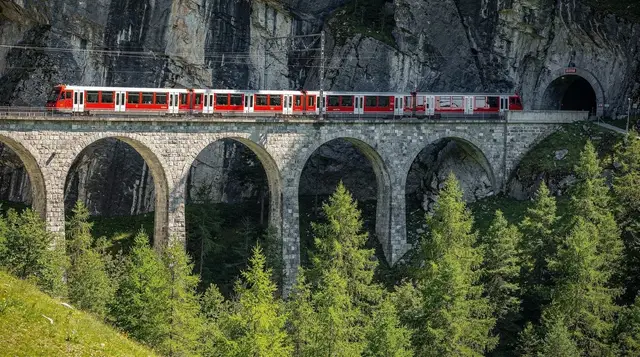
Lucerne to Interlaken Ost. This leg runs on the Zentralbahn network, climbing from Lucerne along the shore of Lake Lucerne before crossing the Brünig Pass — a section steep enough that part of it uses a rack-and-pinion system. The train descends through Meiringen and along Lake Brienz into Interlaken Ost. It’s a scenic ride in its own right, with better views on the left-hand side heading east, and it takes about two hours. This leg has always run on standard gauge and was never affected by the Zweisimmen bottleneck.
Interlaken Ost to Montreux. This is the GoldenPass Express proper, and the leg where the variable-gauge Prisma trains matter. The route runs along Lake Thun to Spiez, climbs to Zweisimmen (where the gauge change happens), continues through Gstaad and Saanen, drops into Château-d’Œx and Montbovon, and finishes with a long descent to Montreux on Lake Geneva. This leg takes roughly three hours fifteen minutes on the direct GoldenPass Express.
| Leg | Distance feel | Typical journey time | Gauge |
|---|---|---|---|
| Lucerne – Interlaken Ost | Lake Lucerne, Brünig Pass | about 2h | Standard (1435mm) |
| Interlaken Ost – Zweisimmen | Lake Thun, Simme valley | about 1h05 | Standard (1435mm) |
| Zweisimmen – Montreux | Gstaad, Château-d’Œx | about 2h10 | Metre (1000mm) |
| Full Lucerne – Montreux | Whole route | 5h30–6h with a normal connection | Both, via Prisma bogie change |
Those figures are typical off-peak timings rather than a guarantee — always check the current SBB timetable for your travel date, since the GoldenPass Express doesn’t run hourly and the connection at Interlaken Ost isn’t always tight.
What actually changed with the Prisma trains
Before the Prisma carriages, “GoldenPass” was a marketing umbrella over several unconnected trains: the Lucerne-Interlaken Express, a regional or express service to Zweisimmen, and the classic MOB panoramic trains on to Montreux. Travellers had to plan two or three separate connections and, on the Zweisimmen changeover in particular, sometimes had only a few minutes to cross the platform with luggage.
The Prisma trains remove that middle change. Each unit is built jointly by Stadler for the mechanical running gear and fitted out by MOB, with panoramic windows that curve up into the roof line — closer to a coach than a conventional train interior. The variable-gauge system itself is patented and was tested for several years before entering regular service; it works by running the whole train through a gauge-changing facility at walking pace, rather than anything passengers need to do themselves.
It’s worth being precise about what this fixes and what it doesn’t. The Prisma trains solve the change of train. They don’t turn the journey into a single flat run without stops — the train still calls at Zweisimmen, Gstaad, Château-d’Œx and other stations along the way, and it still takes over three hours from Interlaken Ost to Montreux. If your priority is speed rather than scenery, a combination of ordinary InterCity trains via Bern is usually quicker; the GoldenPass Express exists for the view, not to save time.
Not every service on this route uses Prisma stock. Some departures, particularly the classic GoldenPass Panoramic and the vintage Belle Époque carriages between Montreux and Zweisimmen, are older rolling stock that still terminates at Zweisimmen and requires you to change trains for Interlaken. If a direct ride matters to you, check the train type shown on your reservation, not just the “GoldenPass” name.
Panoramic classes and what a seat costs
The GoldenPass Express sells two classes on the Prisma trains. First class puts you in individual or paired seats close to the driver’s cab window at one end of the train, with the best forward-facing view of the line — these seats are the ones featured in most of the marketing photography, and they’re also the first to sell out. Second class is a standard panoramic carriage: still glass-roofed, still comfortable, with a noticeably lower price for a view that’s only marginally less good unless you specifically want the front window.
Seat reservation is compulsory in both classes and is charged as a separate fee on top of your train fare, whether you’re using a point-to-point ticket, a Half Fare Card, or a Swiss Travel Pass. Expect the second-class reservation to run to roughly CHF 15–20 and the sought-after first-class front seats to cost more, sometimes CHF 30 or above in peak season — fares and reservation charges are adjusted periodically, so treat these as a planning estimate and check the current price when you book rather than relying on last year’s figure.
| Item | Who it covers | Approx. cost (CHF) |
|---|---|---|
| Second-class seat reservation | Compulsory, GoldenPass Express | 15–20 |
| First-class seat reservation, front window | Compulsory, limited seats | 25–35+ |
| Swiss Travel Pass | Covers train fare, not reservation | — |
| Half Fare Card | Covers 50% of fare, not reservation | — |
Book reservations as early as you can, especially for July, August and the weeks around Christmas — the front-window seats on the Interlaken-Montreux leg are a known target for rail enthusiasts and can sell out a week or more ahead. If you’re using the Swiss Travel Pass for the wider trip, it’s worth reading through what it does and doesn’t cover before you rely on it for this specific route.
Stopping off, rather than riding straight through
Almost nobody who does this journey well treats it as a single seven-hour transit. The line runs through several places worth a night or at least a few hours, and both point-to-point tickets and the Swiss Travel Pass allow you to break your journey along the way as long as you hold a valid reservation for whichever specific GoldenPass Express service you eventually board.
Interlaken sits at the junction of the two halves of the line, on the strip of land between Lake Thun and Lake Brienz, and is a natural place to break for lunch or stay a night before the more scenic second half. If you want to add an activity rather than just changing platforms, a guided snowshoe tour from Interlaken works well in winter, when the GoldenPass views are at their whitest.
Gstaad is the best-known stop on the MOB half of the line — an expensive, low-key resort town rather than a big destination in its own right, but a pleasant place to break for an afternoon. Trains between Zweisimmen and Montreux stop there regularly enough to make a stopover practical without derailing a same-day plan.
Zweisimmen itself is not a destination, but it’s the gauge-change point and a sensible place to note if your onward train is a classic panoramic service rather than a Prisma one, since that’s where you’d need to change.
At the far end, Montreux rewards more than a photo stop at the station. The lakeside promenade, the Château de Chillon a short walk or bus ride along the shore, and the wider Montreux and Vevey area are worth an overnight if your schedule allows it. From Montreux, Gruyères is an easy onward trip, and it’s the pairing behind the Montreux day trip to Gruyères on the GoldenPass train, which uses this same line for part of its route if you’d rather not plan the connections yourself.
On the Lucerne side, the Brünig leg passes through the canton of Obwalden, around Sarnen and Giswil — quieter countryside than the Bernese Oberland half, but a genuine option if you want to add a physical day out rather than just watch scenery from a window; there’s a guided mountain bike tour in Obwalden that starts from this stretch of the route.
Booking and planning notes
Reservations for the GoldenPass Express can be made through the SBB app or website, and through MOB directly for the Zweisimmen-Montreux portion. Booking opens a few months ahead of travel; for peak summer dates and the front-window seats, book as soon as your dates are fixed rather than waiting until the week of travel.
If you’re combining this line with wider rail travel around Switzerland — the Glacier Express, the Bernina Express, or the Gotthard Panorama Express — it’s worth mapping out reservations for all of them together, since each has its own separate compulsory-reservation system and its own sell-out pattern.
A customisable Swiss Travel Pass itinerary with a private guide can be a practical shortcut if juggling several scenic-train reservations on your own feels like more admin than you want on holiday. For general background on how Swiss trains work — punctuality, platform numbering, luggage racks — it’s worth a read before your first long-distance leg in the country.
A few practical points that catch people out on this specific line:
- Luggage racks on the Prisma carriages are smaller than on standard InterCity stock, since more of the carriage interior is given over to panoramic glazing. Large suitcases fit less comfortably than on a typical SBB train.
- The gauge-changing manoeuvre at Zweisimmen happens at low speed and takes a few minutes; it’s not dramatic to watch from inside the train, and some passengers don’t notice it happening at all.
- Weather affects the view more than the schedule. The Gstaad-to-Montreux descent is the most photographed stretch of the line, and low cloud in the Simme and Sarine valleys is common enough in spring and autumn that it’s worth checking a short-range forecast rather than assuming a clear day.
- If your plan also involves a cable car or mountain lift somewhere along the route — Gstaad’s Glacier 3000 is the obvious example — check its operating dates first. Swiss mountain lifts routinely close for scheduled maintenance in spring and again in autumn, and that closure window is one of the more common ways a day built around this line gets derailed.
- Compare this line against Switzerland’s other named scenic routes before committing a full day to it — our comparison of the country’s panoramic trains and the day trips from Zurich guide both cover where the GoldenPass line fits against the Glacier Express and Bernina Express if you only have time for one.
Questions about the GoldenPass line
Do I have to change trains between Lucerne and Montreux?
Not any more, if you catch a GoldenPass Express service with Prisma carriages: the train itself changes wheel gauge at Zweisimmen, so you stay in your seat for the whole journey from Interlaken Ost to Montreux. Older GoldenPass Panoramic and regional connections may still require you to change at Zweisimmen, so check the train type on your ticket or the SBB app before you board.
What is a Prisma train?
Prisma is the name MOB and BLS gave the panoramic carriages introduced on the GoldenPass Express in December 2022. Each carriage runs on variable-gauge bogies that widen or narrow automatically inside a short section of track at Zweisimmen station, switching between the standard-gauge BLS line and the metre-gauge MOB line without stopping passenger service.
Is seat reservation compulsory on the GoldenPass Express?
Yes. A seat reservation is compulsory on every GoldenPass Express service, in both classes, and it costs extra even if you already hold a Swiss Travel Pass or a point-to-point ticket. Book it as early as you can in summer and around Christmas, since the panoramic carriages sell out days in advance on the Interlaken-Montreux leg.
How long does the full journey from Lucerne to Montreux take?
Budget around five and a half to six hours door to door, including the connection at Interlaken Ost: about two hours from Lucerne to Interlaken Ost on the Brünig line, then roughly three hours fifteen minutes from Interlaken Ost to Montreux on the GoldenPass Express. Add time if you break the journey in Gstaad or Château-d’Œx, which most people who make this trip do.
Is the GoldenPass line covered by the Swiss Travel Pass?
The Swiss Travel Pass covers the train fare on the whole route, but not the compulsory seat reservation, which you pay separately regardless of which pass or ticket you’re travelling on. A Half Fare Card also works for the fare but not the reservation fee.
What’s the difference between the GoldenPass Express and the GoldenPass Panoramic?
GoldenPass Express is the current through service with Prisma variable-gauge carriages, running Interlaken Ost to Montreux without a change of train. GoldenPass Panoramic is the older branding, still used for some classic and Belle Époque carriages on the Montreux side, which terminate at Zweisimmen and require passengers to cross the platform to a separate train for Interlaken.
Can I stop off at Gstaad or Interlaken along the way?
Yes, and it’s worth doing rather than riding the whole route in one sitting. Both a standard train ticket and a Swiss Travel Pass allow stopovers on the way, so you can break the journey in Interlaken, Spiez, Zweisimmen or Gstaad and catch a later GoldenPass Express onward, as long as you still hold a seat reservation for the specific service you eventually board.
Scenic train tours on GetYourGuide
Verified deep-linked GetYourGuide tours. Book through these links and we earn a small commission at no cost to you.
GetYourGuide does not provide a product photo for this activity — the image shows the meeting point, photographed by us.