The Bernina Express: Chur to Tirano on the UNESCO Albula-Bernina line
What is the Bernina Express and do I need a reservation?
The Bernina Express is a Rhaetian Railway scenic train running between Chur (or St Moritz) and Tirano, crossing the UNESCO-listed Albula-Bernina line over the Brusio spiral viaduct and Ospizio Bernina, the highest point reached by any Swiss adhesion railway. A seat reservation of around CHF 30 in summer and CHF 15-20 in winter is compulsory on the panoramic service, on top of your regular rail ticket or pass.
What the Bernina Express actually is
The Bernina Express is not a separate railway. It is a set of Rhaetian Railway trains, fitted out with panoramic carriages and large tilted windows, that run over ordinary track shared with regional services. The stretch that gets it onto UNESCO’s World Heritage list is the Albula-Bernina line, added in 2008 for the engineering used to get a metre-gauge railway over an Alpine pass without a single tunnel through the main ridge: spiral tunnels, open loops, and viaducts stacked on top of each other on the mountainside.
The classic run goes from Chur, the oldest town in Switzerland and the gateway to the region covered in our Chur guide, up through the Albula tunnel to St Moritz, then over the Bernina Pass and down to Tirano on the Italian side. Most people join or leave partway, at St Moritz, since that’s the more useful base if you’re coming from Zurich. From Tirano, a connecting bus continues to Lugano for those routing onward into Ticino, which we cover separately in our Lugano guide.
The route in three stages
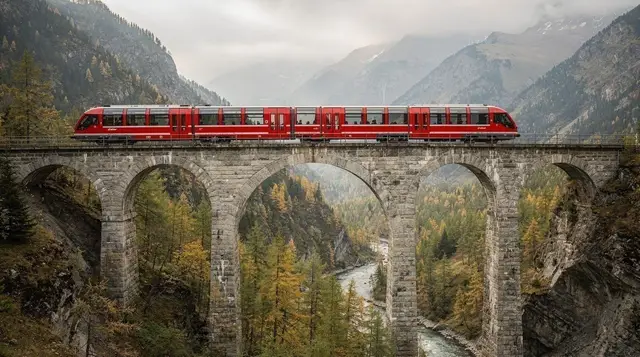
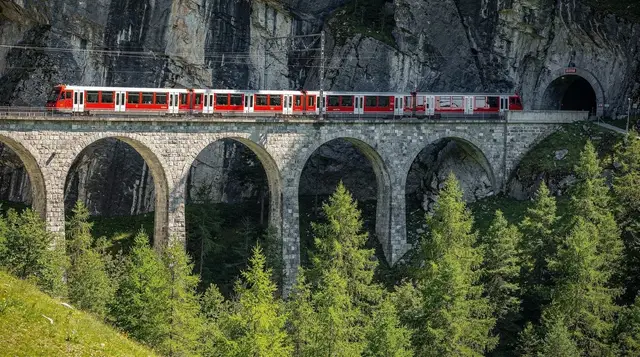
Chur to St Moritz runs through the Albula valley, past the Landwasser Viaduct near Filisur, a six-arch limestone bridge that plunges straight into a tunnel mouth cut into the rock face. This section alone justifies the trip for people who never continue over the Bernina Pass. It takes a little over two hours on the direct trains and is also covered, unreserved, by regional services.
St Moritz to Tirano is the Bernina Pass crossing proper, the section people mean when they say “the Bernina Express.” The line climbs to Ospizio Bernina at 2,253 metres, the highest point reached by any Swiss adhesion railway (no cogs, just friction), skirts the turquoise Lago Bianco, then drops nearly 1,800 metres to Tirano in about two hours, using the Brusio spiral viaduct, a nine-arch loop that lets the train circle back over its own track to lose height gradually. Around Pontresina and Alp Grüm you’ll see marmots and ibex on the slopes in early morning light, which is the basis of a dedicated wildlife photo excursion out of Pontresina if you want to linger rather than just watch from the window.
Tirano to Lugano is not a train at all. It’s a Rhaetian Railway-branded postal bus, the Palm Express, that crosses back into Switzerland via the Maloja road system and Val Poschiavo before dropping into Ticino. It runs a seasonal timetable, largely June to October with a reduced winter service around Christmas, and needs its own seat reservation.
What it costs
The base fare for the whole route is an ordinary Rhaetian Railway ticket, which a Swiss Travel Pass covers in full and a Half Fare Card halves. What you pay on top is the panoramic reservation, and it varies by season and by how far you ride.
| Reservation | Typical cost | Notes |
|---|---|---|
| Chur–Tirano, summer (Apr–Oct) | CHF 30–33 | Peaks in July–August; window seats sell out first |
| Chur–Tirano, winter (Nov–Mar, excl. holidays) | CHF 15–20 | Easiest season to get a seat |
| St Moritz–Tirano only | CHF 15–20 | Shorter reservation fee for the shorter panoramic leg |
| Tirano–Lugano bus (Palm Express) | Separate fee, seasonal | Not covered by rail reservation; own booking required |
None of this is cheap by most countries’ standards, but it is honestly priced for what it is: a scenic seat reservation, not a full fare. If your budget is the concern rather than the panoramic glass, the regional trains covered in the next section are the same railway for a fraction of the cost.
Regular trains cover the same track for less
This is the detail most guides skip. The panoramic Bernina Express carriages are optional. Ordinary Rhaetian Railway regional trains run the Chur-St Moritz-Tirano line all day, with normal windows that open, no reservation requirement, and no surcharge beyond whatever pass or ticket you’re already using. They stop at more stations, so the journey runs somewhat longer, and there’s no onboard commentary, but the Landwasser Viaduct and the Brusio spiral look identical from a regional carriage.
Families with a Junior or Grandchild travelcard, or anyone travelling on a tight Swiss Travel Pass budget, should weigh this option seriously rather than assuming the panoramic reservation is mandatory. For a fuller breakdown of pass eligibility across Swiss scenic routes, our Swiss Travel Pass vs Half Fare comparison and how Swiss trains actually work guide both cover the mechanics in more depth than fits here.
a private-guide version of the Tirano to St Moritz leg handles seat booking and border logistics for people who would rather not manage Italian and Swiss ticketing themselves in one day.
Doing it from Zurich: be realistic about time
Zurich is not on this line, and the honest answer is that a same-day round trip from Zurich to Tirano and back is a very long day, arguably too long to enjoy. Budget roughly 1 hour 15 minutes from Zurich HB to Chur, then over 4 hours of train time each way between Chur and Tirano if you ride the full route, before any time actually spent in Tirano or St Moritz. Doing Zurich-Chur-Tirano-Chur-Zurich in one day means well over 10 hours on trains for perhaps an hour on the ground.
The two arrangements that actually work:
- Base yourself in St Moritz or the wider St Moritz and Engadine area for a night or two, ride the Bernina Pass section to Tirano and back as a half-day excursion, and use the rest of the stay for the surrounding valleys, including a cable car up to Muottas Muragl or Piz Corvatsch if the lift is running (note that many Alpine lifts close for maintenance in the spring and autumn shoulder seasons, so check operating dates before building a day around one).
- Treat it as one leg of a longer loop, continuing Tirano to Lugano by the Palm Express bus and from there into Ticino via Bellinzona or Locarno and Ascona, rather than doubling back the way you came. This is the version worth planning if you’re already building a longer rail itinerary; our rail-only 7 day itinerary sequences it this way.
a full day trip from Milan up to St Moritz on the Bernina Express is the version that suits people based in northern Italy rather than Zurich, and it’s worth knowing about if your trip straddles both countries.
When to go, and what the seasons actually change
Summer (June to September) gives the longest daylight and the greenest valleys, but also the highest reservation prices and the fullest carriages; book the panoramic seats at least two to three weeks out for July and August. Winter turns the Lago Bianco into a frozen white sheet and the Brusio viaduct into a genuinely striking snow scene, and reservations are both cheaper and easier to get outside the Christmas and New Year fortnight.
Spring (April, early May) and late autumn (November) are the quietest and least reliable: snowmelt or early snow can affect the higher sections, and this is also when several of the region’s cable cars and chairlifts close entirely for scheduled maintenance, so don’t build a day trip around a specific mountain lift in these windows without checking first.
| Season | Reservation cost | Crowds | What to expect |
|---|---|---|---|
| Jun–Sep | CHF 30–33 | High, book ahead | Full green valleys, longest bus season for Tirano–Lugano |
| Oct | CHF 25–30 | Moderate | Autumn colour in the Poschiavo valley, Palm Express winding down |
| Nov, Apr–early May | CHF 15–25 | Low | Shoulder season; some lifts and lines under maintenance |
| Dec–Mar (excl. holidays) | CHF 15–20 | Low outside holidays | Snow scenery, easiest seat availability |
Choosing your seat and your side of the train
Where you sit changes what you see. On the climb towards the Bernina Pass the views open up on both sides at different moments, so a window seat matters more than the direction you face. If you booked a panoramic seat, take the window and keep the camera ready before the big set pieces: the approach to the Landwasser Viaduct and the Brusio spiral both arrive faster than most people expect. The tilted glass also means reflections are lower than on an ordinary carriage, but a dark jacket held against the window still helps on bright days.
Travelling in a pair or a small group, it is worth deciding in advance who gets the better side for which stretch, because swapping seats in a full carriage is awkward. Solo travellers have an easier time: a single window seat is usually the last thing to sell out.
Packing and pacing for a day on the line
The Bernina Pass crossing climbs high, so the weather at the top can differ sharply from the valley floor you left that morning. Bring a warm layer even in summer, and sunglasses for the snow and lake glare. Carry water and something to eat, since the timetable rarely leaves time for a relaxed meal between connections, and plan any stop in Tirano or St Moritz around the departure you intend to catch rather than leaving it open.
Keep your reservation confirmation and your pass or ticket together where you can reach them, because staff check both. If you are building a longer trip, the Zurich travel costs guide helps you see where a scenic reservation fits in the wider budget, and first-time mistakes in Zurich lists the planning slips that cost visitors the most time.
Combining the Bernina Express with the rest of your trip
Many visitors treat this railway as a single highlight inside a wider Swiss plan. A sensible pairing is a few days in the city followed by a move into the mountains, using the three-day Zurich itinerary or the five-day summer Alps itinerary as the frame and slotting the Engadine in where the weather looks best. If you are still choosing between mountain days, the best mountain excursions from Zurich page compares the main options, and the glacier experiences guide covers the ice side of the Alps for anyone who wants more than one kind of high-altitude day.
Alternatives and comparisons worth knowing
The Bernina Express is one of several named scenic trains radiating from this part of Switzerland, and people often conflate them. The Glacier Express is the much longer Zermatt-St Moritz run with a different character and price point. The Gotthard Panorama Express combines a boat and a train through the older Gotthard route further north.
The GoldenPass Line covers the Lucerne-Interlaken-Montreux corridor entirely separately. If you’re trying to decide which one deserves your time and budget, our direct write-up on Jungfraujoch versus Schilthorn and the wider day trips from Zurich guide both help place the Bernina Express against the rest of the shortlist.
For a shorter regional add-on near the St Moritz end of the line, the spa town of Davos and Klosters sits within easy reach if you want a second overnight rather than pushing straight through to Tirano and back in one day.
a Milan-based day trip riding the Bernina Express up to St Moritz and a guided photo walk near Pontresina to spot marmots and ibex are the two add-ons that make the most sense if you’re overnighting in the Engadine rather than passing straight through.
Bernina Express FAQ: cost, timing and booking
How much does the Bernina Express actually cost from Chur to Tirano?
The train itself is a normal Rhaetian Railway service, so the base fare is covered by a Swiss Travel Pass, discounted by a Half Fare Card, or bought as a standard point-to-point ticket. What costs extra is the compulsory seat reservation on the panoramic carriages: roughly CHF 30-33 from April to October and CHF 15-20 in winter, plus a further reservation fee if you continue on the connecting bus to Lugano.
Is the Bernina Express covered by the Swiss Travel Pass?
The pass covers the underlying rail fare for the whole route, including the stretch run by Trenord between the border and Tirano. It does not cover the panoramic seat reservation, which every passenger in the red panoramic carriages has to buy separately regardless of what pass or ticket they’re travelling on.
Do I need to book the panoramic carriage weeks in advance?
In July, August and around Christmas and New Year, yes, since the panoramic carriages sell out days or weeks ahead, window seats first. In the shoulder months a few days’ notice usually suffices, and in deep winter outside the holiday peak, seats are rarely a problem.
Can I do the same route without the panoramic reservation?
Yes. Regular Rhaetian Railway regional trains run the identical Chur-St Moritz-Tirano track all day, with the same windows and largely the same views, no reservation, and no surcharge beyond the base fare already covered by a pass. They take a little longer because they stop more often and lack the tilted glass and onboard commentary.
How do I get from Tirano onward to Lugano?
The Palm Express postal bus runs from Tirano through Val Poschiavo and back into Switzerland before dropping into Ticino, taking around 3 hours. It operates a limited seasonal timetable, mainly June to October with a reduced winter service, and needs its own reservation and fee separate from the train.
Is the Bernina Express better than the Glacier Express?
Neither is objectively better; they cover different ground. The Bernina Express is shorter, cheaper, crosses a UNESCO line with steeper gradients and tighter loops, and can be done as a half-day trip from St Moritz or Chur. The Glacier Express is a full-day, pricier journey between Zermatt and St Moritz built around its dining-car culture.
Scenic train tours on GetYourGuide
Verified deep-linked GetYourGuide tours. Book through these links and we earn a small commission at no cost to you.
GetYourGuide does not provide a product photo for this activity — the image shows the meeting point, photographed by us.