Lake Lucerne to Ticino: the Gotthard Panorama Express
What is the Gotthard Panorama Express?
It is a combined journey that starts with a scenic boat crossing of Lake Lucerne from Lucerne to Flüelen, then continues by panoramic train over the historic Gotthard mountain line to Bellinzona and Lugano. The train section runs seasonally, roughly late April to mid-October, and needs a compulsory seat reservation on top of a normal rail fare or pass.
A boat, then a train that takes the long way round
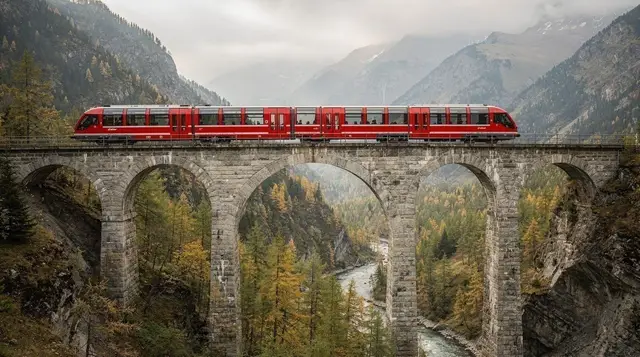
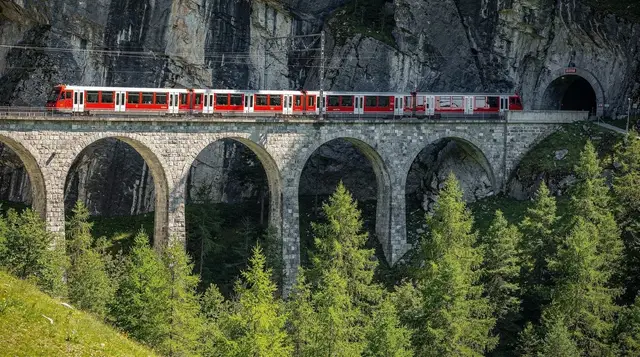
Before the Gotthard Base Tunnel opened in 2016, every train between German-speaking Switzerland and Ticino climbed over the mountain on a line built in 1882, complete with spiral tunnels to manage the gradient. That old line is still there, still running trains, and for about six months a year it carries panoramic carriages aimed squarely at people who are in no hurry. The Gotthard Panorama Express pairs that train with a Lake Lucerne steamer, so the whole journey from Lucerne to Ticino is done without a car and mostly without looking at a phone.
This is not a single named train in the way the Glacier Express is. It is a booked combination: a scheduled boat, then a scheduled train, sold and reserved as one product by SBB. Understanding that helps explain both what you are paying for and where the flexibility is.
The route in outline
Starting point is Lucerne, reachable from Zurich HB in about 45 minutes by regular train. From there:
| Leg | Mode | Approx. duration |
|---|---|---|
| Lucerne to Flüelen | Lake steamer | About 3 hours |
| Flüelen to Bellinzona | Panorama train | About 1 hour 35 minutes |
| Bellinzona to Lugano | Regular train | About 25 minutes |
Total journey time from Lucerne to Lugano this way runs to roughly five hours, against about two hours 20 minutes if you take a direct train straight through the Gotthard Base Tunnel and skip the boat entirely. The three extra hours are the point, not a flaw: they are spent on open water looking at Lake Lucerne rather than in a tunnel.
The boat across Lake Lucerne
The steamers that run this route include some genuine paddle steamers from the early twentieth century alongside newer motor vessels, and which one you get depends on the timetable slot you book. The crossing calls at a string of lakeside villages — Weggis, Vitznau, Beckenried, Gersau, Brunnen — with mountains rising directly from the water on both sides, Rigi to one side and Pilatus visible behind you for much of the trip. It is a slower, calmer experience than the train half of the day, and a good one to have breakfast or an early lunch on board rather than rushing it. For a broader look at what the lake’s boats cover beyond this one route, see our Lake Lucerne boat trips guide.
Boats dock at Flüelen at the southern tip of the lake, where the railway station sits a short walk from the pier. Connection times between boat and train are built into the published Gotthard Panorama Express timetable, so there is no need to sprint, but it is still worth knowing which sailing you are on before you leave Lucerne.
The train: the historic Gotthard line
From Flüelen the train climbs steadily through the Reuss valley, past Erstfeld and Amsteg, gaining height for the run up to the Gotthard massif. The panoramic carriages used on this service have larger windows and, on some rolling stock, glass sections extending into the roof, along with an onboard commentary covering the engineering history of the line. It is a working railway rather than a purpose-built tourist train, so you will also see and hear regular freight and passenger traffic sharing the same tracks.
South of Göschenen the train enters the original Gotthard rail tunnel, a nine-kilometre bore that was the main route through the Alps for well over a century before the base tunnel took over the flat, fast traffic below. Emerging at Airolo on the Ticino side, the character of the landscape changes fairly abruptly — chestnut trees and stone-roofed villages replace the higher alpine scenery on the northern side, one of the more obvious markers that you have crossed into Switzerland’s Italian-speaking canton.
The spiral at Wassen
The single most talked-about section of the whole line is the run through Wassen, a village the train effectively circles three times. Engineers dealing with a steep gradient built a set of tunnels that loop back on themselves inside the mountainside, so the track gains height while doubling back over itself. The practical result: passengers see Wassen’s parish church from the train three separate times, at three increasingly higher vantage points, within the space of a few minutes. It sounds like a gimmick until you are actually watching it happen, at which point it is a genuinely well-engineered piece of nineteenth-century railway building rather than a novelty.
Where to sit and what to watch for
On the boat, the open decks give the best views but the weather decides how long you will want to stay out there; the lower saloons keep the same windows without the wind. On the train, a window seat is the obvious choice, and it is worth thinking about which side of the carriage you want before the reservation is made, since the valley opens up differently on each side as the line climbs. Keep the camera ready for the Wassen section rather than putting it away after the lake, and give the tunnel stretches a rest, because there is little to see in them and the best light is outside.
Travelling with children or with relatives who tire quickly is entirely realistic on this route, because the boat leg is calm and the train leg offers plenty to look at without any walking. If that describes your group, our Zurich with kids and family day trips from Zurich pages have ideas for pacing the rest of the day.
Bellinzona and on to Lugano
The train calls at Bellinzona, capital of Ticino and home to three well-preserved medieval castles that are easily visible from the station approach; it is worth a stop here on a future trip even if you continue straight through this time. From Bellinzona it is a short additional hop to Lugano, the largest town in Ticino and the usual end point for this itinerary, with its lakefront promenade, funicular up to Monte San Salvatore, and a noticeably more Mediterranean feel than anywhere on the northern side of the Alps.
a guided walk through Lugano’s old town with a funicular ride up the hillside is a reasonable way to get orientated in an unfamiliar town if you are arriving in the late afternoon with limited energy left for working out where things are on your own.
Prices and what your pass covers
Both the Swiss Travel Pass and the Half Fare Card cover the underlying point-to-point fares for the boat and the train — this is a normal scheduled service, not a private charter, so standard Swiss rail and lake pricing applies. What neither pass covers is the compulsory seat reservation for the panoramic carriages themselves.
| Item | Approx. price (at time of writing) |
|---|---|
| Seat reservation, panorama carriage, 2nd class | Around CHF 33 |
| Seat reservation, panorama carriage, 1st class | Around CHF 43 |
| Lucerne–Lugano point-to-point 2nd class fare (no pass) | Around CHF 79 |
| Same fare with Half Fare Card | Around CHF 40 |
| Same fare with Swiss Travel Pass | Included |
These figures move with SBB’s annual fare updates, so treat them as a planning guide rather than a quote, and check the current numbers when you book. If you already hold a Swiss Travel Pass for the rest of your trip, the marginal cost of doing this route is just the reservation fee, which makes it considerably better value than treating it as a one-off excursion bought at full fare.
When it runs, and when it doesn’t
The panoramic carriages operate seasonally, typically from late April to mid-October. Outside that window the boat still runs a reduced winter timetable and the train line is open year-round, but you will be on ordinary regional and InterCity rolling stock rather than the panorama cars, and the seat reservation requirement disappears along with them. If scenic-train viewing is the main goal rather than simply getting from Lucerne to Ticino, plan for the warmer months.
This is the same seasonal pattern that trips up plenty of people booking mountain excursions from Zurich in general — lift and panoramic-train operators alike tend to close for maintenance in spring and again in autumn, so always check the specific date rather than assuming a service that ran last month is still running this one.
Doing it from Zurich: realistic timings
Zurich HB to Lucerne is about 45 minutes, and it is worth taking an early train to give yourself margin before the boat departs Lucerne. As a same-day round trip from Zurich, expect something in the region of eleven to twelve hours door to door once you add the return journey from Lugano, which is a long day by any measure and leaves very little time in Ticino itself once you arrive.
A more comfortable version of this trip is one-way outbound at a relaxed pace, an overnight stay in Lugano or Bellinzona, and a fast return the next day straight through the Gotthard Base Tunnel in around two and a half hours from Lugano to Zurich. That splits the slow, scenic half of the journey from the fast, practical half, rather than trying to cram both into a single day. If you are building out a longer trip, our day trips from Zurich guide and the dedicated Lugano and Ticino day trip page cover both the one-day and overnight versions in more detail.
Is it worth it, or should you just take the fast train?
Honestly, it depends what you are optimising for. If the goal is simply reaching Ticino, the direct train through the Gotthard Base Tunnel does the job in well under half the time and at a lower cost once you strip out the reservation fee. The Panorama Express version exists for people who want the journey itself to be the point — three hours on a lake steamer followed by a historic mountain railway, spiral tunnels included, rather than forty minutes underground.
It is also worth comparing against Switzerland’s two better-known scenic routes. The Glacier Express between Zermatt and St Moritz is a full-day commitment and priced accordingly, while the Bernina Express crosses into Italy over the Bernina Pass with no tunnel at all at its summit.
Set against those two, the Gotthard Panorama Express is the shorter, cheaper, more accessible option, better suited to a single day or an overnight add-on than a trip built entirely around it. For a wider sense of how Swiss rail travel generally works, including reservations and pass rules, see Swiss trains explained and Zurich Card vs Swiss Travel Pass.
If you would rather book the historic Gotthard line as part of a guided rail holiday that also covers other Swiss classics, a multi-day Swiss Alps rail tour departing from Basel that also takes in Lucerne and the Glacier Express bundles several of these routes together rather than leaving you to book each leg separately. And if the Bernina Express interests you more than the Gotthard line once you have compared the two, a day trip from Milan on the Bernina Express to St Moritz approaches the same part of Switzerland from the Italian side.
Fitting it into a longer trip
This route works best as one chapter of a wider journey rather than a stand-alone excursion. Travellers basing themselves in the city can slot it into a multi-day plan such as the three-day first-timer itinerary or the rail-only week, swapping it in for a day that would otherwise be spent on a closer outing. Anyone planning several scenic rides in the same trip should read about the Swiss Travel Pass against the Half Fare Card first, since the right choice changes how much each additional route really costs.
If Lake Lucerne itself is the draw, the Lake Lucerne destination page and the story of a day on the Rigi in November show how different the same water looks from above and from the deck. For readers who like the idea of trains as the main event, why Swiss trains run on time explains some of the thinking behind the network you are riding, and night trains from Zurich covers the other end of the slow-travel spectrum.
Ticino rewards a longer stay than a single evening. Beyond Lugano, Bellinzona and Locarno and Ascona are natural additions if you decide to turn the overnight version into two nights, and the pace there suits people who have just spent a day deliberately going slowly.
Practical notes before you book
Buy tickets and reservations through SBB directly, either online or at any Swiss station counter, well before travelling in July and August when panorama-carriage seats sell out days in advance. Luggage space on the panoramic carriages is more limited than on standard InterCity stock, so a single case or backpack per person travels more comfortably than a full set of hold luggage. Wi-Fi and refreshments are available on both the boat and the train, but neither is a dedicated dining service, so eat before departure or bring something with you if a full lake crossing plus a train ride sounds like a long stretch without food.
Weather affects the experience more than most Swiss train journeys, since the appeal is largely visual. A clear day shows off the lake and the Wassen spiral properly; heavy cloud on the Reuss valley climb reduces the whole thing to a fairly ordinary train ride with an expensive reservation attached. Checking a short-range forecast before locking in a date is worth the five minutes it takes, particularly if you are choosing between this and a fast, indifferent-to-weather transit through the base tunnel instead.
Scenic train tours on GetYourGuide
Verified deep-linked GetYourGuide tours. Book through these links and we earn a small commission at no cost to you.
GetYourGuide does not provide a product photo for this activity — the image shows the meeting point, photographed by us.