Basel day trip from Zurich: museums, old town and the Rhine ferries
Is Basel worth a day trip from Zurich?
Yes: trains from Zurich HB take about an hour and run twice an hour, and Basel's old town, three major art museums and its Rhine ferries fit into a single day without rushing. Budget at least CHF 60-80 per person for transport plus one museum, more if you add Fondation Beyeler.
What a Basel day trip actually looks like
Basel sits an hour north-west of Zurich, right where Switzerland, Germany and France meet along the Rhine. It gets less tourist traffic than Lucerne or Interlaken, partly because it has no mountain and no lake shoreline to put on a postcard, and partly because most of what makes it worth the trip — the art museums, the medieval old town, the working river — takes a bit more explaining than “look at the view”. That’s also why it rewards a proper day trip rather than a rushed half-day: you need time to get into a museum, walk the old town at street level and actually cross the Rhine on the little ferries, not just photograph them.
This guide sets out a realistic one-day itinerary from Zurich, what things cost, and where people usually go wrong.
Getting from Zurich to Basel
Direct InterCity trains run from Zurich HB to Basel SBB roughly every 30 minutes, and the journey takes about an hour. There’s no need to reserve a seat on Swiss domestic trains, and no need to change platforms — most services run straight through.
| Ticket type | Approx. one-way price (2nd class) | Notes |
|---|---|---|
| Full fare | CHF 25-27 | Buy on the SBB app or at the station; price is fixed by distance, not by time of booking |
| Half Fare Card fare | CHF 13-14 | Card costs CHF 120/year, worth it if you’re taking several day trips |
| Saver Day Pass | From CHF 29 for the whole day, if bought in advance | Limited quota per train, so book as early as you can once dates are fixed |
| Swiss Travel Pass | Included | Only makes sense if you already need one for a longer Switzerland itinerary |
For background on which of these actually pays off, see Swiss trains explained and Swiss Travel Pass vs Half Fare. If you’re coming straight off a flight, Zurich airport to city centre covers getting to Zurich HB first.
Once in Basel, the old town and the main museums are walkable from Basel SBB in 15-20 minutes, or a short tram ride (buy a single ticket or a day pass from the machine on the platform; Basel’s transport zone is separate from Zurich’s ZVV).
The old town on foot
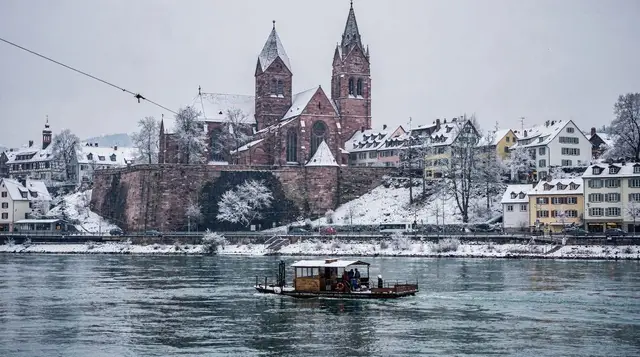
Basel’s Altstadt is compact and doesn’t need a guide to enjoy for a couple of hours. Start at the Marktplatz, dominated by the bright red-and-gold Rathaus (town hall), still Basel’s seat of government and free to look around the courtyard of. From there it’s a five-minute walk up to Basel Münster, the red sandstone cathedral overlooking the Rhine. Entry to the cathedral itself is free; climbing the twin towers costs a small fee (around CHF 5) and gives a genuinely useful view over the river bend and the three-country landscape beyond, not just a nice photo.
Behind the Münster, the Pfalz terrace is a free viewpoint over the Rhine that most day-trippers walk straight past — worth the two-minute detour, especially if you want to watch the ferries working before you use one yourself.
The rest of the old town rewards wandering rather than a checklist: narrow streets like Spalenberg and Augustinergasse, half-timbered facades, small independent shops rather than chain stores. If you’re hungry, Basler Läckerli (a dense, spiced honey biscuit) is the local souvenir food, sold in bakeries all over the centre.
The big three art museums
Basel’s museum density is out of proportion to its size, and this is the main reason people make the trip. You will not fit all three into one day alongside everything else — pick one, or at most two if you’re skipping most of the old town.
Kunstmuseum Basel is the oldest public art collection in the world, with an unusually strong Holbein collection alongside 19th and 20th century European painting. It’s a five-minute walk from the SBB station area of the old town. Standard entry is around CHF 26, more for special exhibitions; the permanent collection alone is worth two to three hours.
Fondation Beyeler, in the suburb of Riehen, is the museum most people have actually heard of before they arrive — a strong collection of Monet, Picasso, Giacometti and Rothko in a Renzo Piano building set in parkland. It’s reached by tram 6 from the city centre (about 20 minutes) rather than being walkable, which is the detail that trips people up when planning a tight day. Entry runs around CHF 35, and it’s closed on Mondays.
Museum Tinguely, on the Rhine east of the old town, is smaller and stranger: kinetic sculpture by Jean Tinguely, much of it mechanically moving. Entry is about CHF 18 and an hour is usually enough.
If your interest in art runs more contemporary-Zurich than classic-European, the Zurich museums guide and Kunsthaus Zurich guide cover what’s available without leaving the city.
Rhine ferries: the Fähri
Basel’s four cable ferries — Ueli, Wilde Maa, Vogel Gryff and Leu — are one of the few things in the city that cost almost nothing and are genuinely distinctive. Each is a small wooden boat attached to an overhead cable strung across the Rhine; the ferryman angles the rudder and the current alone pushes the boat across, with no motor. A crossing takes about two minutes and costs CHF 1.80 per person, dropped into a box on board.
They’re not a tourist gimmick built for visitors — locals use them daily to cross the river — but they’re also genuinely worth doing as a visitor: pick a warm afternoon, cross at the Münster ferry near the cathedral, and you’ve done something in Basel you can’t do anywhere else in Switzerland.
Swimming the Rhine (in season)
From late spring to early autumn, when the water is warm enough, Baslers swim down the Rhine through the city centre as a normal way to get from one part of town to another — not a special activity, just a commute. Visitors do it too, usually buying a Wickelfisch, a fish-shaped waterproof bag (around CHF 25 from kiosks and the tourist office) to keep dry clothes and a phone with you while you float. If you’re visiting between roughly May and September and the weather cooperates, it’s worth building 30-45 minutes into the day for this rather than treating it as an afterthought — it’s a better sense of how Basel actually works than any museum.
Outside that window, or if the Rhine is running high after rain, skip it: the current is genuinely strong and this isn’t a supervised activity.
The Dreiländereck: three countries in an afternoon
North of the old town, past the container port at Kleinhüningen, the Rhine bends at a point where Switzerland, Germany and France all meet — the Dreiländereck. There’s a small marker and an observation tower with a view over the river confluence and the industrial edge of the city, but honestly not much else. It’s reached by tram plus a 15-20 minute walk, or by a longer Rhine boat trip that takes it in as part of a loop.
It’s worth doing as a curiosity — how often do you stand in three countries within a few metres — but don’t build your whole day around it; 45 minutes to an hour there and back is enough. If border-crossing day trips interest you more broadly, see Black Forest day trip and Liechtenstein day trip for other single-day crossings from the Zurich area, and Black Forest for a longer look at what’s over the German side.
For visitors who want the France side properly rather than just a marker, a guided private car trip that combines Basel with a run across the border into Strasbourg covers more ground than public transport comfortably allows in a day out of Zurich.
Rheinfelden: a beer-focused add-on
If Basel’s museums aren’t your thing, Rheinfelden — a small town about 20 minutes from Basel by train, itself with its own old town on the Rhine — is home to the Feldschlösschen brewery, one of Switzerland’s oldest and largest. Basel-based operators run both a self-guided entry ticket with tasting at the Feldschlösschen Brauwelt visitor centre and a fuller guided tour through the working brewery with tasting included, either of which turns into a half-day if paired with a walk around Rheinfelden’s own old town.
A realistic one-day itinerary
| Time | Activity |
|---|---|
| 08:00 | Train from Zurich HB, arrive Basel SBB around 09:00 |
| 09:15 | Walk to the old town via Marktplatz and the Rathaus |
| 09:45 | Basel Münster and the Pfalz terrace viewpoint |
| 10:30 | Kunstmuseum Basel (or tram out to Fondation Beyeler instead — not both) |
| 13:00 | Lunch in the old town |
| 14:00 | Fähri crossing near the Münster, walk the Kleinbasel side of the river |
| 15:00 | Rhine swim if the season and weather allow, or Museum Tinguely if not |
| 16:30 | Free time / shopping around Freie Strasse, or the tram out to the Dreiländereck |
| 18:00 | Train back to Zurich HB |
This is deliberately a “pick one museum” plan. Trying to add Fondation Beyeler on top of the Kunstmuseum and everything else listed above turns a comfortable day into a rushed one — Riehen is a real tram ride away, not a quick detour.
What it costs
| Item | Approx. cost per person |
|---|---|
| Return train, Zurich-Basel (full fare) | CHF 50-54 |
| Return train (Half Fare Card) | CHF 26-28 |
| Basel public transport day ticket | CHF 9-10 |
| One major museum entry | CHF 18-35 |
| Fähri crossing (each way) | CHF 1.80 |
| Wickelfisch (one-off purchase) | CHF 25 |
| Lunch | CHF 20-35 |
A day with one museum and lunch, travelling on a Half Fare Card, comes to roughly CHF 70-100 per person — not cheap, but in line with the rest of what things cost around Zurich.
When to go, and when to skip it
Avoid Basel Fasnacht — the three days following Ash Wednesday, usually in late February or March — unless the carnival itself is why you’re going. It’s genuinely worth seeing once, with masked processions and drumming through the old town from 4am, but museums shift their hours, restaurants get booked out, and it’s a poor day for the itinerary above.
Outside that, spring through autumn is more forgiving than winter, mainly because the Rhine swimming and ferry-hopping half of the day only works when it’s warm. In winter, lean harder on the museums and the old town and treat the river as a viewpoint rather than something to get into.
Getting back, and what else to see nearby
Trains back to Zurich HB run on the same roughly-30-minute schedule until late evening, so there’s no need to plan the return leg precisely — just check the departure board at Basel SBB when you’re ready to leave.
If you’re weighing Basel against other single-day options from Zurich, Day trips from Zurich lays out the full set, and How many days in Zurich is useful if you’re deciding how many of these day trips to fit into a longer stay. For a broader itinerary that includes a day like this one, see Zurich 3 days.
Travellers combining Basel with the Rhine Falls sometimes book it as one loop rather than two separate trips — a Basel-based private excursion out to the Rhine Falls, Europe’s largest waterfall by volume covers that combination directly, and the same operators run a private tour pairing Basel with Zurich and the Rhine Falls in a single outing for visitors based in Basel rather than Zurich. For the falls on their own terms, see the Rhine Falls visiting guide and Rhine Falls day trip.
First-time visitors juggling Basel against Zurich’s other obligations should also check First-time mistakes in Zurich, which covers a few scheduling errors — like booking Fondation Beyeler on a Monday — that apply just as much to day trips as to the city itself.
Best day trips from Zurich on GetYourGuide
Verified deep-linked GetYourGuide tours. Book through these links and we earn a small commission at no cost to you.
GetYourGuide does not provide a product photo for this activity — the image shows the meeting point, photographed by us.