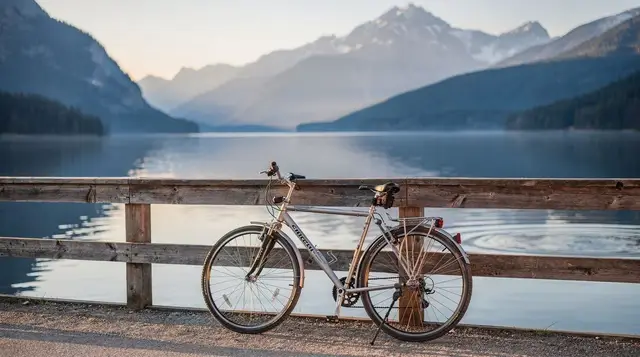
Cycling and e-bike routes around Zurich
What is the easiest way to cycle around Zurich?
Züri rollt lends standard bikes free of charge from April to November, while SBB's Rent a Bike scheme puts e-bikes at railway stations across the country. Both connect easily to signed SuisseMobile routes along Lake Zurich and the Limmat, and bikes travel on regional trains with a day pass.
Zurich is a genuinely good cycling city, which is not something you can say about every European capital. The lakeshore is flat, the Limmat has a paved path on both banks, and the canton has spent decades building a signed cycling network that actually goes somewhere useful. What trips people up is the logistics: which bike scheme to use, whether an e-bike is worth the money, and how the trains and boats fit around the ride. This guide covers all three.
Getting a bike: free, cheap and expensive options
There are three practical ways to get a bike in Zurich, and they suit different trips.
Züri rollt is the free city bike scheme, run by the city with sponsorship rather than fares. Standard bikes are lent out from staffed and self-service stations — the main ones sit at Turbinenplatz and near the Hauptbahnhof — for a CHF 20 deposit or your ID card. The bikes themselves cost nothing for as long as the station is open, and you return them to any Züri rollt point, not necessarily the one you started at. The catch is the season: stations generally run from mid-April to mid-November, closed over winter, and hours are limited outside summer, so this is not a year-round option. It is also first-come, first-served with no advance booking, so turn up early on a warm Saturday.
Rent a Bike, operated through SBB at railway stations, is the option for e-bikes and for picking up a bike in one town and dropping it in another. Standard bikes run in the region of CHF 27 a day, e-bikes CHF 33 to 66 depending on the model, and you can reserve online in advance, which matters in high season. Zurich HB, Rapperswil, Winterthur and most larger stations along the lake have a rental point, and one-way rentals between stations are possible for a surcharge — useful if you want to ride to Rapperswil and take the train back without carrying the bike.
Private and bike-shop rentals fill the gap for cargo bikes, kids’ bikes and multi-day hire, usually a little cheaper than Rent a Bike for longer periods but tied to a single pick-up and drop-off point.
| Option | Typical cost | Season | Best for |
|---|---|---|---|
| Züri rollt | Free (CHF 20 deposit) | Mid-April to mid-November | A few hours in the city, flat routes |
| Rent a Bike (standard) | Approx. CHF 27/day | Year-round | Day trips, one-way station drop-off |
| Rent a Bike (e-bike) | Approx. CHF 33–66/day | Year-round | Hillier routes, longer distances |
| Bike shop hire | Varies, often CHF 20–35/day | Year-round | Multi-day hire, kids’ bikes, cargo bikes |
If you only want a couple of hours by the lake and it is between April and November, Züri rollt is the obvious choice and it costs nothing. For a proper day trip with any climbing, book an e-bike in advance through Rent a Bike.
If you would rather not manage logistics at all, an urban bike tour with a local guide sorts the bike, the route and the commentary in one booking, which is a reasonable trade-off on a short visit.
Whichever scheme you pick, it helps to know how the rest of your transport fits around it. Our guide to getting around Zurich with the ZVV network explains the trams, buses and S-Bahn lines you will use to reach the start of a ride, and the Zurich airport to city centre guide is worth a read if you plan to collect a bike soon after landing. If you are still deciding how much time the city deserves, how many days in Zurich will help you decide whether a full cycling day earns a place in your plan.
Lake Zurich: the loop everyone attempts
The lakeshore path is where most cycling in Zurich actually happens. Both banks are cycled, but they suit different riders.
The left (western) bank, through Kilchberg, Thalwil and Horgen, has more traffic and road sections mixed with cycle path, but reaches Rapperswil in around two and a half hours of steady riding, roughly 35 kilometres. The right (eastern) bank, via Küsnacht, Meilen and Männedorf, is quieter and closer to the water for longer stretches, at a similar distance.
Very few people cycle the full loop, close to 90 kilometres, in a single day — it is achievable on an e-bike but a long day on a standard bike. The far more common plan: ride one bank to Rapperswil, look around the old town and the castle, then take the train back to Zurich HB (around 35 to 40 minutes) or a boat if you have time to spare. Boats run a limited winter schedule, so check timetables outside summer.
A photo stop at Rapperswil’s rose garden and castle is a reasonable reward at the halfway point if you are riding rather than boating out.
Rapperswil rewards a slow visit rather than a quick turnaround, so build in time to wander before you head back. The Rapperswil destination page covers the old town in more detail, and the wider Zurich destination overview helps you place the lakeshore ride within the rest of your stay. If you want a different rhythm on the way home, the Lake Zurich boat trips guide and the quieter perspective in the quiet side of Lake Zurich give you good reasons to swap the saddle for a deck seat. Cyclists with a longer stay may also like to slot the ride into the 2-day Zurich itinerary as the active half of a day.
For the boat option without the ride, see our separate guide to Lake Zurich boat trips, and for the town itself, the Rapperswil destination page has opening hours and the walk up to the castle.
The Limmat path: city to Baden
The Limmat river path runs from central Zurich out through Dietikon towards Baden, mostly flat, mostly paved, and shaded in more places than the open lakeshore, which matters on a hot July afternoon. It is a good half-day ride: roughly two hours each way to Baden at an easy pace, with the option to take the train back from Baden station in 20 minutes and skip the return leg entirely.
Baden itself is worth the stop — a compact old town, thermal baths, and the Limmat running through the middle of it. A private tour to Baden with a Limmat riverside walk covers the same ground without the pedalling if you would rather combine the ride out with a guided walk back.
Closer to the city, the stretch between the Hauptbahnhof and Dietikon is popular with commuters on weekday mornings, so weekends and midday are more pleasant for a leisurely ride. If you want the river without the saddle at all, self-guided rafting from the city centre down to Dietikon covers a similar stretch of the Limmat from the water.
The river is also the best place in the city to cool off after a ride. Swimming in the Limmat describes what the experience is actually like, which is a useful companion to a hot summer cycling day, and our Zurich in summer guide explains how the season shapes everything from crowds to daylight. Riders who prefer to keep moving can link the path with the free things to do in Zurich, since much of what is worth seeing along the water costs nothing.
National routes: SuisseMobile
Switzerland’s signed long-distance cycling network, SuisseMobile, uses red numbered signs at junctions, similar in principle to hiking waymarking. Two routes pass close enough to Zurich to matter for a day trip:
- Route 9, the Rhine Route, follows the Rhine roughly from Andermatt to Basel, and the stretch near Schaffhausen and the Rhine Falls is reachable as a day ride combined with the train.
- Route 66, the Lakes Route (Seen-Route), threads between several Swiss lakes including the Zürichsee, connecting toward Zug and Lucerne.
You do not need to plan turn-by-turn if you are on a signed route — the SwitzerlandMobility app (and paper maps at tourist offices) show your position against the numbered network, and the physical signs at junctions confirm you are still on route. For a day trip built entirely around cycling to Schaffhausen, cross-reference this with the Rhine Falls visiting guide for what to do once you arrive, since the falls themselves are a short ride or bus connection from Schaffhausen station.
A ride toward the Rhine pairs naturally with a boat or a walk once you arrive. The Rhine Falls destination page and the Rhine boat trips from Schaffhausen guide both suggest ways to spend the afternoon without getting back on the bike, which suits riders who would rather finish the day with a rest than a long return pedal.
Taking a bike on the train
Regional trains, the S-Bahn network and most boats accept bikes, but not automatically with a normal ticket. You need a separate bicycle day pass (Velo-Tageskarte), which is not included in the Swiss Travel Pass or the Zürich Card and must be bought on top. It is valid for one calendar day on regional and most InterRegio services; fast InterCity trains have limited bike space and sometimes require reservation. Space is first-come, first-served in the marked bike carriage, and it fills up on Sunday afternoons in summer when half of Zurich is riding home from the lake.
If you are only moving a rented e-bike a short distance — say, from Rapperswil back to Zurich after a one-way ride — check whether your rental agreement already includes return transport before buying a separate pass.
Planning around the train is easier once you understand how the network behaves. Swiss trains explained sets out how the different service types work, and why Swiss trains run on time is a good read if you are building a tight connection between a ride and a departure. If you are travelling on a pass, remember that it does not replace the bike pass, and the Swiss Travel Pass guide is the place to check what your ticket does and does not cover.
Route planning at a glance
| Route | Distance | Riding time | Notes |
|---|---|---|---|
| Zurich to Rapperswil (either bank) | ~35 km | 2–2.5 hours | Train back in ~40 min, boat in summer |
| Full Lake Zurich loop | ~90 km | Full day, e-bike recommended | Rarely done on a standard bike |
| Zurich to Baden (Limmat path) | ~28 km | ~2 hours | Flat, shaded, train back in 20 min |
| Zurich to Schaffhausen area (Route 9) | Varies, often combined with train | Half to full day | Pair with the Rhine Falls |
Practical notes
Zurich’s tram tracks are the single biggest hazard for cyclists in the city centre: a wheel caught in a track groove at the wrong angle is the most common cause of falls, and it happens to confident riders as often as nervous ones. Cross tracks at as close to a right angle as you can manage, especially when wet.
Helmets are not legally required for adults, though the cycling lobby Pro Velo recommends them, and rental e-bikes reach speeds where a fall matters more than on a pedal bike. Cycle paths are well maintained but shared with pedestrians in places, particularly on the lakeshore promenade in summer, so speed limits there are a courtesy worth keeping.
Weather-wise, spring and autumn bring fog that sits on the lake and river valley into the late morning, which is atmospheric for photos but reduces visibility for the first hour or two of a ride. The same shoulder seasons are when several mountain lifts and cable cars close for scheduled maintenance — relevant if your cycling day trip is meant to connect with a cable car further out, such as toward Mount Rigi or the Uetliberg funicular’s timetable; check operating dates before you build a route around one.
For the cost side of renting versus city bikes, see our guide to overall Zurich travel costs, and if you are weighing this trip against the Swiss Travel Pass for a longer stay, the Swiss Travel Pass guide and the Zürich Card comparison cover what each pass actually includes.
Cyclists who enjoy the outdoors will find that a ride combines well with time on foot. The Uetliberg guide and best hikes near Zurich cover the walking side, while Zurich viewpoints lists places worth reaching for the view. To judge the best season for a ride, check Zurich weather month by month, and if you are weighing the expense of a cycling day against everything else on your list, Zurich travel costs puts it in context.
Cycling and e-biking around Zurich: your questions answered
Is Züri rollt really free?
Yes, for standard city bikes. You leave a CHF 20 deposit or ID at the station, ride as long as you like during opening hours, and return the bike to any Züri rollt point before closing. E-bikes and cargo bikes at the same stations cost extra per hour.
Do I need a helmet by law in Switzerland?
No. Helmets are not compulsory for adult cyclists, though Swiss cycling associations recommend them and most rental e-bikes are fast enough that wearing one is sensible.
Can I take a rented bike on the train?
Yes, but you need a bicycle day pass (Velo-Tageskarte) bought separately from your own ticket, valid on regional trains, some InterCity services and most boats. It is not covered by the Swiss Travel Pass and must be validated for each region or bought as a national pass.
How long is the full loop around Lake Zurich?
Roughly 90 kilometres via both shores. Almost nobody rides the whole thing in one day; the usual plan is to cycle one bank to Rapperswil, around 35 kilometres, and take the train or a boat back.
Are e-bikes worth the extra cost for day trips from Zurich?
For flat lakeside routes, a standard bike is enough. For anything with real climbing, such as the hills around the Zürichsee’s eastern shore or routes into the Knonaueramt, an e-bike removes most of the effort and is worth the CHF 15 to 20 daily premium.
What is SuisseMobile?
Switzerland’s national network of signed cycling, mountain-biking and skating routes, numbered and marked with red pictograms at junctions. Route 9 (Rhine Route) and Route 66 (Lakes Route) both pass close to Zurich and can be followed without a map once you recognise the signs.
When do cycling conditions get difficult around Zurich?
Heavy fog sits on the Limmat valley and lakeshore from November to February, and mountain e-bike routes further afield are affected the same way ski lifts are: many hill and cable-car connections close for maintenance in spring and again in autumn, so check operating dates before planning a route that relies on one.
Is cycling in Zurich’s Old Town practical?
Not really. The Altstadt is cobbled, hilly, partly pedestrianised and full of trams. Most people walk it and start cycling from the lake promenade or the Limmat instead; see our old town walking guide for that part on foot.
Adventure & outdoor activities on GetYourGuide
Verified deep-linked GetYourGuide tours. Book through these links and we earn a small commission at no cost to you.
GetYourGuide does not provide a product photo for this activity — the image shows the meeting point, photographed by us.