Aargau and Solothurn sit on the Swiss Plateau between Zurich and Basel, and neither region gets much attention next to Lucerne or the Bernese Oberland. There are no cable cars here and no glacier views. What you get instead is a baroque cathedral town, a canton capital with painted house fronts, two castles of very different scale, and Switzerland’s oldest spa town — all under an hour from Zurich by train and noticeably cheaper than most of the country’s headline stops. If you have already done the obvious day trips from Zurich and want somewhere quieter, this is where to look next.
Solothurn: the baroque old town on the Aare
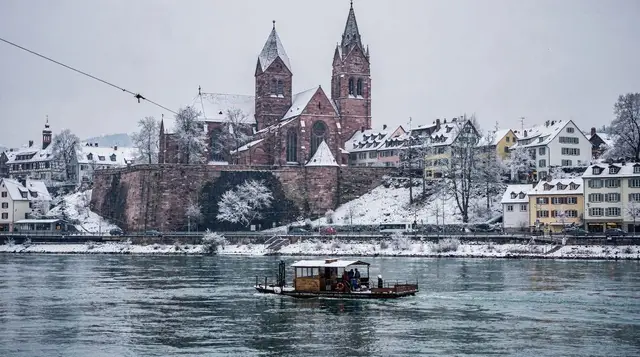
Solothurn calls itself the Baroque town of Switzerland, and the claim holds up. The old town sits on both banks of the Aare, ringed by a mostly intact 17th-century fortification wall, with narrow streets of ochre and cream façades that were rebuilt in a deliberately Italianate style after a fire and a change in political fashion in the late 1600s.
The centrepiece is St Ursen Cathedral, a late-18th-century building with a broad flight of steps out front and a plain, symmetrical façade that photographs well in low afternoon light. Solothurn is locally nicknamed the town of eleven — eleven churches and chapels, eleven museums, eleven fountains, eleven towers and gates, a cathedral with eleven bells — and whether or not you go looking for every instance, it is a genuinely enjoyable excuse to wander rather than march between sights on a checklist.
Worth building in: the Altes Zeughaus (Old Arsenal), one of Europe’s larger arms collections in an unglamorous building that most visitors walk past; the Kunstmuseum Solothurn, a small but well-regarded art museum with a Holbein Madonna as its best-known piece; and a walk along the Aare embankment, where the river runs a startling turquoise on clear days, fed by glacial meltwater further upstream.
a guided walk through Solothurn’s old town is a sensible way to get the “eleven” theme and the fire-and-rebuild history explained properly rather than pieced together from plaques, and it runs at a pace that suits a half-day visit.
Getting to Solothurn and Aarau by train
Neither town needs a car. Both sit on direct or single-change routes from Zurich HB, and Swiss trains run to a schedule you can actually plan around.
| From Zurich HB | Journey time | Change required |
|---|---|---|
| Aarau | 25–30 min | Direct (IC/IR) |
| Baden | 15–20 min | Direct (S-Bahn/IC) |
| Solothurn | 50–60 min | Via Olten |
| Brugg (for Habsburg Castle) | 20–25 min | Direct, then a 25-min walk or short bus |
| Lenzburg | 25–30 min | Direct |
A standard Zurich–Solothurn return in second class runs roughly CHF 60–70 at full fare; half-price card holders pay about half that. Whether the Swiss Travel Pass or a Half Fare Card makes sense depends entirely on what else you are doing that week — for a single trip out here, a normal ticket or a Saver Day Pass booked in advance usually works out cheaper than either.
Aarau: painted eaves and a quieter old town
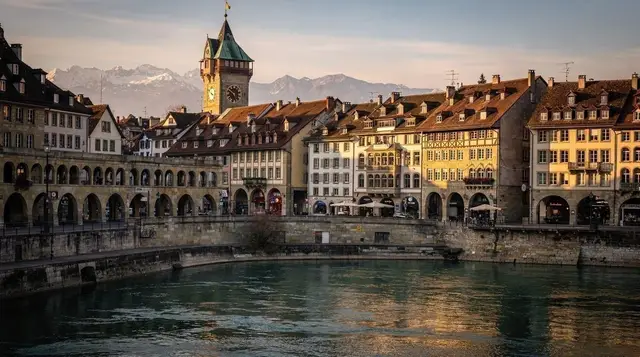
Aarau, the capital of canton Aargau, is smaller and less visited than Solothurn, and that is part of its appeal. Its distinguishing feature is architectural rather than monumental: rows of wide, painted wooden eaves (Dachvorsprünge) projecting out over the narrow lanes of the old town, decorated with murals, flowers and geometric patterns that date mostly from the 18th and 19th centuries. Walk Pelzgasse, Rathausgasse and Graben with your eyes up rather than down and you will see what the fuss is about.
The town’s other notable feature is the Aarebrücke and the older Kettenbrücke, a covered pedestrian crossing over the Aare, plus a compact old town core that takes perhaps two hours to walk properly without stopping, longer with coffee breaks. The Naturama natural history museum and the Stadtmuseum Schlössli, housed in a small castle-like building, are the two indoor options if the weather turns.
a private walking tour with a local guide in Aarau is worth it specifically for the painted eaves — a guide will point out which houses are genuinely centuries old and which have been restored or repainted more recently, a distinction that is not obvious on your own.
Two castles, two very different scales: Lenzburg and Habsburg
Lenzburg Castle is the region’s main historical attraction: a genuinely large medieval fortress on a wooded hill, inhabited more or less continuously since the 11th century and expanded by a succession of noble families before becoming a museum. The visit includes a keep you can climb for a panorama over the Aargau countryside, period rooms furnished across several centuries of ownership, and grounds that make a reasonable picnic stop in summer. Budget 1.5–2 hours.
Habsburg Castle, near Brugg, is the historical curiosity rather than the visual one. This is the actual ancestral seat of the House of Habsburg — the family that went on to rule Austria-Hungary and much of central Europe for centuries — and it is a small, plain stone keep with a modest exhibition inside, not a palace. Anyone arriving expecting something on the scale of the dynasty’s later residences will be surprised by how little is here; anyone coming for the history and the view down over the Aare valley from the tower will likely find the 45-minute stop worthwhile. It is a fair walk or short bus ride up from Brugg station, and combining it with Brugg’s own small old town rounds out a half day.
If you would rather have the region’s back lanes and viewpoints explained on the move, a six-hour guided route through some of Aargau’s lesser-known corners covers ground that is genuinely hard to string together on your own with train timetables. And if you are travelling with children and want to turn a Lenzburg stop into a full family day rather than just a castle visit, transport and entry combined with a trip to Europa Park is the practical way to do both without renting a car.
Baden: Switzerland’s oldest spa town
Baden earns its name honestly — thermal springs here were used by the Romans, and the town has operated as a bathing destination for close to two thousand years. The modern spa quarter (Bäderquartier), rebuilt over the past decade, sits along the Limmat below the old town, with the mineral water piped into a mix of historic and newly built pool complexes. Entry to the main facilities runs roughly CHF 35–65 depending on the operator and whether you add a sauna package, which is a real cost on top of an otherwise inexpensive day.
The old town above the river is compact and pleasant rather than essential: a wooden covered bridge, a hilltop ruin (Stein Castle) with a view over the rooftops, and a scattering of cafés. Most visitors come for the water and treat the old town as the walk between the station and the baths. If you have already sampled Zurich’s own thermal baths, Baden’s appeal is specifically the mineral content and the history, not a different style of pool.
A day in Aargau and Solothurn: what it actually costs
| Item | Typical cost (CHF) |
|---|---|
| Return train, Zurich–Solothurn | 60–70 (30–35 with half-fare) |
| Return train, Zurich–Aarau | 30–36 (15–18 with half-fare) |
| Museum or castle entry | 8–15 |
| Guided walking tour | 25–45 |
| Lunch, sit-down | 20–28 |
| Coffee and pastry | 6–9 |
| Baden spa entry | 35–65 |
A no-frills day in Solothurn or Aarau — train, one museum, lunch, coffee — lands around CHF 60–80. Add a guided tour or a Baden spa session and CHF 100–120 is more realistic.
Where this fits your itinerary
If you are building a longer Switzerland trip around Zurich, Aargau and Solothurn slot in well as a change of pace between more strenuous days. They pair naturally with a wider look at getting around on the ZVV and national network, and they sit roughly on the way if you are also considering a day trip to Basel or a day trip to Bern — both share the same rail corridor and can be combined with an Aargau stop if you are willing to start early.
Compared with the Rhine Falls day trip, which is a single big sight and a short visit, this region rewards a slower, wandering pace better suited to a three-day or five-day itinerary than a tightly scheduled one-day dash.
For a first visit, pick one town — Solothurn for architecture, Aarau for something quieter, Baden if a soak matters more than sightseeing — rather than trying to string all four stops (Solothurn, Aarau, Lenzburg, Baden) into a single day. It can be done on paper with the train times above, but it turns a relaxed regional day into a station-platform relay, which rather defeats the point of choosing the quiet plateau over the crowded Alpine routes in the first place. Compared with a base in Basel or Bern, Zurich remains the more convenient anchor for all four of these stops, since none of them requires more than an hour each way.
Common questions about visiting Aargau and Solothurn
Can I visit Solothurn and Aarau in the same day?
You can, but it makes for a long day. There is no direct train between them, so you connect via Olten, and each old town deserves at least two to three unhurried hours. Most people who try both in one day report seeing the outside of things rather than going in.
Is Aargau expensive compared to the rest of Switzerland?
It is one of the cheaper regions to visit. Museum entry runs CHF 8–15, a sit-down lunch is CHF 20–28, and none of these towns charge the tourist-town markup you find in Lucerne or Interlaken. Baden’s spa entry is the one genuine splurge, at CHF 35–65 depending on the facility and package.
Do I need the Swiss Travel Pass for this trip?
Only if you are already using it for a wider Switzerland itinerary. A single return ticket from Zurich to Solothurn or Aarau costs less than the daily pro-rated value of the pass, so buying it purely for this trip rarely pays off; check current fares against your other planned journeys before deciding.
What is Habsburg Castle actually like?
It is a squat stone keep on a low hill, not a palace. People expecting something on the scale of the Habsburg dynasty’s later Austrian residences are usually disappointed by the size; people who come for the history and the view over the Aare valley tend to find it a fair 45-minute stop.
Is Baden worth visiting if I have already used Zurich’s own pools?
Baden’s draw is the mineral-rich thermal water and a 2,000-year bathing history, which Zurich’s municipal pools do not offer. If you have already done a Zurich thermal circuit purely for swimming, Baden is still worth it for the water itself and the old town around it, but treat it as a different kind of visit, not a repeat.
Which town should I pick if I only have time for one?
Solothurn for architecture and a walkable, compact old town on the Aare; Aarau if you would rather see painted house fronts and a quieter, less-visited centre; Baden if a thermal soak matters more to you than sightseeing.
Are the castles and museums open in winter?
Lenzburg Castle’s museum and Solothurn’s Kunstmuseum keep normal winter hours, though some run reduced days from November to March. Habsburg Castle’s small exhibition has shorter winter opening; check the current schedule before a cold-season visit so you are not stood outside a locked gate.