Zurich in six days: Lucerne, the Jungfrau region, Bern and a spare day
Six days on this loop gets you everything the five-day version covers plus Bern, and — more usefully — a genuine spare day. That matters here more than almost anywhere else in Switzerland, because the two headline excursions, the Jungfraujoch and the Grindelwald lifts, are the parts of the trip most likely to be cancelled by weather rather than by anything you control. Book the mountain day loosely, keep the spare day free until the night before, and swap them if the forecast for the peaks looks poor.
How the six days fit together
| Day | Base | Focus | Rough cost per person |
|---|---|---|---|
| 1 | Zurich | Old town, arrival | CHF 60–90 (excl. hotel) |
| 2 | Zurich | Day trip to Lucerne | CHF 90–140 |
| 3 | Interlaken | Travel + settle in, easy afternoon | CHF 80–110 |
| 4 | Interlaken | Jungfraujoch, Top of Europe | CHF 220–260 |
| 5 | Interlaken | Grindelwald & Mount First, or buffer | CHF 100–180 |
| 6 | Zurich | Bern, then Rhine Falls on the way back | CHF 90–130 |
Figures are transport and admission only, based on standard second-class fares and full-price tickets at the time of writing; a Swiss Travel Pass can lower several of these, though it does not make the Jungfraujoch free. See Zurich travel costs for a fuller breakdown.
Day 1: settle into Zurich
Land at Zurich Airport and take the train straight into Zurich — it’s about ten minutes to Zurich HB, and a same-day public transport ticket or Zürich Card covers it. Check the Zurich Airport to city centre guide before you land so you’re not buying the wrong ticket at the machine.
Spend the afternoon on the Zurich old town walking guide route: the Grossmünster’s twin towers, the Fraumünster’s Chagall windows (CHF 6 for the crypt and windows), and a walk down Bahnhofstrasse, which is genuinely one of the most expensive shopping streets in Europe and worth a look even if you buy nothing. If jet lag hasn’t caught up with you, the Polybahn funicular up to the ETH terrace is free with a transport ticket and gives a good first view over the city and the lake.
Dinner doesn’t need to be fancy to be expensive here — a basic restaurant main runs CHF 28–38, a coffee CHF 4.50–5.50. Read the real cost of a coffee in Zurich so the first bill doesn’t come as a shock, and see eating well in Zurich without going broke for where the better-value places actually are.
Day 2: Lucerne, on a return ticket
Lucerne is 45 minutes from Zurich HB by direct train, which makes it an easy full day trip rather than a relocation. The Chapel Bridge (Kapellbrücke) and the Lion Monument are both free and worth the short walk between them; the Swiss Museum of Transport is the one paid stop most people rate highly, at CHF 35 for adults.
A lake cruise on Lake Lucerne runs from roughly CHF 40 for an hour-long loop — see Lake Lucerne boat trips for routes and prices. If you start early and don’t mind a longer day, Mount Rigi is reachable from Lucerne by boat and cogwheel railway, with return fares from around CHF 80–100 depending on the boat leg you choose: a round-trip ticket up Mount Rigi from Lucerne covers the boat and rail combination in one booking, which is simpler than piecing it together at the counter. Read Mount Rigi guide and Pilatus vs Rigi vs Titlis before committing, since adding Rigi turns this into a long day and you’ll want the last train back to Zurich confirmed in advance.
Day 3: move to Interlaken, no rush
Take the direct train from Zurich HB to Interlaken Ost, roughly two hours through Lucerne and along Lake Brienz. Check out of your Zurich hotel before you leave — you won’t be back until Day 6.
Interlaken itself is a small, functional base rather than a destination to linger in; use the afternoon to walk along the Aare or ride the funicular up to Harder Kulm (about CHF 36 return) for a first proper Alpine panorama over the Jungfrau, Eiger and Mönch. This is a deliberately light day, partly because you’ve just travelled and partly because it’s the natural place to absorb a schedule change if tomorrow’s mountain forecast looks bad — see best time to visit Zurich for how the shoulder-season lift closures in spring and autumn affect this stretch of the trip.
Day 4: the Jungfraujoch, weather permitting
This is the day to check the forecast for the summit, not for Interlaken — the top of the Jungfraujoch can be in cloud while the valley is clear, and the ticket is not cheap enough to gamble on a white-out. If the outlook for tomorrow (your buffer day) looks better than today’s, swap them now rather than after you’ve bought a ticket.
The standard route runs Interlaken Ost to Lauterbrunnen to Kleine Scheidegg to the Jungfraujoch itself, “Top of Europe” at 3,454 metres, with the Sphinx observation terrace and the ice palace included in admission. A standard adult return from Interlaken runs into the CHF 200s at full fare; a Swiss Travel Pass gives roughly 25% off that fare rather than covering it outright. a day trip to the Jungfraujoch from Interlaken bundles the return rail journey into one ticket, which is worth it mainly for the guaranteed seat reservation in peak season. For a smaller-group version with a guide who explains the route as you go, there’s also a small-group Jungfraujoch tour from Interlaken
Read the Jungfraujoch guide and what nobody tells you about Jungfraujoch before you go — the second one is blunter about the queues and the cost than most tour descriptions.
Day 5: Grindelwald and Mount First — or the buffer
If Day 4 went to plan, spend today in Grindelwald, a short train ride from Interlaken. The gondola up to Mount First (around CHF 84 return) is the draw here, with a cliff walk and, in summer, the First Flyer zipline as an add-on for the less risk-averse. the Grindelwald gondola and Mount First adventure ticket covers the lift and gives you the option to add the zipline or the mountain cart on the spot rather than pre-deciding. A quieter alternative for the same afternoon is Lauterbrunnen waterfalls, which needs no lift ticket at all and is a reasonable fallback if First is also socked in.
If instead Day 4 was rained or clouded out, this is where the trip earns its extra day: shift the Jungfraujoch here and treat what would have been today’s Grindelwald visit as the one thing you skip. It is far better to lose Mount First than the Jungfraujoch, since the latter is the harder booking to rearrange and the more expensive ticket to waste.
Day 6: Bern, then the Rhine Falls, back to Zurich
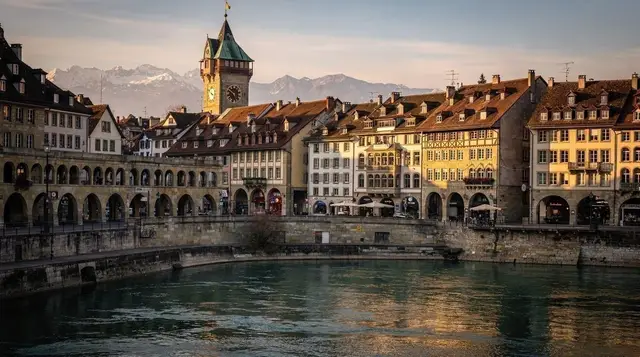
Start early. The direct train from Interlaken Ost to Bern takes just under an hour. Bern’s old town is compact and genuinely walkable in half a day: the Zytglogge astronomical clock, the arcaded streets of the UNESCO-listed centre, the Bundeshaus terrace, and the bear enclosures (Bärengraben) down by the river, all free to look at.
From Bern, trains to Zurich HB run roughly hourly and take about an hour. If you’ve kept the pace realistic, there’s time in the late afternoon for one more stop: the Rhine Falls at Schaffhausen, about 50 minutes from Zurich HB, are Europe’s largest waterfall by volume and worth the detour even for 45 minutes at the viewing platforms (basic access is free; the boat trip to the rock in the middle of the falls costs extra). See the Rhine Falls visiting guide for the last realistic train back.
If an early Bern start plus a Rhine Falls stop feels like one connection too many, that’s a fair read of the day — it is genuinely tight — and Bern alone, with a relaxed evening back in Zurich, is the better choice for a slower finish. For travellers who’d rather not manage the connections at all,
a private driver covering Zurich, the Jungfrau region and Bern
can be booked for one or more of these legs instead of the train, at a considerably higher cost but with no timetable to watch.
Making the buffer day work
The whole point of the sixth day is flexibility, and that only pays off if you resist the urge to fill it in advance. Don’t pre-book Grindelwald activities for Day 5 until you’ve seen how Day 4 actually went. Two lowland options — Bern and the Rhine Falls — are the reliable fallback precisely because neither depends on the peaks being clear, which is why they’re scheduled for the last day rather than earlier in the loop.
For a tighter version of this same route without the spare day, see the 5-day Zurich itinerary; for more room to add Mount Titlis or a second Bernese Oberland valley, the 7-day itinerary is the natural next step up. General planning questions — how many days you actually need, where to stay, how the ZVV network works — are covered in how many days in Zurich, where to stay in Zurich and getting around Zurich on the ZVV.
FAQ: planning a 6-day Zurich, Bern and Jungfraujoch loop
Is six days enough for Zurich, Lucerne, the Jungfrau region and Bern?
Yes, and it leaves slack the five-day version doesn’t have. Six days means one full day is a genuine spare: a weather buffer for the mountain excursions, or extra time in Bern and at the Rhine Falls if the skies stay clear. Without that spare day, one bad forecast at the Jungfraujoch can wreck the whole trip.
Why add a buffer day instead of just adding another destination?
Because the single biggest way to lose a day on this route is weather, not distance. The Jungfraujoch and the Grindelwald lifts close or turn into a white-out with no view at all when cloud sits low, and both attractions also close for scheduled maintenance in spring and autumn. A spare day lets you shift the mountain day rather than lose it.
Do I need to book Zurich to Interlaken and back, or is a rail pass better?
For this route a Swiss Travel Pass covering the whole trip, or a Half Fare Card plus point-to-point tickets, both work out similarly once you add the Jungfraujoch excursion, which the Travel Pass only discounts rather than covers free. Price it both ways before booking; see the linked comparison guide for the actual numbers.
Where should I base myself: Interlaken or Grindelwald?
Interlaken for this itinerary, because it sits between Lucerne, Bern and the Jungfrau valleys with direct trains in every direction. Grindelwald is closer to the Eiger and First, but every trip out to Bern or Lucerne then means changing at Interlaken anyway.
Can I fit in Mount Rigi or Mount Titlis as well?
Not comfortably on this six-day route without cutting something else. Rigi is easiest added onto the Lucerne day if you start early; Titlis would need its own day. Both fit better on a seven-day version of this loop.
What happens if it rains on the Jungfraujoch day?
Move it to the buffer day and use the freed-up day for Bern or the Rhine Falls instead, since neither depends on clear mountain skies. Check the Jungfraujoch webcams the night before rather than the general forecast for Interlaken, since the summit weather is often worse than the valley.
How much should I budget per day for this trip?
Plan on roughly CHF 220 to 320 per person per day including a mid-range hotel, three meals and the day’s transport or tour, before flights. The Jungfraujoch and Schilthorn days push toward the top of that range; Bern and the Zurich old-town days sit lower.
tours.6 days
Verified deep-linked GetYourGuide tours. Book through these links and we earn a small commission at no cost to you.
GetYourGuide does not provide a product photo for this activity — the image shows the meeting point, photographed by us.